Monday, April 29, 2013

Wild Turkeys, Northern Illinois Year Round Resident

A flock of Wild Turkeys on the lawn of a house adjacent to Rock Cut State Park, Rockford, IL; 4/1/2013.
Along with the Ring-necked Pheasant (yesterday's post, 4/28/2013), Wild Turkeys are another upland game bird that is a year round resident of the Northern Illinois area.  After a day of hiking and photography, I was leaving Rock Cut State Park early this spring when a I saw at least two dozen Wild Turkeys feeding on the lawn of a house that borders the boundary of the park. With my 150-500mm Sigma lens I couldn't back up far enough to fit all of the turkeys into one frame, but (Above) are 16 of the 24 turkeys that were on the lawn.
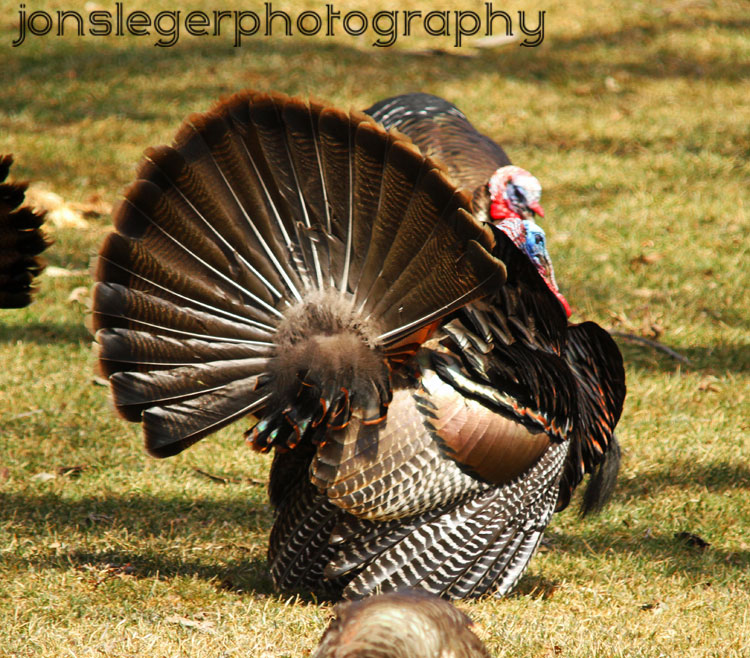
A male showing off his stuff for the surrounding females, Rock Cut State Park, Rockford, IL; 4/1/2013.
There were at least 5 males displaying their full tail feathers - ah, must be springtime.
A good look at the tail feathers from behind, Rock Cut State Park, Rockford, IL; 4/1/2013.
When the male's feathers are at full display it almost looks like he wearing a floor length skirt as well as the feathered out tail.

Wild Turkeys are found throughout most of the U.S. east of the Mississippi and much of the West, especially in the Prairie States, but also into the mountains.

Sunday, April 28, 2013

Ring-necked Pheasant, Northern Illinois year round resident.

A Ring-necked Pheasant crossing the road in front of me out near, Rockton, IL; 5/6/2012.
I have seen many Ring-necked Pheasants in my life, but until about a year ago, I have never had one so out in the open while I had a camera with me. This beautiful guy (Above) crossed the road in front of my car and obliged me by hanging around long enough for me to find my camera and snap off a few pics out the window before he disappeared in the tall weeds.

Ring-necked Pheasants are year round residents in open fields of long weeds and grasses that will hide them from view. At times you can find them along road edges near edges of forests or along thick weedy brush. They can be found in the Northern States from coast to coast.

Monday, March 25, 2013

Horned Lark

A Horned Lark in the light of a setting sun, near Cherry Valley, IL; 2/25/2012.
Horned Larks (Above) are common year round residents of Northern Illinois; but it seems that they are more easily located in the winter months. They like to forage for food out in vast sparsely vegetated areas such as plowed fields and on the edges of airport runways. Because of this, they are often not visible as they are far out from our immediate viewing pleasure. However in winter months when their feeding grounds are under a blanket of snow, they look for food along road edges that have been plowed free of snow.  This makes them more visible. That's where I saw a flock a year ago, while driving the rural farm roads outside of Cherry Valley, IL (Below).
With their usual feeding grounds covered under snow, Horned Larks, forage for their dinner at the side of a road that is snow-free, Cherry Valley, IL; 2/25/2012.
Horned Larks can be found throughout the country from coast to coast from Mexico to Canada.
The same Horned Lark near Cherry Valley, IL; 2/25/2012.
The Horned Lark (Above) was in the middle of the road as I drove by, hopped to the side of the road and stayed in clear view as I slowly inched my way past him and allowed me to snap a few pics.

Sunday, March 17, 2013

Bald Eagles in Northern Illinois

This adult Bald Eagle soared past me while I was on Beehive Lookout, Starved Rock State Park, IL; 2/19/2012.
Bald Eagles have been making a comeback in the Northern Illinois area for over a decade now. The best place to look for them is in Starved Rock State Park near Utica, Illinois. They arrive there to fish along the Illinois River for the Winter. For the past three winters I have made the hour plus drive south from Rockford to get a glimpse of these majestic raptors.  Usually I have to be content to see them perched in distant trees or soaring high above me. A year ago while I climbed up Beehive  Lookout, an adult flew right past me. I only had 4-5 seconds to lift my camera find it in my viewfinder and snap one burst series before it was already hidden by trees. Out of the few pics that resulted from the burst, I managed two that I thought were pretty good (Above and Below).
The same Bald Eagle, Beehive Lookout, Starved Rock State Park, IL; 2/19/2012.
I couldn't have been luckier - in the right spot at the right time.

Other than Starved Rock State Park, Bald Eagles can be found in moderate to large numbers during Winter months along the Mississippi River, especially near Lock & Dams where water is not frozen over. In the Spring most of these Eagles will return north to their Summer hunting and breeding grounds in Canada and along both oceanic coasts. However, it has been less rare to find Bald Eagles sticking around our area year round. We've had at least two Bald Eagle nests along the Kishwaukee River last summer. Several times over the past year I have spotted Bald Eagles while hiking along the Kishwaukee and in Rock Cut State Park near Rockford.

Saturday, March 16, 2013

Whit-winged Crossbills; Northern Illinois Winter Visitors


An immature, male and female White-winged Crossbill, near Anna Page Park, Rockford, IL; 2/5/2012.
I often use the IBET, a birding site that birders throughout Illinois use to post about what birds they have seen (Link to the site at right):  http://groups.yahoo.com/group/ILbirds/

 A year ago, I noticed that one of the local active birders posted a report about a small flock of White-winged Crossbills were present in some Spruce trees on a road West of Rockford. I thought, Fantastic! - White-winged Crossbills (Above) would be an addition to my life list and it wasn't more than a 15-20 minute drive from my house. So off I went. After finding the spot, I explored the area and the grove of Spruce they were observed in. After a few minutes I heard some commotion in the trees and saw a flurry of activity high in one of the Spruce.  I zoomed-in on the birds which wouldn't stay still and hid themselves fairly well in the thick boughs. But I captured a few in my viewfinder long enough to identify them as the Crossbills I was hoping to see. I couldn't get a good photo as they wouldn't stay in an open spot for more than a  second or two. I slowly circled he grove of trees they were feeding in, but like the good instincts of wildlife trying to protect themselves from intruders, they always kept distance and branches in between them and me. Eventually, I was on the complete opposite side of the trees than where I parked my car on the side of the road. The Crossbills sunk deeper into the center of the tree, where they were impossible to see. I made the decision to climb through the thick lower boughs to get under the tree to see if I could get a photo of one of them from the inside.

A warp of White-winged Crossbills near Anna Page Park, Rockford, IL; 2/5/2012.
No sooner did I get near the trunk at the center of the Spruce and look upwards, a flock of 10 White-winged Crossbills (Above) double crossed me and landed on the roadside next to my parked car.  So I had the task of trying to sneak out from under the tree and circle back towards my car. They were now in the open, but I had to try to get to a spot where I could take pictures without scaring them back into the tree.
A female White-winged Crossbill, near Anna Page Park, Rockford, IL; 2/5/2012.
Eventually, after some stealthy movement, I was able to make a rather wide arc back around behind my car - opposite the side that the Crossbills were feeding on the ground.  Then I was able to use my car as sort of blind, and to my pleasant surprise the Crossbills did not flush back into the thick Spruce trees. I was then able to take some photos (Above and Below):

An immature male and female White-winged Crossbill near Anna Page Park, Rockford, IL; 2/5/2012.

Male White-winged Crossbills have a rosy reddish head, back, and breast, with dark lores and a small collar. They also have black wings with two bold white stripes (hence its name). Females are yellowish with the same wing markings. Immature Crossbills look like females with some additional streaking on their heads, back, flanks and breasts. Immature males will start molting into their red feathers thus giving them a rather splotchy red/yellow look about them (Above left). And of course, one can't forget about their bills which sport a long curved-down upper bill which crosses over its long curved-up lower mandible.

Another immature male White-winger Crossbill, starting to earn its red-feathered status of a male grown up, near Anna Page Park, Rockford, IL; 2/5/2012.
A male and female pair of White-winged Crossbills, near Anna Page Park, Rockford, IL; 2/5/2012.

A pair of White-winged Crossbills, near Anna Page Park, Rockford, IL; 2/5/2012.
It seems that just in recent winters that White-winged Crossbills have been venturing as far south as Illinois looking for a winter residence with enough food. Usually they will migrate only as far south as Central Wisconsin and across the most Northern States.  They usually spend their winters where they are also found during any season - across most of Canada, from coast to coast.
A good look at the crossbill of one of the females of this species.

Sunday, March 10, 2013

Florida Wading Birds: Tri-colored Heron

I'LL TRY SOME COLORED HERONS, PLEASE!
A "stand" of Tri-colored Herons (and a Snowy Egret far left), 2nd from left and far right are two jueniles while the Heron in the foreground is an adult; Oasis Visitor Center, Big Cypress, FL; 12/26/2012.
Before this trip, the only time I've seen a Tri-colored Heron was when  visited Mexico a few years ago.  During my 2012 Winter Florida trip, I think I saw Tri-colored Herons in almost every stop we made: Big Cypress National Preserve, Lovers Key State Park, Everglades National Park, and Ding Draling National Wildlife Reserve. While on our way south towards the Keys we stopped at what we thought was just a routine wayside/reststop. It turned out to be the Oasis Visitor's Center for the Big Cypress National Preserve, a large swath of area that covers much of Southern Florida from Alligator Alley to the Everglades.  Just a few steps from our rental car in the parking lot was a canal that ran along side of Hwy 41. In that canal there were a variety wading birds, including  at least a half dozen Tri-colored Herons (Above).  As shown, juveniles have a more reddish overall coloring with more white on their necks. Adults turn a bluish gray with a white belly and thin white and yellow stripe running up its throat to its lower mandible. All phases possess yellow legs. Juveniles and non-breeders have yellow bills, but during breeding season will turn a pale blue.
A Tri-colored Heron turning from a juvenile into an adult,  Big Cypress NP, FL; 12/26/2012.
(Above) is a good look at a juvenile that is starting to lose its reddish feathers in favor of the adult bluish feathers. Its bill is already losing most of yellow as it is turning into the blue bill of an adult breeder. By February it will have completed its transition into a breeding adult. (Below) is a good example of an adult.
An adult Tri-colored Heron, Everglades Nat. Park, FL; 12/29/2012.
(Below) is a a panned out photograph of the (above) Heron.
The same Tri-colored Heron as the photo above it; 12/29/2012.
I am wondering if the Heron in the (Above) photo is aware of what's in the grass just in front of it. See below if you can't pick it out.
The black arrow is pointing to a rather large alligator which is laying-in-wait hoping that the heron gets a bit closer; 12/29/2012. 
My guess is the heron was fully aware of the alligator laying in the grass just a few feet in front of it. One slight move of the alligator in the direction of the heron, the heron would have flapped off to safer ground.
Another Tri-colored Heron, Everglades Nat. Park, FL; 12/29/2012.
A different Tri-colored Heron, seen the day before, Everglades Nat. Park, FL; 12/28/2012.
The (above) photo displays a good look at the throat stripe of a Tri-colored.

One of my favorite photos of the trip, a preening Tri-colored Heron, Everglades Nat. Park, FL; 12/28/2102.

Another Tri-colored Heron, Ding Darling Wildlife Refuge, Sanibel Island, FL; 12/30/2012.
Tri-colored Herons are fairly common in the Southeast corner of the country and can be found year round along the Gulf Coast States and Northward up the Atlantic Coast to Virginia.  In the summer months it spreads even further north to the southern tip of Maine. It can also be found in ponds, marshes, bogs, swamps, and lagoons scattered inland from Kansas to Pennsylvania, but with a high concentration in Lousiana and Eastern Texas. In fact, this heron has also been called the Louisiana Heron.

Saturday, March 9, 2013

Yellow-crowned Night Herons

YELLOW CROWNS AND YELLOW FEET
 
Yellow-crowned Night Heron, Corkscrew Swamp National Wildlife Refuge, FL; 12/26/2012.
Until last summer when a yellow-crowned Night Heron appeared in the Chicago area, I had never seen one before. They are more common in the southeast corner of the country than in the Midwest.  During my December trip to Florida, I saw these herons on both my first and last full days in my 5-day visit to this great birding state. My first sighting was in the Corkscrew National Wildlife Conservation Area. In fact I might have missed it if it wasn't for a thoughtful birder who left his spotting scope pointed at where a YCNH was napping in a tree across a shaded section of the swamp. Not only was there a spotting scope sitting by itself unattended, there was a sign attached to it with a page from The Sibley Field Guide to Birds of Eastern North America of the YCNH description. How long that scope and sign was there I couldn't tell, but one thing for sure, the heron was still there smack dab in the center of the viewfinder. At first it was napping with its eyes closed, and semi-hidden by some branches, but just before I was ready to move on down the trail, I noticed that it had woken up and shifted its position so I could get a clearer photograph of it (Above).
A yellow-crowned Night Heron, Ding-Darling National Wildlife Refuge, FL; 12/30/2012.
On my last day in Florida, while hiking in the Ding Darling refuge on Sanibel Island, I saw two more Yellow Crowns (Above and Below) in two separate locations.
A different Yellow-crowned Night Heron, Ding-Darling National Wildlife Refuge, FL; 12/30/2012.
The two I witnessed in Ding Darling were definitely awake and doing some fishing.