Showing posts with label Florida. Show all posts

Sunday, March 10, 2013

Florida Wading Birds: Tri-colored Heron

I'LL TRY SOME COLORED HERONS, PLEASE!
A "stand" of Tri-colored Herons (and a Snowy Egret far left), 2nd from left and far right are two jueniles while the Heron in the foreground is an adult; Oasis Visitor Center, Big Cypress, FL; 12/26/2012.
Before this trip, the only time I've seen a Tri-colored Heron was when  visited Mexico a few years ago.  During my 2012 Winter Florida trip, I think I saw Tri-colored Herons in almost every stop we made: Big Cypress National Preserve, Lovers Key State Park, Everglades National Park, and Ding Draling National Wildlife Reserve. While on our way south towards the Keys we stopped at what we thought was just a routine wayside/reststop. It turned out to be the Oasis Visitor's Center for the Big Cypress National Preserve, a large swath of area that covers much of Southern Florida from Alligator Alley to the Everglades.  Just a few steps from our rental car in the parking lot was a canal that ran along side of Hwy 41. In that canal there were a variety wading birds, including  at least a half dozen Tri-colored Herons (Above).  As shown, juveniles have a more reddish overall coloring with more white on their necks. Adults turn a bluish gray with a white belly and thin white and yellow stripe running up its throat to its lower mandible. All phases possess yellow legs. Juveniles and non-breeders have yellow bills, but during breeding season will turn a pale blue.
A Tri-colored Heron turning from a juvenile into an adult,  Big Cypress NP, FL; 12/26/2012.
(Above) is a good look at a juvenile that is starting to lose its reddish feathers in favor of the adult bluish feathers. Its bill is already losing most of yellow as it is turning into the blue bill of an adult breeder. By February it will have completed its transition into a breeding adult. (Below) is a good example of an adult.
An adult Tri-colored Heron, Everglades Nat. Park, FL; 12/29/2012.
(Below) is a a panned out photograph of the (above) Heron.
The same Tri-colored Heron as the photo above it; 12/29/2012.
I am wondering if the Heron in the (Above) photo is aware of what's in the grass just in front of it. See below if you can't pick it out.
The black arrow is pointing to a rather large alligator which is laying-in-wait hoping that the heron gets a bit closer; 12/29/2012. 
My guess is the heron was fully aware of the alligator laying in the grass just a few feet in front of it. One slight move of the alligator in the direction of the heron, the heron would have flapped off to safer ground.
Another Tri-colored Heron, Everglades Nat. Park, FL; 12/29/2012.
A different Tri-colored Heron, seen the day before, Everglades Nat. Park, FL; 12/28/2012.
The (above) photo displays a good look at the throat stripe of a Tri-colored.

One of my favorite photos of the trip, a preening Tri-colored Heron, Everglades Nat. Park, FL; 12/28/2102.

Another Tri-colored Heron, Ding Darling Wildlife Refuge, Sanibel Island, FL; 12/30/2012.
Tri-colored Herons are fairly common in the Southeast corner of the country and can be found year round along the Gulf Coast States and Northward up the Atlantic Coast to Virginia.  In the summer months it spreads even further north to the southern tip of Maine. It can also be found in ponds, marshes, bogs, swamps, and lagoons scattered inland from Kansas to Pennsylvania, but with a high concentration in Lousiana and Eastern Texas. In fact, this heron has also been called the Louisiana Heron.

Saturday, March 9, 2013

Yellow-crowned Night Herons

YELLOW CROWNS AND YELLOW FEET
 
Yellow-crowned Night Heron, Corkscrew Swamp National Wildlife Refuge, FL; 12/26/2012.
Until last summer when a yellow-crowned Night Heron appeared in the Chicago area, I had never seen one before. They are more common in the southeast corner of the country than in the Midwest.  During my December trip to Florida, I saw these herons on both my first and last full days in my 5-day visit to this great birding state. My first sighting was in the Corkscrew National Wildlife Conservation Area. In fact I might have missed it if it wasn't for a thoughtful birder who left his spotting scope pointed at where a YCNH was napping in a tree across a shaded section of the swamp. Not only was there a spotting scope sitting by itself unattended, there was a sign attached to it with a page from The Sibley Field Guide to Birds of Eastern North America of the YCNH description. How long that scope and sign was there I couldn't tell, but one thing for sure, the heron was still there smack dab in the center of the viewfinder. At first it was napping with its eyes closed, and semi-hidden by some branches, but just before I was ready to move on down the trail, I noticed that it had woken up and shifted its position so I could get a clearer photograph of it (Above).
A yellow-crowned Night Heron, Ding-Darling National Wildlife Refuge, FL; 12/30/2012.
On my last day in Florida, while hiking in the Ding Darling refuge on Sanibel Island, I saw two more Yellow Crowns (Above and Below) in two separate locations.
A different Yellow-crowned Night Heron, Ding-Darling National Wildlife Refuge, FL; 12/30/2012.
The two I witnessed in Ding Darling were definitely awake and doing some fishing.

Friday, March 8, 2013

Green Herons: More Florida Wading Birds

Green Heron, Everglades Nat. park, FL; 12/28/2012.
I saw a some beautiful Green Herons (Above and Below) in the Everglades last December. I saw a pair on December 28 and another on the 29th. At 18", hey are the smallest of the North American Herons.
Another Green Heron, Everglades Nat. Park, FL; 12/28/2012.

Yet another Green Heron, Everglades Nat. Park, FL; 12/29/2012.
I find that Green Herons (sometimes called Green-backed Herons) are fairly easy to photograph. They don't scare away easily and they stand very still while hunting their prey. I always see them solitary and except for a few times when they are roosting high in a tree, I usually see them at the edge of ponds and lakes crouching intently waiting for an unsuspecting fish or frog to become their next meal.

Monday, March 4, 2013

Florida Wading Birds: Little Blue Herons

A flurry of Little Blue Herons, Ding Darling Nat. Wildlife Refuge, Sanibel Island, FL; 12/30/2012.
Yesterday, I posted about Great Blue Herons (46" in length) and today their cousins at nearly half their size, the Little Blue Herons (24" in length). Adult Little Blues (Above) are exactly that, entirely grayish blue in color, with pale dull green legs and light blue bills with dark tips.
A juvenile Little Blue Heron, Everglades Nat. Park, FL; 12/28/2012.
However,  juvenile Little Blues are completely white (Above) and sometimes get confused with Snowy Egrets which are the same size. Snowy Egrets have yellow and black bills with yellow lores (Below) while juvies Little Blues have  pale blueish or grayish bills with grayish/greenish lores and pale greenish legs.
Snowy Egret with black legs bill and yellow lores and feet, Lovers Key State Park, FL; 12/26/2012.
Another juvenile Little Blue Heron, Everglades NP, FL; 12/29/2012.
A good look at the juvenile Little Blue Heron's bill and lores, Everglades Nat Park, FL; 12/28/2012.
Adult Little Blue Heron, Everglades NP, FL; 12/29/2012.
Adult Little Blue Herons (Above) also sport a reddish/purplish tint on its neck.

Little Blue Herons joined by White Ibis and a Tri-colored Heron, Ding Darling NWR, FL; 12/30/2012.
Little Blue Herons are found year round along the Gulf of Mexico coastlines and along the southern Atlantic Coast States up to the Carolinas. During the summer they will migrate north as far the New England States. They will also be found along the Southern California Pacific Coast as well as along the Baja Peninsula of Mexico.

Sunday, February 24, 2013

Egrets of Southern Florida

FLORIDA: THE LAND OF MANY WHITE DOTS
White dots: Great and Snowy Egrets, joined by Herons, Ibis, and Storks, Big Cypress National Preserve, FL; 12/26/2012.
After travelling through Southern Florida at the end of 2012, and hitting many of the important bird hotspots in the area, we could see white specks dotting the landscape everywhere we went. These white dots, of course, were the many white birds found in Florida: White Ibis, juvenile Little Blue Herons, White Great Blue Herons, White Pelicans and the three white Egrets - Great, Snowy and Cattle. These white birds proved to be a great contrast to the dark brown and greens fields, and the blue lakes and oceans that cover Florida. The photo (Above) is a a good representative what one may see just driving down the highway.

A Great Egret wading in the marsh of  the Corkscrew Swamp National Wildlife Refuge, FL; 12/26/2012.
The first of the three white Egrets found in Florida is the Great White Egret (Above), which we also see up in Northern Illinois and Southern Wisconsin during the summer months. The Great White, as its name suggests is the largest of the Egrets, standing at 39" tall. Below you can see its size next to the Little Blue Heron (24") and White Ibis (25").
A Great White Egret towering over a White Ibis and Little Blue Heron, Ding Darling NWR, FL; 12/30/2012.
More Great Egret Pics (Below):
Great Egret on the South Pier, St. Petersburg, FL; 12/25/2012.
A Great Egret looking like it's doing a stand-up comic routine, South Pier, St. Petersburg, FL; 12/25/2012.
Snowy Egret, Lovers Key State Park, FL; 12/26/2012.
Snowy Egrets (Above), another of the big three white egrets were also very well represented throughout Southern Florida. We saw them in fields, in lakes, in marshes, along roadsides, and along ocean beaches. (Below) are more Snowy pics:
A Snowy Egret perched on a dormant bush in the fields of the Everglades NP, FL; 12/29/2012.

A Snowy Egret being dwarfed by a Wood Stork along the roadside canal at the Oasis Visitor Center, Big Cypress National Preserve, FL; 12/26/2012.

A wedge of Snowy Egrets roosting with Ibis and Herons at a pond, Everglades Nat. park, FL; 12/29/2012.
At 20", the smallest of the three white Egrets are the Cattle Egrets (Below), which are found more in the grasslands and open fields than the water as other Egrets.
Cattle Egret, Everglades NP, FL; 12/28/2012.
Another Cattle Egret, Everglades NP, FL; 12/28/2012.
I don't think I could have driven more than a mile in the Everglades without seeing a white dot out my window. It may be that because "white" a more visible color than the blues, grays and browns of tother wading birds, but it seemed that Egrets dominated the landscape of the Everglades, which should be renamed "The Land of the White Birds."

Sunday, February 17, 2013

Wading Birds of Florida: Roseate Spoonbill

IN THE PINK; ROSEATE SPOONBILLS
A Roseate Spoonbill sitting on a tree branch along Hwy 41, Big Cypress National Preserve, FL; 12/29/2012.
One of my target birds during my December, 2012, Winter Florida trip was the Roseate Spoonbill (Above). Previously my only view of these beautiful wading birds was a few years ago while visiting the Yucatan Peninsula in Mexico.
The arrows are pointing to two Roseate Spoonbills mixed in with some Reddish Egrets, Magnificent Frigatebirds, and Brown Pelicans, Isla Contoy, MX; 12/21/2010.
We were on Isla Contoy , an island that was sanctioned as a Mexican National Wildlife Preserve. Only a limited number of people per day were allowed on the island, and only with a required guide.  After spending a few hours exploring part of the Island, we departed and while on the boat, we saw some small dots of pink (Above) flying along the island's far distant coast. They were barely distinguishable. So on this Florida trip, I was looking forward with high hopes of seeing a Spoonbill within good photography distance.
A blurry Roseate Spoonbill flying closely overhead, Everglades Nat. Park, FL; 12/29/2012.
I had three fleeting opportunities to capture a BIF Roseate while in Florida. First, while we were hiking in Lovers Key State Park (near Naples), on 12/26/12, two Roseates flew over, but were gone faster than I could get them in my viewfinder. Then later the same day, while stopping at the Oasis Visitor Center in Big Cypress National Preserve, a small bowl of Spoonbills flew over in the distance, not even close enough to warrant lifting my camera. Then on both days we were in the Everglades Nat. Park, we saw Spoonbills flyover. On 12/28/12, two flew above our heads, but were gone in an instant behind a stand of trees; on 12/29/12, while hiking around "Eco Pond," just beyond the Flamingo Visitor Center, with the purpose of looking for these allusive pink avians (this was the place we were told that Spoonbills are most likely to hang out), one flew by me at close range and I captured it in my viewfinder for a couple of seconds and for at least 4-5 burst shots. Unfortunately, I did not have my autofocus on, which I need for good BIF shots, and it was out of sight before I could manage to try to manually focus or switch to autofocus. I kicked myself for missing the opportunity. All I got was four blurry photos (Above: the best of the four). Doesn't this species ever land?

So as you can see, between my distance pics from Mexico, and my blurry shot in the Everglades, I was getting frustrated with my lack of luck / ability to get a good photograph of one of our country's most beautiful birds.

On our way back to Fort Myers, to catch a flight to Phoenix, AZ, we had two more destinations. The first was to make a second stop at the Oasis Visitor's Center in the Big Cypress National Preserve, since we saw much wildlife there three days before. All along Hwy 41, we were spotting Aligators, Kingfishers and Herons and Egrets of all kinds. The Center did not disappoint as there were lots of widlife hanging out in the canal running along the highway, but no Spoonbills. As we were leaving the parking lot, I saw a flock of Roseate Spoonbills fly overhead, and it looked like one landed in a tree not far from the roadside.  I pulled over, got out and saw the neck and head of a Spoonbill peaking over the treeline where it landed. I climbed onto the rental car to get a better look and sure enough within 100' or so, sat my opportunity. I hoped it would stay put until I could get my camera equipment ready, and it did - it stayed for the entire 5-10 minutes we stopped to get photographs and gave us nice full-body portraits (Top of page).
Roseate Spoonbill sitting pink amidst a stand of White Ibis, Ding Darling Wildlife Preserve, FL; 12/30/2012.
Then a day later, during our last stop before leaving our 5 day Florida trip, we visited the Ding Darling National Wildlife Preserve, on Sanibel Island, near Cape Coral / Fort Myers, I spotted three Roseates in a shallow pond among a congregation of White Ibis. It was quite a distance away, but it stood out beautifully with its bright pink reflecting in the water (Above and Below).
Another of the three Roseate Spoonbills, Ding Darling Wildlife Preserve, FL; 12/30/2012.
It took the final two days of our 5-day trip, but I was finally able to get some decent photographs of the Roseate Spoonbills. Between getting photos of these Spoonbills and Wood Storks from my 1/6/2013 post ...
 http://www.blogger.com/blogger.g?blogID=6337820950786353518#editor/target=post;postID=3841132405047196420
... I would consider the trip a birding success. These waders are primarily found in the southern third of Florida and also along the Texas and Louisiana Gulf Coast.

Friday, January 18, 2013


Winter Wading Birds of Florida; White Ibis
White Ibis, Oasis Visitors Center, Big Cypress National Preserve, FL; 12/30/2012.
While on my five-day-long visit to Southern Florida, the week between Christmas and New Year's, I was fortunate to see 15 of the 18 Floridian wading birds featured in Sibley's Field Guide to Birds of Eastern North America. The three birds I did not observe were: Reddish Egret and both Bitterns (Least and American). Other wading birds found in the Field Guide, but are not found in Florida are White-faced Ibis, Flamingo, Scarlet Ibis, and the Little Egret (it is not surprising that I did not see any of these as well). The latter three are rare visitors from outside the country.
Of all the wading birds present in Florida, the White Ibis (Above and Below) seemed to be the most common and visible. I saw them in every spot I visited.

More White Ibis, Ding Darling National Wildlife Preserve, Sanibel island,FL; 12/30/2012.

My Florida Wading Bird sighting List:
12/26
Lovers Key State Park: White Ibis, Great Blue Herons, Great Egrets, Little Blue Herons, Roseate Spoonbills (Flyover)
Big Cypress Oasis Visitors Center: Cattle Egret, Glossy Ibis, Wood Stork, Tri-colored Heron, Great Blue Herons, Little Blue Herons, Great Egrets, Snowy Egrets, White Ibis
Corkscrew National Wildlife Refuge: Great Blue Herons, Great Egrets, Little Blue Herons, Yellow-crowned Night Heron, White Ibis
12/27
Key West: White Ibis, Great Egret, Great Blue Heron, Great Blue Heron (white phase)
12/28-29
Everglades National Park: Black-crowned Night Heron, Cattle Egret, White Ibis, Glossy Ibis, Great Blue Heron, Great Blue Heron (white phase), Great Egret, Green Heron, Little Blue Heron,  Roseate Spoonbills (flyovers), Snowy Egrets, Tri-colored Herons, White Ibis, Wood Stork
Big Cypress Oasis Visitors Center: Cattle Egret, Wood Stork, Tri-colored Heron, Great Blue Herons, Little Blue Herons, Great Egrets, Snowy Egrets, Roseate Spoonbills, White Ibis
12/30
Ding Darling National Wildlife Refuge & Sanibel Island: Great Blue Heron, Great Egret, Little Blue Heron, Roseate Spoonbills, Tri-colored Herons, White Ibis,  Yellow-crowned Night Herons
White Ibis, Everglades NP, FL; 12/28/2012.
 White Ibis are common in muddy pools, mudflats, and marshes. I also saw them on lawns and fields of all variety - short grass, long grass, and in plowed fields. They are almost completely white save for their black wing tips and bright orange bills and legs. The orange in the adults are closer to a red-orange hue, while juveniles sport a paler orange color.

A juvenile White Ibis, Ding Darling National Wildlife Refuge, FL; 12/30/2012.

When I first spotted a juvenile White Ibis (Above), I thought it was a a different species. Young White Ibis are mostly brown with white rumps and undersides. They start getting their white feathers in December - first on their back, until they molt into white adulthood by spring.
White Ibis resting on a dead branch, Everglades NP, FL; 12/29/2012.
While on a boat trip out onto Whitewater Bay in the Everglades, I saw several couples of White Ibis roosting in trees (Above and below).
A juvenile White Ibis, Everglades NP, FL; 12/29/2012.
White Ibis can be found along the coasts of all the Gulf States and Mexico, as well as up the southern Atlantic Seaboard, reaching as far north as North Carolina.

Sunday, January 6, 2013

Wood Stork; Everglades National Park


THE PREHISTORIC LOOKING WOOD STORK

A Wood Stork dwarfs over a Snowy Egret, Big Cypress National Preserve, FLA; 12/26/2012.
I spent a week in Florida (my first time in the State), between Christmas and New Years. One of my goals was to see a Wood Stork, so I particularly made a trip to Corkscrew Swamp Natural Wildlife Refuge which is known for being a regular habitat for these birds. Unfortunately no Wood Storks were to be found at Corkscrew. We also visited Lovers Key State park, which promised to have a large variety of birds - Their promise of birds was good, but no Wood Storks were included in that promise. We continued our travels toward the Keys for our next stay. While travelling, we were in the Big Cypress National Preserve (a part of the larger Everglades). We were driving on Hwy 41 which was following a long narrow canal and we stopped at what I thought was a typical rest stop, but it turns out it was the Oasis Visitor Center.  As we turned into the parking lot crossing over the canal immediately I saw several wading birds in the water. After parking, I grabbed my camera and walked over to the edge of the canal. There were several types of Egrets, Herons, and Ibises all concentrated into one area. The canal must have been teeming with fish for so many birds to be in one spot. And within seconds a Wood Stork (Above) appeared. I got my Wood Stork, but never imagined, that I would find it in a roadside canal.
In one small section of a roadside canal, within a few steps from the parking lot, there were Great Egrets, Snowy Egrets, White Ibis, Glossy Ibis, Great Blue Herons, Green Herons, Tri-colored Herons, and a Wood Stork (bottom right); Oasis Visitor Center, Big Cypress Preserve, FLA; 12/26/2012.
I was the only person taking photos on this side of the entrance driveway to the parking lot, but I noticed that there were many people congregated on a boardwalk on the other side of the parking lot. Val was already there, so I decided to check out what was so interesting.

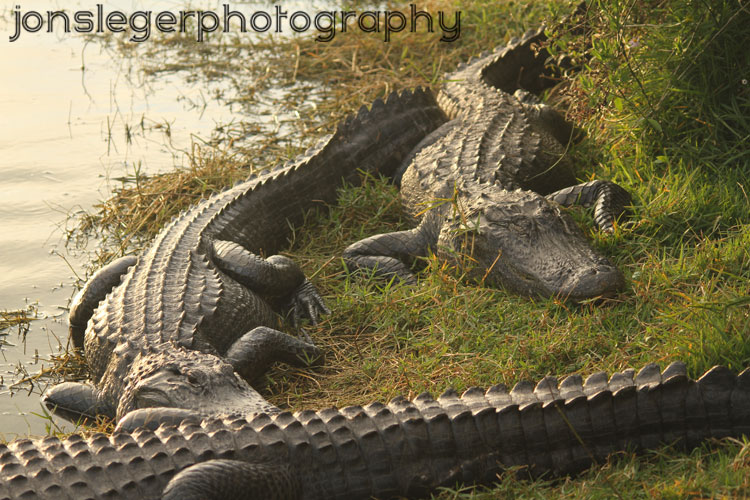
Alligators lounging on the banks of the canal, Oasis Visitor Center, Big Cypress Preserve, FLA; 12/26/2012.
It didn't take long to see what was "so interesting." There were literally dozens of alligators in the water and on the banks (Above).  It was fun watching them try to swim towards a fish in the water and give it a chomp. It was hard to tell if any succeeded as there was much splashing and the gator would disappear under the water for a few seconds. I didn't actually see any of the gators chewing or swallowing, but there were plenty of fat alligators lying on the banks, so the fishing must have been good.

A Wood Stork looking very prehistoric coming for a landing, Oasis Visitor Center, Big Cypress Preserve, FLA; 12/26/2012.
As I was watching the alligators in one side of the canal, I knew why all the wading birds were on the other side. They wanted to be the hunters, not the prey. Soon I noticed another Wood Stork appear in the sky (Above), and come in for a landing near where the other wading birds were feeding. Its bony head and gangly body reminded me of a bird that one would see in a prehistoric setting.

As we were ready to depart, a small group of  Roseate Spoonbills flew over. This area was a fantastic spot for Florida birding - at least a dozen different species of birds in less than a half hour without walking more than a few yards.

Another Wood Stork approaching a pond in the Everglades National Park; 12/28/2012.
A couple of days later while searching for Roseate Spoonbills at Eco Pond, near the Flamingo Visitors Center in  Everglades National Park, I saw another Wood Stork (Above and Below).

The same Wood Stork, Eco Pond,   Everglades National Park; 12/28/2012.
Wood Storks are more likely to be found in southern and central Florida all year round, but during migration they extend their territory to all of the Gulf Coast States and up the Atlantic Coast into South Carolina.  They can grow up to 40" and have wing span of more than 5 feet. This species was a lifer for me.