Showing posts with label Rock Cut State Park. Show all posts

Monday, April 29, 2013

Wild Turkeys, Northern Illinois Year Round Resident

A flock of Wild Turkeys on the lawn of a house adjacent to Rock Cut State Park, Rockford, IL; 4/1/2013.
Along with the Ring-necked Pheasant (yesterday's post, 4/28/2013), Wild Turkeys are another upland game bird that is a year round resident of the Northern Illinois area.  After a day of hiking and photography, I was leaving Rock Cut State Park early this spring when a I saw at least two dozen Wild Turkeys feeding on the lawn of a house that borders the boundary of the park. With my 150-500mm Sigma lens I couldn't back up far enough to fit all of the turkeys into one frame, but (Above) are 16 of the 24 turkeys that were on the lawn.
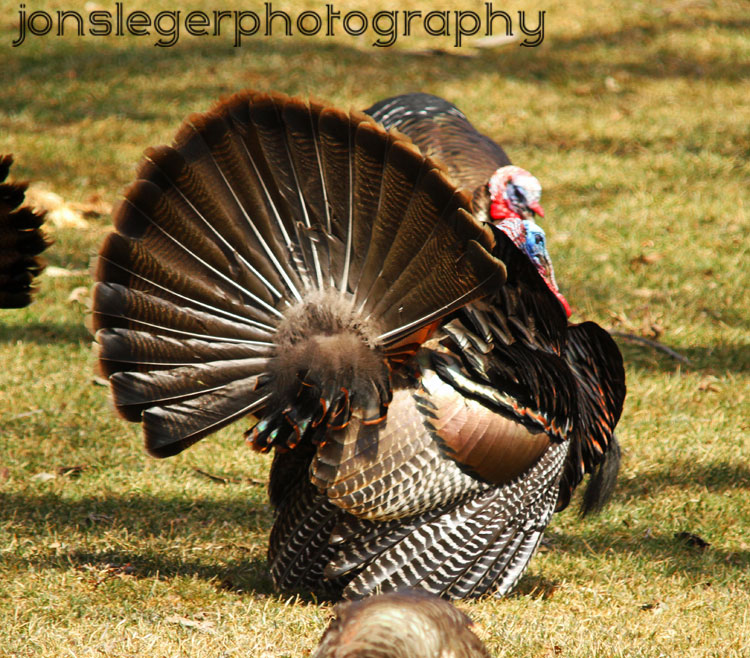
A male showing off his stuff for the surrounding females, Rock Cut State Park, Rockford, IL; 4/1/2013.
There were at least 5 males displaying their full tail feathers - ah, must be springtime.
A good look at the tail feathers from behind, Rock Cut State Park, Rockford, IL; 4/1/2013.
When the male's feathers are at full display it almost looks like he wearing a floor length skirt as well as the feathered out tail.

Wild Turkeys are found throughout most of the U.S. east of the Mississippi and much of the West, especially in the Prairie States, but also into the mountains.

Saturday, September 15, 2012

Red Admirals and Green Frogs

BRUSHFOOTS AND AMPHIBIANS

A Red Admiral Butterfly, Schoenbrun Nature Conservatory, Door County, WI; 6/20/2012.
This Summer I started making a point to do more Butterfly photography, which in the past was haphazard at best. As I became a little more versed in my butterfly identification I found that the Red Admiral (Above) was one of the more common members of the Brushfoot family to find in the Midwest.
Red Admiral, Deer Run Forest Preserve, Cherry Valley, IL; 7/1/2012.
One of the best places for "butterfly hunting" seemed to be in two of my favorite Forest Preserves , Deer Run and Blackhawk Springs, both having excellent wildflower prairies and dark forests - both good habitats for finding butterflies. I found Red Admirals mostly in forests and forest edges many times near streams or ponds, but also had good luck finding them along roadsides with wildflowers.
A Red Admiral and Bullfrog, Deer Run Forest Preserve, Cherry Valley, IL; 7/1/2012.
While hunting dragonflies at Deer Run Forest Preserve, the erratic flight of a Red Admiral caught my eye. I followed its flight pattern as it landed on a log across a murky pond. I zoomed in for a few pictures. I decided to pan back to capture it in its environment. As I was checking my LED screen to check on my settings, only then did I notice that there was a Green Frog (at least I think it's a Green Frog, not a Bullfrog) less than a foot from the Red Admiral (Above). This Green Frog totally escaped my detection until I saw it in my images.
A closer look at the Red Admiral in the sightlines of a hopeful Green Frog, Deer Run Forest Preserve, Cherry Valley, IL; 7/1/2012.
After discovering its presence, I put more of my attention on the Green Frog which was definitely focused upon the Red Admiral. I am sure the Green Frog was thinking about a convenient midday meal. I tried to focus on the two to see if I could capture a strike ...
This Green Frog blended in perfectly with the log it was sitting on, Deer Run Forest Preserve, Cherry Valley, IL; 7/1/2012.
I was wondering if the Red Admiral was even aware that the Frog was there as it perfectly blended in with its surroundings, and how close it might be to ceasing to exist.  I wasn't sure how close prey had to be in order for a frog to make a successful strike. I waited for a couple of long minutes and neither amphibian nor butterfly made a move. I was guessing that Mr. Green wasn't close enough to throw its sticky tongue at the butterfly and was also waiting for Mr. Red to make a fatal move closer within striking range. Unfortunately my arms were getting heavy from holding up my Canon Rebel D7 with Sigma 150-500mm lens attached. As I lowered my equipment, the Red Admiral flew off. Both I and the Green Frog missed our opportunity.
Another Green Frog, which was eyeing damselflies, Rock Cut State Park; 7/17/2012.

Another Red Admiral, Dee Run Forest Preserve, Cheery Valley, IL; 4/22/2012.
A good look at a Red Admiral's colorful wing pattern (Above), which is pretty much unmistakable, as no other Midwestern butterfly has these fiery red-orange bands and white spots on an otherwise all black wing span.

Saturday, September 8, 2012

Great Blue Heron with a broken bill

A Great Blue Heron with a broken bill, Rock Cut State Park, IL; 6/13/2012.
Earlier this summer while I was hiking in Rock Cut State Park, I was watching a Great Blue Heron (Above) about 200 feet across a secluded pond. I didn't notice it on my first few photos, but as I zoomed in, something looked unusual about its bill. It looked broken, but because of the branches behind its head, it was hard to discern from my distance.
The same Great Blue with a broken bill,  Rock Cut State Park, IL; 6/13/2012
When it turned to a more profile position, the broken bill was more evident (Above), as its upper mandible was bent up in a 45 degree angle. I wondered how this might have happened and also expected that this condition would greatly handicap its ability to hunt fish and other food.
A close up of its broken bill, Rock Cut State Park, IL; 6/13/2012
 At a closer look (Above), you can see that the upper bill is broken off and bent up and to one side. The lower mandible also seemed shorter than the usual size of a Great Blue. Compare the photo to a Great Blue Heron with a normal bill (Below).

Another Great Blue heron, RCSP, IL: 7/16/2012.
As you can see (Above), the lower mandible seems to extend further out than on the Heron with the broken bill. The Heron with the broken bill was obviously an adult-sized bird, so I am speculating that the injured bill was probably recent. It most likely was not born in this condition because it wouldn't have been able to hunt and feed very well, thus not letting it grow to normal size. And more than likely the broken portion of the bill would have long fallen off.

If the broken bill condition has been with this bird for some time, I am wondering how it has adapted its hunting skills in order to survive. It seems to me that it would have to jab deeper in the water to catch its prey in the back half of its bill, instead of a normal Heron who could nab a fish with the slimmer and pointed end of the bill. I am also wondering that if indeed this injured bird has been a successful hunter, what kind of prey it has been able to capture. It probably cannot probe into the mud at the bottom of a pond to catch crustaceans, but it might be able to grab onto slower prey such as turtles or larger fish such as catfish that it might be able to hold onto with its back half of its bill.

This is the only time I have seen this particular handicapped Heron, but I haven't been out to Rock Cut State Park much during the summer. Now that it's three months later, it would be interesting to find this guy again and what kind of condition it might be in.

Saturday, September 1, 2012

North. IL Summer Warblers: Black-throated Green Warblers

A Black-throated Green Warbler, Rock Cut State Park, IL, 5/20/2012.
Another summer warbler that resides in the Rockford area of Northern Illinois, is the Black-throated Green Warbler (Above), which I was fortunate to find at Rock Cut State Park last May. At first I didn't recognize its song because I never heard one before in the wild. The only other time before this when I saw one of these warblers was in Mexico two winters ago (Below), but it wasn't vocalizing.

A black-throated Green Warbler, Puerto Morelos, Mexico; 12/24/2010.
Then this past June while I spent a couple of days in Door County, Wisconsin, I heard Black-throated warblers all over the place, but they stayed hidden deep in the trees and I couldn't get one to find itself in my camera's  viewfinder.

Saturday, August 25, 2012

Northern Illinois Summer Warblers: Yellow Warbler

OLD YELLER

Yellow Warbler, Rock Cut State Park, Rockford, IL; 5/5/2012.
The ubiquitous Yellow Warbler (Above) is perhaps the most common and widespread of all warblers, as its summer range spreads across most of the North American continent. These bright yellow birds usually show up in the Northern Illinois area in the first week of May.
A different Yellow Warbler, Rock Cut State Park, Rockford, IL; 5/5/2012.
From May 1 - 4, while I was out and about in my favorite birding and hiking haunts, there was nary a sign of these warblers, then suddenly on May 5, they were all over the place. They descended overnight. In early April, I saw many Yellow Warblers in the southeastern corner of Arizona. So it took these guys about a month to reach our end of the state.
Yet another Yellow Warbler, Rock Cut State Park, Rockford, IL; 5/5/2012.
It seemed that every 20 yards or so I saw a new 'Old Yeller." Probably during a couple hour hike at Rock Cut State Park, I saw and/or heard 50 of these guys (an unofficial count).

Friday, August 24, 2012

Northern Illinois Summer Warblers: Common Yellowthroat

A male Common yellowthroat showing itself briefly in Deer Run Forest Preserve, Cherry Valley, IL: 7/1/2012.
Of the 46 Wood-Warblers listed in The Sibley Field Guide to Birds in Eastern North America,  less than half of these will call northern Illinois their summer home. The 19 listed in Sibley's are:

Summer Warblers in N. IL: Common Yellowthroat* (Above), Yellow-breasted Chat*, American Redstart*, Louisiana Waterthrush*, Ovenbird*, Northern Parula*, and those with "warbler" ending its names: Blue-winged, Yellow*, Chestnut-sided, Cerulean*, Pine*, Prairie, Yellow-throated*, Black & White*, Prothonotary*, Kentucky, Worm-eating*, Mourning, and Hooded*. Obviously birds do not read the field guides to tell them where they should be in certain times of the year, so boundaries and territories are flexible. Warblers that I have seen in the summer in the Rockford area which are not listed in Sibley's as summer residents are: Tennessee, Nashville, and Black-throated Green.  Of this list, I have seen 14 of them (marked above with an *), however, not all of them marked with the * have I seen in the Northern Illinois area. It just means I have seen them in other states (i.e. the Worm-eating and Hooded Warblers I saw in the Smoky Mt. Nat Park, but have yet to see them in Illinois). The 5 Warblers that have avoided my camera's viewfinder are the Blue-winged, Chestnut-sided, Prairie, Kentucky, and Mourning Warblers.

A female Common Yellowthroat, Deer Run FP; 7/1/2012.
One of the more common and visible warblers in our area is the Common Yellowthroat (Above). They are actually very common throughout the U.S. and Canada, in weedy, brushy and marshy habitats. Their sing-song sound is unmistakable which is often described as "wichety, wichety, wichety," coming from out of the long weeds. They like to hang low in the brush but will pop up and show themselves often enough.
Another male Common Yellowthroat, Rock Cut State Park, Rockford, IL; 5/20/2012.
(Above) another shot of a male Common Yellowthroat from earlier this past spring.

Saturday, August 18, 2012

Warbler Fall Migration: Northern Waterthrush

THE WARBLERS ARE COMING!
It's still only mid-August, but birders throughout Illinois are reporting that the fall migration has already begun. Indeed, shorebirds have been passing through the area for several weeks already. But just in the last few days there have been several sightings of Wood Warblers in Northern Illinois. The link below is one such report from the IL Birds Message Board from a birder who saw 14 different species of Warblers at the Montrose shore area in Chicago.


Northern Waterthrush, Rock Cut State Park, Rockford, IL: 5/12/2012.
For myself with school starting, and working on several time-consuming projects, I probably will not be able to get out and do much birding this fall. I'll miss out on the fun, so I will feature photos of Warblers that I took during the spring migration and early summer. One such photo is from last May when I had a good look at a Northern Waterthrush (Above) as it was migrating the other direction. It was hopping around small branches in a thicket near the water's edge of Pierce Lake in Rock Cut State Park. It stayed pretty hidden for quite some time. I did not have a decent photo of this warbler, so I waited it out until it finally alit on a branch that was clear of obstacles so I could snap its portrait. Birding is a hobby that tests one's patience. Wildlife is not predictable and usually not all that cooperative to us photographers. So patience is indeed a virtue that pays off.
The same Northern Waterthrush, Rock Cut State Park, Rockford, IL: 5/12/2012.
Northern Waterthrushes spend their summers in northerly habitats: Northern Wisconsin, Minnesota and Michigan, spreading east to the Northeastern States from Pennsylvania up to Maine, and West in western Montana and Northern Idaho, as well as all of Alaska and coast to coast in Canada. Every once in a while I get a chance to see one of these guys as they travel through in the fall and the Spring.


Saturday, July 14, 2012

Green Heron, juvenile, Rock Cut State Park

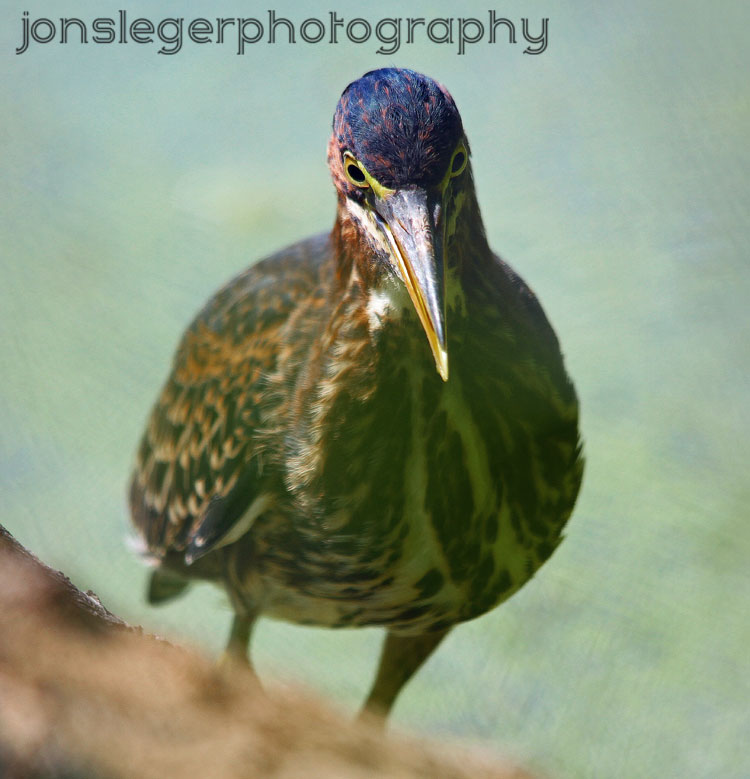
Juvenile Green Heron, Rock Cut State Park, IL; 7/6/2012.
I spent three hours in the 100 degree heat looking for wildlife a week ago. As I was scanning a shallow lagoon at the southeastern end of Pierce Lake in Rock Cut State Park for water birds, a caught glimpse of a shadow of a bird against the algae-covered water at my feet. I realized that this bird was out of my sight, sitting on a low branch behind a larger tree trunk that was stretched out over the water's surface.  Since there was nothing too interesting on the water (Mallards, Canadas, & Coots), I waited patiently to see if this bird would pop out from behind the tree trunk.  And sure enough, it wasn't long and there he was (Above), peaking over the trunk - a Green Heron. It seemed rather small for the Green Herons I've seen, and by the streaks on its neck, I guessed it was a juvenile. It didn't have the dark reddish neck of an adult.
Juvenile Green Heron, Rock Cut State Park, IL; 7/6/2012.
This juvie Green Heron took turns hopping back and forth on the branches that extended from both sides of the tree trunk.  It's too bad that the branches on the side closest to me were in the shadows (Above), while the branches hidden by the tree trunk were in a nice photographical sunlight.
Trying out its ability to hunt,Juvenile Green heron, Rock Cut State Park, IL; 7/6/2012.
Periodically, this young Heron would test its hunting skills (Above).  I snapped a lot of pictures, and there is no way he didn't know I was there.  I was only a matter of ten feet away, and was not hidden. I even had to retreat my zoom lens (Sigma 150-500mm) to its lowest telephoto power to get a full body pic of the guy. I was still surprised how close I was and it did not fly away. Even after a couple of noisy hikers walked by, it still did not make attampt to flee. It just rehid behind the downed tree trunk, and soon reappeared after a minute (Below).

A juvenile Green Heron pretending I was not ten feet away, Rock Cut State Park, 7/6/2012.
A juvenile Kingfisher (yesterday's post) and a juvenile Green Heron were highlights of my Rock Cut hike on a 103 degree day.


Friday, July 13, 2012

Belted Kingfishers, Rock Cut State Park, IL

The Adult belted Kingfisher instructing its young, Rock Cut State Park, IL; 7/6/2012.
A week ago I spent a hot (over 100 degrees) few hours at Rock Cut State Park to see what was shaking and what kind of wildlife would be out and about in such steamy weather. I saw over 40 different species of birds, but the one I enjoyed the most was a family of Belted Kingfishers. As I hiked around Pierce Lake, I seemed to always be a couple beats late with catching a Belted Kingfisher in a position to get a picture. Most often these birds are off and chattering away before I even know they are nearby.  This hike was no exception - in the beginning. But I noticed that one particular B-KF stayed on its perch longer than usual, and when it flew off it didn't go very far. I soon realized that it was a young, probably freshly fledged, Kingfisher (Below).
A juvenile Belted Kingfisher out and about, Rock Cut State Park, IL; 7/6/2012.
This young Kingfisher literally flew completely around the lake following the shoreline, flying perhaps 50-100 feet at a time. In the past as I would approach an adult Belted-KF, it usually flew a good distance (sometimes completely across Pierce Lake, which is a good sized lake.) before I would catch up with it again.
An adult male belted Kingfisher, Rock Cut State Park, IL; 7/6/2012.
This adult male Kingfisher (Above) was not too far away from the juvenile. Sometimes the juvenile would let me get too close for its parent's comfort and I would hear the chatter of the distant adult, and only then would the juvenile take off.

An adult female Belted Kingfisher (L) pokes its head into my picture and appears to be  teaching  the juvenile (R) some important information, Rock Cut State Park, IL; 7/6/2012.
I was almost completely around the Lake, running into the juvenile at least in a dozen points, but never quite fast enough to get a decent picture, nor when I did get close was it in a clear position. I did notice that the adult Kingfishers tend to perch on branches fairly high up in trees, but the juvenile that I was following stayed on low branches, usually just a few feet above the water. I was about 80% around the lake, when I was approaching the little marshy pond on the northeast end the lake, I deliberately slowed down and tried to be stealthy because it is an area that the Kingfishers like to hunt. There were dense head-high bushes between me and the pond, when I heard the familiar clattering of a Kingfisher. In the corner of my eye, I saw the quick flight of a Kingfisher swoop down on the other side of the bushes. I slowly inched my way peering through the few open spaces in the branches until I saw the juvenile with its back to me. There were still branches separating us, and I used these to act as a blind, but I still couldn't get a full body photo without some leaves or branches partly obstructing the view (Photo at Top of page). As I was taking some photos, suddenly an adult female entered into my viewfinder (Above). I have never been this close to an adult Belted Kingfisher before and I tried to get as many photos as I could, knowing how skittish they are and off with the slightest movement.

Blurry green leaves in the foreground keep this from being a great photo of an adult female Belted Kingfisher, Rock Cut State Park, IL; 7/6/2012.
To my pleasant surprise, it didn't fly away as I kept snapping photos. There were still leaves partly obstructing my view (Above). The thin blind of leaves and branches were working well, but I still wished I could get a clearer photo free of obstructions. I knew if I shifted into a position in which I would have had a clearer shot, they would fly away. So I made sure I took enough photos before I tried to get a better vantage point. And sure enough, as soon as I moved to a more open look, they were both gone like a flash.

I had a lot of fun stalking these Kingfishers for the better part of three hours on a 4 1/2 mile hike around the perimeter of Pierce Lake.

Saturday, July 7, 2012

Great Blue Herons at Rock Cut State Park - weird behavior?

Great Blue Herons wondering when the cooler temps will get here?
A pair of Great Blue Herons looking straight up in the air, Rock Cut State ark, Rockford, IL; 7/6/2012.
Yesterday, I decided to brave the 103 degree temperature and take the 4 1/2 mile hike around Pierce Lake at Rock Cut State Park.  Objective? To see what foolish people (other than myself) and wildlife would be out in mid afternoon on a day like this. Usually if I walk at a steady pace without stopping (pre-birding days) the hike would take no more than 90 minutes; however, since I have started taking wildlife photography, which then logically led me to take more interest in birds, which then turned me into a more active birder, the hike now takes me 3-4 hours. Yesterday's hike took me 3 hours.
So what are these Grt Bl Herons doing? Praying for rain? Pleading to the Nature Gods for temperature relief?
At the beginning of my hike at 3 PM, I noticed these two Great Blues standing near the shore looking straight up in the air like a Cormorant. When I saw their silhouettes, as they were back lit, my first reaction was, "Those are really large Cormorants," or "What are Anhingas doing here?" Of course, i knew they were herons, but in the few years of birding (only a 2-3 year novice), I have never seen Great Blue Herons do this.
Initially, what caused me to look their way was that I was following the flight of a Belted Kingfisher, which landed in a tree above where the herons were wading. So I thought that they were watching the Kingfisher. but even after the Kingfisher flew off, they continued this behavior. 
What's up there that's so interesting? Perhaps this a way of cooling off?
I would estimate that these herons were looking up for between 5-10 minutes, before I hiked a little too close for their comfort and they flew across the lake. I saw at least another half dozen Great Blues and one Green during the rest of my hike, and no other Herons were looking up in the air as this pair.

So if any readers have come across this behavior, let me know, and if you know why they were doing this, also clue me in. Thanks ahead of time.
**********************************************************

Thanks to Barbara from the Illinois Ornithological Society (Link below) for her explanation of this behavior. See her comment below:

"That posture is a typical threat display. My guess would be that one heron was intruding on the feeding territory of the other and they had a "Mexican standoff" type of interaction going. Great Blue Herons aren't going to suffer from this kind of heat the way we do. Their range extends well into the steamiest parts of the tropics and they are in the water much of the time. Their plumage is not very thick. In fact, it always surprises me that we can almost always find them around here in the middle of winter."
Barbara Williams
IOS Membership Secretary
Winnebago Co.