Saturday, July 14, 2012

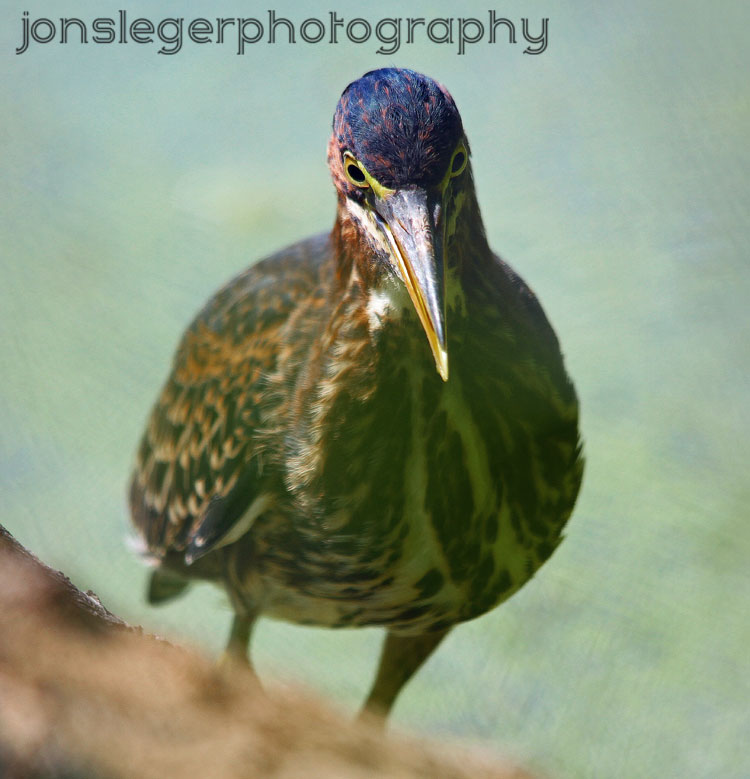
Green Heron, juvenile, Rock Cut State Park

Juvenile Green Heron, Rock Cut State Park, IL; 7/6/2012.
I spent three hours in the 100 degree heat looking for wildlife a week ago. As I was scanning a shallow lagoon at the southeastern end of Pierce Lake in Rock Cut State Park for water birds, a caught glimpse of a shadow of a bird against the algae-covered water at my feet. I realized that this bird was out of my sight, sitting on a low branch behind a larger tree trunk that was stretched out over the water's surface.  Since there was nothing too interesting on the water (Mallards, Canadas, & Coots), I waited patiently to see if this bird would pop out from behind the tree trunk.  And sure enough, it wasn't long and there he was (Above), peaking over the trunk - a Green Heron. It seemed rather small for the Green Herons I've seen, and by the streaks on its neck, I guessed it was a juvenile. It didn't have the dark reddish neck of an adult.
Juvenile Green Heron, Rock Cut State Park, IL; 7/6/2012.
This juvie Green Heron took turns hopping back and forth on the branches that extended from both sides of the tree trunk.  It's too bad that the branches on the side closest to me were in the shadows (Above), while the branches hidden by the tree trunk were in a nice photographical sunlight.
Trying out its ability to hunt,Juvenile Green heron, Rock Cut State Park, IL; 7/6/2012.
Periodically, this young Heron would test its hunting skills (Above).  I snapped a lot of pictures, and there is no way he didn't know I was there.  I was only a matter of ten feet away, and was not hidden. I even had to retreat my zoom lens (Sigma 150-500mm) to its lowest telephoto power to get a full body pic of the guy. I was still surprised how close I was and it did not fly away. Even after a couple of noisy hikers walked by, it still did not make attampt to flee. It just rehid behind the downed tree trunk, and soon reappeared after a minute (Below).

A juvenile Green Heron pretending I was not ten feet away, Rock Cut State Park, 7/6/2012.
A juvenile Kingfisher (yesterday's post) and a juvenile Green Heron were highlights of my Rock Cut hike on a 103 degree day.


Friday, July 13, 2012

Belted Kingfishers, Rock Cut State Park, IL

The Adult belted Kingfisher instructing its young, Rock Cut State Park, IL; 7/6/2012.
A week ago I spent a hot (over 100 degrees) few hours at Rock Cut State Park to see what was shaking and what kind of wildlife would be out and about in such steamy weather. I saw over 40 different species of birds, but the one I enjoyed the most was a family of Belted Kingfishers. As I hiked around Pierce Lake, I seemed to always be a couple beats late with catching a Belted Kingfisher in a position to get a picture. Most often these birds are off and chattering away before I even know they are nearby.  This hike was no exception - in the beginning. But I noticed that one particular B-KF stayed on its perch longer than usual, and when it flew off it didn't go very far. I soon realized that it was a young, probably freshly fledged, Kingfisher (Below).
A juvenile Belted Kingfisher out and about, Rock Cut State Park, IL; 7/6/2012.
This young Kingfisher literally flew completely around the lake following the shoreline, flying perhaps 50-100 feet at a time. In the past as I would approach an adult Belted-KF, it usually flew a good distance (sometimes completely across Pierce Lake, which is a good sized lake.) before I would catch up with it again.
An adult male belted Kingfisher, Rock Cut State Park, IL; 7/6/2012.
This adult male Kingfisher (Above) was not too far away from the juvenile. Sometimes the juvenile would let me get too close for its parent's comfort and I would hear the chatter of the distant adult, and only then would the juvenile take off.

An adult female Belted Kingfisher (L) pokes its head into my picture and appears to be  teaching  the juvenile (R) some important information, Rock Cut State Park, IL; 7/6/2012.
I was almost completely around the Lake, running into the juvenile at least in a dozen points, but never quite fast enough to get a decent picture, nor when I did get close was it in a clear position. I did notice that the adult Kingfishers tend to perch on branches fairly high up in trees, but the juvenile that I was following stayed on low branches, usually just a few feet above the water. I was about 80% around the lake, when I was approaching the little marshy pond on the northeast end the lake, I deliberately slowed down and tried to be stealthy because it is an area that the Kingfishers like to hunt. There were dense head-high bushes between me and the pond, when I heard the familiar clattering of a Kingfisher. In the corner of my eye, I saw the quick flight of a Kingfisher swoop down on the other side of the bushes. I slowly inched my way peering through the few open spaces in the branches until I saw the juvenile with its back to me. There were still branches separating us, and I used these to act as a blind, but I still couldn't get a full body photo without some leaves or branches partly obstructing the view (Photo at Top of page). As I was taking some photos, suddenly an adult female entered into my viewfinder (Above). I have never been this close to an adult Belted Kingfisher before and I tried to get as many photos as I could, knowing how skittish they are and off with the slightest movement.

Blurry green leaves in the foreground keep this from being a great photo of an adult female Belted Kingfisher, Rock Cut State Park, IL; 7/6/2012.
To my pleasant surprise, it didn't fly away as I kept snapping photos. There were still leaves partly obstructing my view (Above). The thin blind of leaves and branches were working well, but I still wished I could get a clearer photo free of obstructions. I knew if I shifted into a position in which I would have had a clearer shot, they would fly away. So I made sure I took enough photos before I tried to get a better vantage point. And sure enough, as soon as I moved to a more open look, they were both gone like a flash.

I had a lot of fun stalking these Kingfishers for the better part of three hours on a 4 1/2 mile hike around the perimeter of Pierce Lake.

Tuesday, July 10, 2012

Tree Swallow feeding its fledgling, Horicon Marsh NWR

Even though the series of photos below are not the sharpest, I thought  it was fun to see a Fledgdling Tree Swallow being fed in mid flight by its mother.

"Feed me! Feed me!"  This young Tree Swallow was squawking up a storm, Horicon Marsh National Wildlife Refuge, WI; 6/16/2012.
While hiking through the many trails at Horicon Marsh National Wildlife Refuge I was trying to photograph Tree Swallows flying through the air, but was unable to get any decent shots. But I did notice the young Tree Swallow (Above) sitting on a branch and not doing much flying. As I aimed my camera at it, it suddenly started squawking, and before I knew it another Tree Swallow swooped in with a bug in its bill and fed the Juvenile while in flight (Below)...

An Adult Tree Swallow feeding its young in mid flight, Horicon Marsh NWR, WI; 6/16/2012.
"Feed me! Don't fly away! Don't ignore me!"
The Juvenile Tree Swallow kept squawking even after its parent had fed it and was leaing.
Even after the adult Swalllow fed its young, the youngster kept complaining, until it realized it had some food, then suddenly it looked very content (Below)...
"Oh, I have some food...thanks, Mom"
"Don't mention it. Please."

Monday, July 9, 2012

Downy Woodpecker feeding its brood, Sugar River Forest Preserve

A DOWNY WOODPECKER FAMILY AT WORK

A male Downy Woodpecker feeding a young Downy, Sugar River Forest Preserve; 6/2/2012.
My first trip to Sugar River Forest Preserve rewarded me with an interesting interaction between an adult Downy Woodpecker feeding their young (Above) which were taking turns peeking their heads out of the excavated hole in a tree trunk. I was first attracted to their nest when I heard the constant rattling of the woodpecker nearby.  But it seemed different than when I usually hear Downys. This time the the Woodpecker sound was a constant, unceasing call that seemd a bit higher pitch. So when I looked up I saw a young male Downy peeking its head out of the trunk hole (Below) while the adult was nearby in the tree next to it.  The little guy didn't stop chattering until its parent showed up to give it something to eat.
A young male Downy peeking out of his nest waiting for a meal to show up, Sugar River Forest Preserve; 6/2/2012.

The  male Adult Downy gives the young male Downy a stern look, Sugar River Forest Preserve; 6/2/2012.
Then the father showed up (Above) and silenced the youngun. After it flew away, the chattering started again. I looked up, but this time it was a different young Downy. This one didn't have the red patch on its crown, so I knew it was a young female (Below)...

A young female Downy peeking its head out of her nest waiting for some attention, Sugar River Forest Preserve; 6/2/2012.

The female Adult shows up to deal with her young Downy, Sugar River Forest Preserve; 6/2/2012.
... then the female adult also shows up.

A different male Downy baby? Sugar River Forest Preserve; 6/2/2012.
After a bit, the young male popped his head out again, but upon analyzing it, I believed it was a third juvenal, because its bill looked bent, whereas the other male juvie had a straight bill.  It was cool to see an entire family of Downy Woodpeckers, both adults and probably three of their babies.  I found out from a very good website (Link Below) that most Downy broods will be between 3 -8 eggs, and the youngest (latest to hatch) frequently die.  Also both the male and female take turns caring for the young while they are being fledged.

Sunday, July 8, 2012

Pied-billed Grebe family at Horicon Marsh NWR

On a gray rainy morning a couple of weeks ago, while I was stalking some Marsh Wrens in the long cattail reeds on the side of a pond, a little duck-like bird suddenly swam out of the reeds making a beeline away from me. The little guy had a black, white and orange markings on its head and was quite striking. I had never seen a water bird like this before, but the shape of its body, particularly its head and bill looked like a Pied-billed Grebe. My suspicions were confirmed when I saw its Pied-billed Mama swimming fast toward it and diverting its course to the opposite side of the pond.
A Pied-billed Grebelet, Horicon Marsh National Wildlife Refuge, WI; 6/16/2012.

A Pied-billed Grebe with a soon-to-be-a meal-frog in its bill, Horicon Marsh NWR; 6/16/2012.

The P-B Grebe turned toward the opposite side of the pond, still with the frog in its bill, Horicon Marsh NWR; 6/16/2012.

"Look at what I have for dinner...yummy," says the Mother to her Grebeling, Horicon Marsh NWR; 6/16/2012.

Soon two more Grebelets appeared and followed Mom,  Horicon Marsh NWR; 6/16/2012.

"Okay, now we all have to learn to share," Mother Grebe says to her brood, Horicon Marsh NWR; 6/16/2012. 
Because of this little episode in the the lives of the Pied-billed Grebe family, I lost the Marsh Wrens that were chattering in the reeds.


Saturday, July 7, 2012

Great Blue Herons at Rock Cut State Park - weird behavior?

Great Blue Herons wondering when the cooler temps will get here?
A pair of Great Blue Herons looking straight up in the air, Rock Cut State ark, Rockford, IL; 7/6/2012.
Yesterday, I decided to brave the 103 degree temperature and take the 4 1/2 mile hike around Pierce Lake at Rock Cut State Park.  Objective? To see what foolish people (other than myself) and wildlife would be out in mid afternoon on a day like this. Usually if I walk at a steady pace without stopping (pre-birding days) the hike would take no more than 90 minutes; however, since I have started taking wildlife photography, which then logically led me to take more interest in birds, which then turned me into a more active birder, the hike now takes me 3-4 hours. Yesterday's hike took me 3 hours.
So what are these Grt Bl Herons doing? Praying for rain? Pleading to the Nature Gods for temperature relief?
At the beginning of my hike at 3 PM, I noticed these two Great Blues standing near the shore looking straight up in the air like a Cormorant. When I saw their silhouettes, as they were back lit, my first reaction was, "Those are really large Cormorants," or "What are Anhingas doing here?" Of course, i knew they were herons, but in the few years of birding (only a 2-3 year novice), I have never seen Great Blue Herons do this.
Initially, what caused me to look their way was that I was following the flight of a Belted Kingfisher, which landed in a tree above where the herons were wading. So I thought that they were watching the Kingfisher. but even after the Kingfisher flew off, they continued this behavior. 
What's up there that's so interesting? Perhaps this a way of cooling off?
I would estimate that these herons were looking up for between 5-10 minutes, before I hiked a little too close for their comfort and they flew across the lake. I saw at least another half dozen Great Blues and one Green during the rest of my hike, and no other Herons were looking up in the air as this pair.

So if any readers have come across this behavior, let me know, and if you know why they were doing this, also clue me in. Thanks ahead of time.
**********************************************************

Thanks to Barbara from the Illinois Ornithological Society (Link below) for her explanation of this behavior. See her comment below:

"That posture is a typical threat display. My guess would be that one heron was intruding on the feeding territory of the other and they had a "Mexican standoff" type of interaction going. Great Blue Herons aren't going to suffer from this kind of heat the way we do. Their range extends well into the steamiest parts of the tropics and they are in the water much of the time. Their plumage is not very thick. In fact, it always surprises me that we can almost always find them around here in the middle of winter."
Barbara Williams
IOS Membership Secretary
Winnebago Co.

Duck Families - Mallards & Woods

Mother Mallard looking after her 3 ducklings, Rock Cut State Park; 6/15/2012.
As with Canada Geese (yesterday's post), by mid June to mid July, Mallard Duck families (Above) are easy to run across almost anywhere in the northern half of North America. Generally, Mallards will lay anywhere from a half dozen to a dozen eggs in one clutch taking about one month to incubate. Then another 7-8 weeks for the ducklings to be fully fledged. The large quantity of young in a clutch makes the Mallard Duck the most widely spread Duck in North America (perhaps the world?), so I was surprised last year while I was watching a Mallard with only one duckling following it around (Below). I waited for more to appear, but no more did. It goes to reason that the rest of her clutch was lost by a predator, parasites, or perhaps didn't hatch.
Mallard and single baby, Rock Cut State Park, IL; 5/22/2011.

Manky Mallard (cross with a domestic duck?) mother giving instructions to her brood, Rock Cut SP; 7/21/2010.
At first glance, you wouldn't suspect that the family of ducks (Above) were Mallards. The Mother (on the right) is likely a mix of a Mallard with a domestic species (the dark bill and white breast looked like perhaps a mix with a Northern Pintail? but more likely with a domestic duck).  Mallards have been notoriously known for their promiscuous behavior with their mating habits. They have been known to breed with several other species - wild and domestic.  When Mallards breed with a domestic duck they have been called "Manky Mallards" (coined by Charlie Moores at http://10000birds.com/manky-mallards-domestic-feral-or-just-plain-odd-mallards.htm ). This particular Manky mother has a brood of eight "Manklets" (I coined that one). In the photo (Above) you can see that six of them have the same markings as their mother, and in the photo (Below), you can see that only two of them have the more traditional Mallard Duckling look.
Falling in line under the watchful eye of the Sgt. Manky Mallard, Rock Cut SP; 7/21/2010.
In my short Birding life (2-3 years?) I have been trying to photograph as many Manky Mallards as I come across them. perhaps someday I will do a post featuring all these Mankies.

A Wood Duck family at the Nygren Wetlands, Rockton, IL; 6/2/2012.
Another duck speces, that is less common or promiscuous than the Mallard, is the Wood Duck. I have had the lucky oppurtunity to winess at least two Wood Duck families this Spring. The family of six ducklings (Above) were at quite a distance at Nygren Wetlands. (Below) I was was able to catch a baby Woodie running acoss the mudflat to catch up with the rest of the family. Again I was quite far away, and the ISO on my camera was not working properly that day, so all my photos in this outing were blown out and contrasty.
A blurry fuzzball of a Wood Duckling scurrying to catch up with rest of the brood, Nygren Wetlands, Rockton, IL; 6/2/2012.
Another distance shot of a different Wood Duck family, Horicon Marsh NWR, WI; 6/16/2012.
The second Wood Duck family (Above) I saw this Spring was at Horicon Marsh National Wildlife Refuge in Wisconsin.  Even though I was quite far across the pond from them, it didn't take Mother Woodie long to coax her brood of three into the cattail reeds out of sight. Because Wood Ducks are less common than Mallards, it is always a treat to spot one.