Showing posts with label Northern IL. Show all posts

Sunday, September 2, 2012

Northern IL Summer Warblers: Cerulean, Prothonitary, and Yellow-throated.

PRETTY BIRDS and PRETTY POOR PHOTOS
I'll finish my series about Wood Warblers who live in Northern Illinois for the summer with a group of my poor quality pictures of the cerulean warbler, Prothonitary warbler, Yellow-throated warbler and Ovenbird. The reason I am showing bad pictures, is because I didn't get any better photos of this group of warblers that I don't get a chance to see very often. I also entered my "excuses" for the poor picture quality.
Cerulean Warbler, Rock Cut State Park, IL; 5/12/2012.
It took me some time to finally spot the beautiful Cerulean warbler, as I heard it singing but couldn't find it. Unfortunately it was a dark gray day and the photo quality wasn't very good.

Ovenbird, Mississippi Palisades State park, IL; 5/28/2012.
Ovenbirds are warblers I hear far more than see. Surprisingly this Ovenbird (Above) was high up on a tree branch. They are usually scrounging around in the underbrush. This guy was not only high in a tree but also probably 200-250 feet away in a dark part of the forest, and I had trouble getting a sharp focus with my hand-held 150-500mm Sigma Zoom lens.
Prothonitary Warbler, Colored Sands Forest Preserve, Shirland, IL; 6/12/2012.
This Prothonitary Warbler was also hiding pretty well high in the tree tops and (Above) was probably my best effort as it popped out for a brief second and before I could sharpen my manual focus, it flew off out of sight.
Yellow-throated Warbler, Rock Cut State park, IL; 6/15/2012.
I thought I lucked out when I saw a Yellow-throated Warbler sitting wide open on the road in front of me. I took a quick shot out of my car window (Above), before I pulled over and tried to stealthily get a better vantage point of this beautifully appointed bird. I tried my trick of shooting a photo then moving slowly closer, but this crafty little guy wouldn't cooperate. As I took one step closer, it would fly 20 feet further down the road. it stayed in the open, but was always a little too far out of my "sharp focus" range and it stayed in the tree shadows at the side of the road and finally out of sight completely. So it turned out that my best shot was the one I took out of the window of my car. My only other photo of this species was a blurry one-attempt shot earlier this spring (Below).
A blurry Yellow-throated Warbler, Rock Cut State Park, IL; 5/5/2012.
This ends my series of summer warblers from northern Illinois. To see a complete list of Warblers that call Northern Illinois their summer home, see my post from 8/19/ 2012.

Sunday, August 26, 2012

Northern Illinois Summer Warblers: American Redstart

A male American Redstart, Nygren Wetlands, Rockton, IL; 5/12/2012. 
Talking about summer warblers that reside in Northern IL in my past few posts, another very common warbler found in Northern Illinois is the American Redstart (Above). I found this one at the Nygren Wetlands...
Another male American Redstart, Rock Cut State Park, IL; 5/12/2012.
...then the same day I found another Redstart (Above) at Rock Cut State Park. Another one, a week later (Female Below).
A female American Redstart, Rock Cut State park, Rockford, IL; 5/20/2012.

American Redstarts are fairly easy to find as they like to perch on medium height branches in smaller trees and are very vocal with their song. males and females are quite different in their appearances as seen by the female (Above). The remaining pics are all of male Redstarts.
Another male American Redstart, Rock Cut SP, Rockford, IL; 6/13/2012.


A male American Redstart, Peninsula SP, Door County, WI; 6/20/2012.

Saturday, July 7, 2012

Great Blue Herons at Rock Cut State Park - weird behavior?

Great Blue Herons wondering when the cooler temps will get here?
A pair of Great Blue Herons looking straight up in the air, Rock Cut State ark, Rockford, IL; 7/6/2012.
Yesterday, I decided to brave the 103 degree temperature and take the 4 1/2 mile hike around Pierce Lake at Rock Cut State Park.  Objective? To see what foolish people (other than myself) and wildlife would be out in mid afternoon on a day like this. Usually if I walk at a steady pace without stopping (pre-birding days) the hike would take no more than 90 minutes; however, since I have started taking wildlife photography, which then logically led me to take more interest in birds, which then turned me into a more active birder, the hike now takes me 3-4 hours. Yesterday's hike took me 3 hours.
So what are these Grt Bl Herons doing? Praying for rain? Pleading to the Nature Gods for temperature relief?
At the beginning of my hike at 3 PM, I noticed these two Great Blues standing near the shore looking straight up in the air like a Cormorant. When I saw their silhouettes, as they were back lit, my first reaction was, "Those are really large Cormorants," or "What are Anhingas doing here?" Of course, i knew they were herons, but in the few years of birding (only a 2-3 year novice), I have never seen Great Blue Herons do this.
Initially, what caused me to look their way was that I was following the flight of a Belted Kingfisher, which landed in a tree above where the herons were wading. So I thought that they were watching the Kingfisher. but even after the Kingfisher flew off, they continued this behavior. 
What's up there that's so interesting? Perhaps this a way of cooling off?
I would estimate that these herons were looking up for between 5-10 minutes, before I hiked a little too close for their comfort and they flew across the lake. I saw at least another half dozen Great Blues and one Green during the rest of my hike, and no other Herons were looking up in the air as this pair.

So if any readers have come across this behavior, let me know, and if you know why they were doing this, also clue me in. Thanks ahead of time.
**********************************************************

Thanks to Barbara from the Illinois Ornithological Society (Link below) for her explanation of this behavior. See her comment below:

"That posture is a typical threat display. My guess would be that one heron was intruding on the feeding territory of the other and they had a "Mexican standoff" type of interaction going. Great Blue Herons aren't going to suffer from this kind of heat the way we do. Their range extends well into the steamiest parts of the tropics and they are in the water much of the time. Their plumage is not very thick. In fact, it always surprises me that we can almost always find them around here in the middle of winter."
Barbara Williams
IOS Membership Secretary
Winnebago Co.


Friday, June 29, 2012

The Nestbuilders

MAY IS HOMEBUILDERS MONTH FOR BIRDS
A Baltimore Oriole gathering material to build a nest, Rock Cut Sate Park, Rockford, IL; 5/5/2012.
May is the month where one can find birds picking, pulling and gathering all sorts of nesting materials to get ready to lay eggs and raise their newest family. Today I'll feature a few photos of such birds caught in the act of pulling fiber out of plants and branches, picking cotton out of milkweed, and scooping up twigs and blades of grass to add to their nests.
A female Baltimore Oriole looking proud of the job she has done constructing their unique hanging basket nest, Rock Cut State Park, Rockford, IL; 5/8/2011.
Baltimore Orioles especially look for long grasses and fiberous materials to build their unique hanging nests (Above and Below). The nest building is primarily the responsibility of the female Oriole. She looks for materials that must be strong enough to hold the weight of up to six eggs plus the bird lying on the eggs.  The female Oriole lays 3 to 6 pale blue eggs with dark marks. Incubation of the eggs last 12 to 14 days and the young birds will leave the nest in 12 to 14 days after hatching.
A close up of a different Oriole nest that I found just a few days ago in Black Hawk Springs Forest Preserve, Rockford,  IL; 6/26/2012.
A Blue-gray Gnatcatcher gathering nesting material, Nygren Wetlands, Rockton, IL; 5/12/2012.
Blue Gray Gnatcatchers (Above) will collect entirely different types of materials for their nests, which are quite small and shallow (Below) in the shape of a cup. These Gnatcatchers look for more cottony or fuzzy types of materials, such as from dandelions or thistles blossoms. In my research some experts use the term 'down' (reminiscent of goose down or duck down feathers) to describe the types of  materials that B-G Gnatcatchers like to use.
A Blue Gray Gnatcatcher finishing up its construction of its nest, Espenscheid Forest Preserve, Rockford, IL; 5/30/2012.
Their nests (Above) are usually saddled in between the fork of  two limbs, on a horizontal limb which serves as the foundation and an upright branch which becomes the side support.

One of my earlier photos: a female American Redstart weaving together her nest with spider silk, Rock Cut State Park, IL; 5/23/2010.
Another summer resident of Northern Illinois is the American Redstart. I was lucky to follow the flight path of a female Redstart at Rock Cut State Park as it flew from a stream into a nearby tree. After flitting around from branch to branch it eventually settled on its nest. Their nests have a similar cup-shape like the B-G Gnatcatchers, but are made with a tightly woven grasses, bark strips, hair, leaves, twigs, or mosses, which are glued together with spider silk. In the photo (Above) you can see that she has a firm grip of some spider silk in  her bill as she uses it to weave the nesting materials together.
A Field Sparrow gathering grasses for its nest, Black Hawk Springs Forest Preserve, Rockford, IL; 5/1/2011.
Like other avian species, it is the female Field Sparrow's duty to build the nest (Above), which is an open cup-shaped nest constructed almost exclusively of grasses and tend to be close to the ground on clumps at the base of shrubs.
More photos of birds gathering nesting materials below:
A House Wren with nesting materials in its bill, Colored Sands Forest Preserve, Shirland, IL; 5/12/2012.
A female Red-winged Blackbird getting ready to add to her nest, which could very well be for her 2nd brood of the season, Glacial Park, McHenry County, IL; 6/10/2012.
Red-winged Blackbirds are an early arrival to Northern Illinois, so they are already mating and nesting by mid April. It could be by early June, the R-W Blackbird (Above and Below) might already be starting a second nest for a second brood.
The same Red-winged Blackbird, Glacial Park, McHenry County, IL; 6/10/2012.
A Song Sparrow gathering grass stems for its nest, Black Hawk Springs Forest Preserve, Rockford, IL; 5/1/2011.

A White-breasted Nuthatch entring a tree cavity where it has likely built its nest, Rock Cut State Park, Rockford, IL; 5/22/2011.
White-breasted Nuthatches (Above) will build their nests in natural tree cavities such as abandoned woodpecker holes, or holes they excavate themselves. They will also use nest boxes as in the very cool documentary of a brood of nuthatches that I located on youtube (Click on the Link Below).
Another bird that uses a tree cavity to build its nest, a Mountain Bluebird, Rocky Mountain Nat. Park; 7/8/2010.

A Yellow Warbler gathering milkweed fuzz for its nest, Rock Cut State Park, Rockford, IL; 5/5/2012.
One of our early nest builders in Northern Illinois, an Eastern Phoebe with nesting grass in its bill, Rock Cut State Park; 4/23/2011
Trees along the Mississippi River that hold many nests of the Double-crested Cormorants, near Savannah, IL; 8/7/2011.
Two of Illinois' larger birds build very grand nests high up in trees. Both the Double-crested Cormorants (Above) and the Great Blue Herons (Below) build their nests in a community style (many together within the same tree or group of trees), made up largely of small dry branches. The nests average over a yard in diameter and have a central cavity almost a foot deep by two feet wide which is sometimes lined with twigs, moss, lichens, or conifer needles.

A dead tree bearing at least three nests of the Great Blue Heron, Phoenix, AZ; 12/26/2009.

Tomorrow I will feature birds which use man-made structures for its nesting abodes.

Monday, June 25, 2012

Dickcissals take over Northern Illinois in June 2012

"DICK - DICK-CISSAL-CISSAL!"
A male Dickcissal, one of many that have saturated Northern Illinois grasslands; Glacial park, McHenry County, IL; 6/10/2012.
Before this year, I have not seen or heard many Dickcissals in our area. This could be that usually in June - as soon as the school year ends, I am taking off somewhere out of state on a month long vacation. However, this year I stayed put for the first half of June and was rewarded by all the Dickcissals (Above) that have arrived in our part of the State, with their catchy song - "dick-dick-cissal-cissal."
A female Dickcissal, North Branch NCA, McHenry County, IL; 6/10/2012.
In the first week of June, I visited the Colored Sands Forest Preserve, near Shirland, IL, and all along the roadways in that rural part of Northern Illinois, I heard the familiar Dickcissals singing. There were also plenty of them in the prairie near the bird-banding station, while I was searching for Henslow's Sparrows. The same day, there were many Dickcissals present at Nygren Wetlands (Bottom photo) as well. Then a week later, I made my first birding trip to McHenry County to check out a rare sighting of a Lark Bunting at the Nippersink North Branch Natural Area (Above & Below). While I was scoping out the Lark Bunting, there were Dickcissals and Meadowlarks surrounding the area. While I was in the neighborhood, I also checked out the highly recommended birding area of Glacial Park, near Richmond. There too were many Dickcissals (Top photo).
Another Dickcissal, North Branch Natural Area, McHenry County, IL; 6/10/2012.
A singing Dickcissal, Nygren Wetlands, Rockton, IL; 6/2/2012.
Dickcissals were also present at Deer Run, and Black Hawk Springs Forest Preserves near Rockford, IL.

Sunday, June 24, 2012

Indigo Buntings - Early May in Northern Illinois

An Indigo Bunting mugging for the camera, Nygren Wetlands, Rockton, IL; 5/12/2012.
Indigo Buntings (Above) have been quite a presence this Spring in Northern Illinois. I always love finding one of these blue beauties because they always present a great contrast against the greens, yellows and browns of their habitat.
Indigo Bunting, Rock Cut State Park, IL; 5/20/2012.
Indigo Bunting, Mississippi Palisades State Park, IL; 5/28/2012.

Indigo Bunting, Rock Cut State Park, IL; 6/13/2012.
These Buntings are one of Northern Illinois' summer residents as they can be seen in our parks and forests from early May through September, when they migrate south to Mexico and to the very southern tip of Florida.

Friday, June 22, 2012

More Flycatchers - Willow Flycatcher in Northern Illinois

A Willow Flycatcher, Glacial Park, McHenry Cnty, IL; 6/10/2012.
June should be named "The Month of the Flycatcher" in Northern Illinois, as I have seen and heard all seven Flycatcher species that reside in our area for the summer. All of my posts to this blog last weekend were devoted to Flycatchers. Flycatcher residents that I have seen/heard in the first two weeks of June are: Eastern Phoebe, Eastern Kingbird, Eastern Wood Pewee,  Least Flycatcher, Acadian Flycatcher, Great-crested Flycatcher, and Willow Flycatcher (Above). Of the three Flycatchers that have travel through our area to more northern homes, I have seen two of them: Olive-sided Flycatchers and Alder Flycatchers. The only Flycatcher species that I have been unable to locate is the Yellow-bellied Flycatcher.
The same Willow Flycatcher, Glacial park, IL; 6/10/2012.
Eastern Phoebes, Eastern Kingbirds and Great-crested Flycatchers are easily identified by their appearance. But all the others look very much alike and I have to rely on their sounds to be sure of my identification. Luckily each of them have their own unique song which are fairly easy to distinguish. Willow flycatchers (Above) have their unique song which is translated in bird guides and bird recordings as "fitzbew" or "ritzbew." In the Summer, these Flycatchers can be found from coast to coast in the northern half of the U.S. and will travel to Mexico and Central America to spend the Winter.

Monday, June 18, 2012

Great Crested Flycatcher - Late Migrant to Northern IL

A Great Crested Flycatcher doing its thing - catching flies, Rock Cut State Park, IL; 6-13-12.
Keeping with the weekend theme of Flycatchers, one of the later birds to migrate to Northern Illinois, is the Great Crested Flycatcher. These guys showed up in our parts in late May and by early June, I was finding them in many Northern Illinois natural areas - Black Hawk Springs Forest Preserve, Colored Sands FP, Rock Cut State Park, Morton Arboretum, Glacial Park, and Nygren wetlands. It is one those birds that I have learned to recognize its very vocal sounds this Spring, which ultimately makes me more aware of its existence.

The same Great Crested Flycatcher, Rock Cut State Park, IL; 6-13-12.
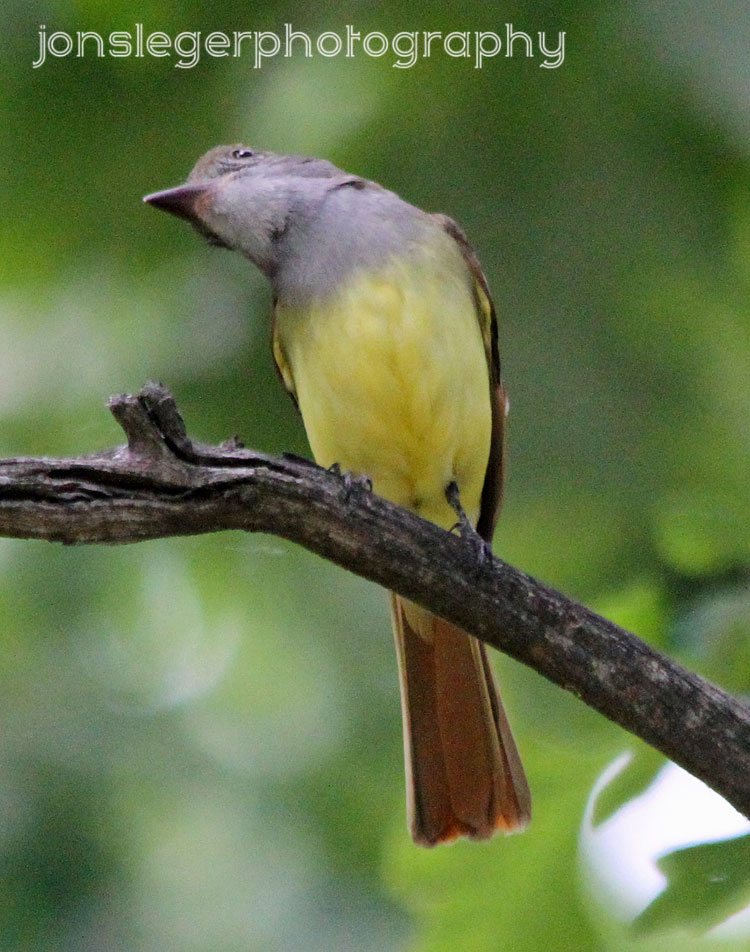
Great Crested Flycatchers (Above) is the largest of the Tyrant Flycatchers found in the Eastern half of the U.S., and is commonly found in mature deciduous trees. Its range stretches from the Atlantic Coast westward to the Great Plains of Nebraska, Kansas, Oklahoma, East Texas, and the Dakotas. They can also be found in the Southern edges of Canada. For Winter, they will travel to Mexico and Central America.
Great Crested Flycatcher, Rock Cut State Park, IL; 6-13-12.
I followed the movements of this particular Great Crested (Above) for quite some time, as it would fly back and forth between 2-3 large Oak trees and then suddenly make a dive bomb to the ground (Below) going after some insects, and then return to its perch in one of the Oaks.
Great-crested Flycatcher, Rock Cut State Park, IL; 6-13-12.
Its combination of colors makes it one of our prettier Flycatchers with its olive back and crown, gray throat and breast, bright yellow belly, and rufous tail and wing edges.

Monday, June 11, 2012

Baltimore Orioles Galore! and some Orchards too in Northern Illinois

A Baltimore Oriole gathering nesting materials near Olsen Lake, Rock Cut State Park; 5/5/2012.
I have never seen or heard as many Baltimore Orioles as I did on May 5, at Rock Cut State Park this year.  I am guessing I probably saw and heard as many as 2 - 3 dozen Orioles. The day before - None. They showed up overnight in huge numbers. Judging by the posts on the IBET (birdingonthe.net) boards from the same date, the same thing was happening all over Northern Illinois - Baltimore Orioles were being reported in large numbers by many birders from the Mississippi River to Lake Michigan in the northern third of Illinois.
Another Baltimore Oriole, Rock Cut State Park; 5/5/2012.
Within the week, while visiting Colored Sands FP, Espenscheid FP, Black Hawk Springs FP, and Nygren Wetlands, I saw many Baltimore Orioles in each of these places.
Another Baltimore Oriole, Rock Cut State Park; 5/12/2012.
A Male Balt. Oriole checking out a female who is in obvious mating position, Rock Cut State Park; 5/20/2012.
As I was waiting for the male Baltimore Oriole to get more in the open, he was soon joined by a female. By the looks of things, they were getting ready to mate (Above and Below), but I never actually witnessed the deed. I think they were bothered by my presence and probably waited until I was out of sight.
The same Oriole pair, Rock Cut State Park; 5/20/2012.

An Orchard Oriole, Rock Cut State Park; 5/12/2012.
Another Oriole species that showed up about mid May was the Orchard Oriole (Above). They are not as common as the Baltimores, but I have had a chance to see an Orchard in at least three different occaissions this Spring.
An Orchard Oriole, Rock Cut State Park; 5/20/2012.
A 1st Year Orchard Oriole, Nygren Wetlands, Rockton, IL; 6/2/2012.
While hiking in Nygren Wetlands, I was following a yellow bird that flew behind a small bush. I initially thought it was a Common Yellowthroat, but it seemed too big to be a Yellowthroat so I kept on it. While I was aiming my camera at the bush hoping to get a better glimpse, it poked its head out and I saw that it was a First Year Orchard Oriole, which are mostly yellow with dark wings and a black mask and throat. This was very satisfying, since I haven't seen a First-year Orchard since two years ago at the Rowe Sanctuary in Nebraska.