Sunday, October 21, 2012

Damselflies at Lodge Lake, Snoqualmie Wilderness, WA

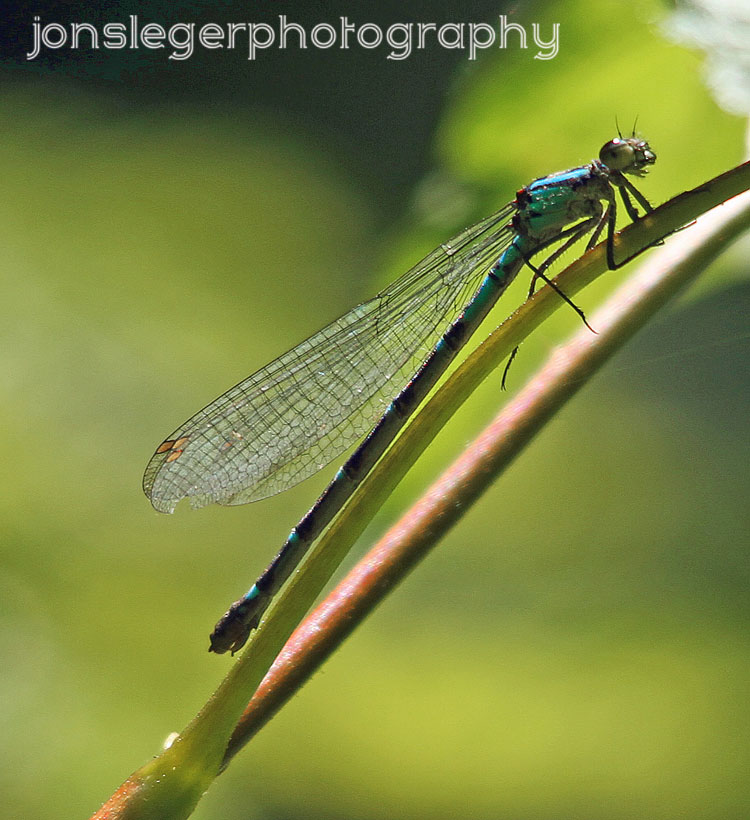
What I think is a Boreal Bluet Damselfly, Lodge Lake Trail, Snoqualmie Wilderness, WA; 8/10/2012.
A few posts ago I featured my series of attempts at trying to get a sharp pic of a Lance-tipped Darner Dragonfly in flight ( http://northernillinoisbirder.blogspot.com/2012/09/lance-tipped-darner-lodge-lake-wa.html ), which was quite a challenge for me.  At the same edge of the Lodge Lake there were also a large number of damselflies of which were much easier to photograph as they landed and stayed still for me. I am not altogether sure what their exact identification is, but I narrowed them down to three good possibilities: Boreal Bluets (Above), Common Blue Damselflies (Below), and Northern Bluets. All three fit the general appearance of the damselflies I observed and all seemed to be considered residents of the northwest region; however, not being an expert of the Odonata order of insects, I am not versed in the minute markings on a damselfly's thorax and abdomen to be able to identify them with any certainty.

A group of what I have identified as Common Blue Damselflies, Lodge Lake, Snoqualmie Wilderness, WA; 8/10/2012.
The Common Blue Damselflies (or at least what I think are) were all over the place, as evidenced by the photo (Above) with four alit in the same spot. There were at least three more just above the couple on the top right hand corner,  but I zoomed in too close to capture all seven together.
A close up of the pair of Common Blue Damselflies in the couple position, Lodge Lake, Snoqualmie Wilderness, WA; 8/10/2012.
The pair of Common Blue Damselflies (Above) coupled together in a position just before they move into the "wheel" position for mating.
An unidentified damselfly coming in for a landing, Lodge Lake Trail, Snoqualmie Wilderness, WA; 8/10/2012.
There was one damselfly (Above and Below) that I wasn't able to find any photo anywhere  similar to its appearance, which was quite different from the Common Blues and the Boreal Bluets. This damselfly was more of a turquoise color and the tip of its tail did not have the wide blue band - it was darker.
The same damselfly after it alit on a stem,Lodge Lake Trail, Snoqualmie Wilderness, WA; 8/10/2012.
Even after it landed and I captured a more clear photo, I still was not able to identify this guy.

If there are any readers out there who know the true identifications of these damselflies that I have photographed for this post, write in and set me straight.

Sunday, October 14, 2012

More Olympic Peninsula Nat. Park Beach Birds

BIRDS IN THE MIST

Early mourning at Ruby Beach, Olympic Peninsula National Park, WA; 8/3/2012.
Keeping my theme of Coastlines along the Pacific shore of the Olympic Peninsula National Park, today I post pics from our couple of hikes to two more Beach locations.  Yesterday and the last couple of weeks I featured bird pics from Kalaloch Beach. Today I feature Ruby Beach and Second Beach, both just up the coast from Kalaloch.  The marine layer was thick over Ruby beach; therefore visibility was poor and birding came at a premium. But as the sun rose higher in the east, it cast a Nice pinkish glow on the Western fog (Above).
The Northwestern Chestnut-backed Chickadee, Ruby Beach, Olympic Peninsula National Park, WA; 8/3/2012.
One of my lucky finds was in the Ruby Beach Parking Lot.  I saw a small congregation of birds in a spruce tree chattering and flitting about. Even though the beach itself was socked in by the fog, the Parking Lot was more than 50% in the sun, as a large hole in the mist opened up.  It turned out that this flock was of Chestnut-backed Chickadees (Above), which were a nice new addition to my Life List. In the Midwest where I am from all we have are the Black-capped variety (Below). Chestnut-backs are slightly smaller than the black-caps, but were just as lively flitting from branch to branch and from tree to tree in high energetic bursts. Except for their reddish brown backs and scapulars, and more reddish underneath (Black-Caps are more buffy yellowish underneath), their faces are almost identical with black caps and throats.
The Midwestern Black-capped Chickadee, Espenscheid Forest Preserve, Cherry Valley, IL; 5/26/2012.
After leaving the fogged-in Ruby beach, we tried our luck further up the Olympic coast in the LaPush area, and hiked out to Second Beach.  The hike out to Second Beach started in bright sun, but as we neared the Beach we could see rolls of mist pouring through the trees of the forested trail (Below).
Misty sun rays pour through the Forest of the Second Beach Trail, LaPush, Olympic Peninsula National Park, WA; 8/3/2012.

Second Beach, Olympic Peninsula National Park, WA; 8/3/2012.

When we arrived on the Beach, the fog and sun were basically divided by the coastline. The foggy marine layer stretched parallel with the shore while the blue sunny sky lit up the forest (Above). It was like being in two weather patterns simultaneously, which made for some interesting photo compositions (More below).
Misty Trees on Second Beach, Olympic Peninsula National Park, WA; 8/3/2012.
The same misty tree silhouettes as seen through some driftwood roots on Second Beach, LaPush, Olympic Peninsula National Park, WA; 8/3/2012. 


A back lit Stellar's jay on the forested trail leading to Second Beach, LaPush, Olympic Peninsula National Park, WA; 8/3/2012. 
Even the few bird photographs I took had a misty quality to them, as is the Stellar's Jay that wouldn't cooperate and land in better light for a portrait. but as it turned out, I ended up liking the back lit Jay.

Other birds that I observed in the misty forest (with no notable pics) were: American Crows, American Robin, Cedar Waxwings, Chestnut-backed Chickadees, Common Ravens, Downy Woodpeckers, Oregon Juncos, Red-breasted Nuthatches, Stellar Jays, Northern Red-Shafted Flickers, White-crowned Sparrows and Song Sparrows.

Saturday, October 13, 2012

The Many Disguises of the Song Sparrow; Olympic Peninsula Nat. Park

Which coat shall I wear today?

A dark Song Sparrow from the Northwest, Kalaloch Beach, Olympic Peninsula Nat. Park, WA; 8/3/2012.
Last week I posted some photos of many Sea Birds hanging around the shorelines at Kalaloch Beach in the Olympic Peninsula National Park from last August.  The area was also very rich with a variety of shore and land birds as well.  The Kalaloch area not only had some fine beach habitat, but also included some nice woodland and grassland areas. Some of these I observed along the coastline include: Bald Eagles, Spotted Sandpipers, Ospreys, belted Kingfishers, American Crows, American Robin, Barn Swallows, Northern Rough-winged Swallows, Brown-headed Cowbirds, Cedar Waxwings, Chestnut-backed Chickadees, Common Ravens, Downy Woodpeckers,  Oregon Juncos, Rufus Hummingbirds, Red-breasted Nuthatches, Stellar Jays, European Starlings, Mourning Doves, Northern Red-Shafted Flickers, Spotted Towhees, and many types of sparrows, including Fox, House, White-crowned, Chipping, Savannah and Song. It was this latter sparrow, the Song Sparrow, that actually gave me the most trouble with identification.
On a dark gray early mourning I was returning from a hike on the beach, when I noticed some dark birds flitting in and out of the bushes along the dirt path leading up from the beach. After a few minutes of waiting for one of them to appear in a clearing, I was able to get a few shots (Above). I guessed these were either the Sooty versions of the Pacific Northwest Fox Sparrows or the Pacific Northwest versions of Song Sparrows, which are darker than the Song Sparrows I am accustomed to back in the Midwest (Below). I was leaning towards the Song Sparrow as my ID, but after reviewing my photos later in the day, I actually wasn't very sure about my Song Sparrow ID.  In the Northwest, both the Song and Fox are dark, but the bill seemed too dark and the back too streaked to be a Fox Sparrow. It had a small yellow spot at the base of the bill, which I thought could be an underdeveloped yellow lower mandible of the Fox, but the streaked back and dark legs pointed away from being a Fox.  No other type of Sparrow made sense, so by default I deemed it to be a Song Sparrow. It still seemed too dark for a Song Sparrow and the black legs and bill with the small yellow spot at the base also seemed out of character. But it still made the most sense out of any other Sparrow that be found in this location.
A Midwest Song Sparrow, Horicon Marsh national Wildlife area, WI; 6/16/2012.
Another Midwest version of the Song Sparrow, Nygren Wetlands, Rockton, IL; 4/5/2012.
As seen in the photos (Above), Song Sparrows in the Midwest are a bit lighter and have more definition in the streaks on their back, wings and flanks. They also have more contrast in their head stripes.
A Song Sparrow in the Southeast, Cherokee, North Carolina; 6/11/2010.
Song Sparrows in the Southeast (Above) are very similar to the Midwest, but seemed a bit lighter overall.
A very red version of a Song Sparrow from the Southwest, San Pedro Riparian Conservation Area, Sierra Vista, AZ; 4/10/2012.
But the song Sparrows from the Southwest Are much redder on their back and side streaks as well as their head stripes (Above).
Song Sparrow, Crystal Cove State Park, CA; 6/13/2011.
Yet another look of the Song Sparrow comes from the California Coast, where the stripes on the head, back, breast and flanks are almost black in contrast with the whiter breast feathers. These Song Sparrows (Above and below) were on the beach of Crystal Cove State Park a year ago.
Another California Coast version of a Song Sparrow, Crystal Cove State Park, Newport, CA; 6/13/2011.

Sunday, October 7, 2012

Sea Bird Feeding Frenzy on the Olympic Peninsula

THERE'S SOMETHING IN THE WATER

A feeding frenzy of sea birds, Kalaloch Beach, Olympic Peninsula, WA; 8/2/2012.

You can see some birds on the shore in the lower left center portion of the photo,  Kalaloch Beach, Olympic Peninsula, WA; 8/2/2012. 
While holing up in one of the Kalaloch Beach cabins in the Olympic Peninsula National Park last August, I scanned the beach for bird activity. It was already getting late in the day. The sun was low behind a bank of thick marine clouds; therefore, it wasn't particularly good photography light, but I saw a large congregation of birds (Above) far out on the shoreline during a low-tide period. You know me, I can't pass up the opportunity to try to find some new birds. So I hiked out on the sandy beach at least a quarter mile towards the bird activity by the shore.
As I venture closer to the shore birds, I became slightly irritated with some people purposely running at the birds causing them to fly off in a flurry of squawks and wing beats. The flock flew off to a different location along the shore about a half mile away. So I obediently followed their course. Fortunately for me, this new location seemed a better spot. The flock joined another flock which seemed more diverse. 
Gulls and Pelicans on the shore, Kalaloch Beach, Olympic Peninsula, WA; 8/2/2012.
As I closed in on this new location, initially I saw just the gulls on the shore. Soon I saw there were Brown Pelicans with ate least four different species of Gulls (Western, California, Heerman's, and Glaucaus-winged) and a couple of Caspian Terns. This group of birds on the shore (Above) was just the beginning. As I started taking pictures in this low light, I noticed more bird out in the water. There were birds floating in the water near the shore, then another flotilla of birds further out. The more I looked into the gray light, I saw that there must have been thousands of birds and they were weren't just passively hanging out. They were there for a reason. There was a lot of flying back and forth, and diving, as they were following an obvious food source in the water (Top photo - Feeding Frenzy). I guessed sardines, but thought that they were more of a warmer southern climate fish.  On the hike out, there was much evidence of shell fish on the beach (Below), which would explain the large number of gulls on the beach.

A crab on the Kalaloch Beach, Olympic Peninsula, WA; 8/2/2012.

What was left of a crab after the gulls had their way, Kalaloch Beach, Olympic Peninsula, WA; 8/2/2012.
But there was much more feeding activity in the water. I thought perhaps there were a lot of shell fish in the water as well, but I saw many birds flying by with small silvery fish in their bills.
Gulls and other sea birds diving for their dinner, Kalaloch Beach, Olympic Peninsula, WA; 8/2/2012.
The first layer of birds were the Gulls, Terns and Pelicans on the beach. The second layer of birds were the birds dive-bombing the surf near the shore (Above and Below). There were some Sooty Shearwaters and Caspian Terns also in the mix.
The sea birds were fussing at each other, no doubt competing for prime dinner fare; Kalaloch Beach, Olympic Peninsula, WA; 8/2/2012.
Murres, Murrelets, and Auklets, Kalaloch Beach, Olympic Peninsula, WA; 8/2/2012.
 A bit further out away from the crashing surf were another layer of sea birds joining this feeding frenzy. I didn't immediately recognize all the birds that were present, but later after analyzing my images with lots zooming-in and highlighting, I was able to identify lots of Common Murres, and a few Thick-billed Murres, Pigeon Guillemots, Marbled Murrelets, and Cassin's Auklets.
More sea birds, even a Tufted Puffin (right center) even further out, Kalaloch Beach, Olympic Peninsula, WA; 8/2/2012.
Then there was a third layer of birds even further out (Above). With more zooming-in and highlighting this layer, I was able to identify a couple of Tufted Puffins and Rhinoceros Auklets, and there were some more Shearwaters, but I wasn't able to know exactly what kind, although I suspected Sootys. Also in this layer were a group of rocks that were covered in birds - mostly Gulls and Pelicans with some Alcids surfing the crashing waves into these rocks.
Brown Pelicans and Gulls resting on the rocks, Kalaloch Beach, Olympic Peninsula, WA; 8/2/2012.
Altogether my little venture into the gray evening netted 14 sea birds, six of which were added to my life list. I didn't expect such a windfall (waterfall?) of avian life. I expected Gulls and Terns at best. Indeed, I was surprised to see Brown Pelicans this far North, and even more surprised to see so many Pelagic, which I wold never have thought to find so close to shore. These are birds that I thought I would need to be aboard a ocean-going vessel to ever observe. Most of my photos were not very good, but a few of the better ones below...
Heerman's Gulls,Kalaloch Beach, Olympic Peninsula, WA; 8/2/2012.

Western Gull (left) and California Gull (right), Kalaloch Beach, Olympic Peninsula, WA; 8/2/2012.
Not a bird, but I liked the sea stacks with the backdrop of the setting sun peaking through the thick clouds, Ruby Beach, Olympic Peninsula, WA; 8/2/2012.


Saturday, September 29, 2012

Lance-tipped Darner, Lodge Lake, WA

PATIENCE, PATIENCE.. HAS ITS REWARDS
Indian Paintbrush grace the trail leading to Lodge Lake, Snoqualmie Wilderness, WA; 8/10/2012.
Last weekend I posted some photos of a young one-legged Northern Harrier that I found along the trail leading to Lodge lake, in the Snoqualmie Wilderness just East of Seattle, WA. This weekend I'll feature some of the dragonflies and damselflies that I found at Lodge lake.
When I reached Lodge Lake, there were some good-sized dragonflies buzzing and hovering over the shoreline of the lake. I waited for many minutes for one of these guys to land on something so I could try to get a photo and ID, but they didn't land. They kept airborne. Sometimes they would hover over a spot for a few seconds, but mostly they cruised back and forth at varying speeds, making it very difficult for me to get a focus of one in my viewfinder.
A Lance-tipped Darner appearing in my viewfinder, Lodge Lk, WA; 8/10/2012.
After many minutes of trying to follow the path of one of these dragonflies (Above), I knew it would be in vain. Either they were too fast and sporadic for me to follow with my Sigma lens at its 500mm maximum zoom, or if I zoomed out to less magnification, I could not get any in focus, as they were too small and far away.  So I tried a new tactic...
The same Lance-tipped Darner entering further into my viewfinder...
My strategy was to locate a common spot that these dragonflies seemed to prefer. Then I chose a focus point as close to the spot as I thought a dragonfly might come close to. Then I waited (and waited...) for a dragonfly that was tending to hover instead of cruise, to come close to that area.
...the Darner almost completely in my viewfinder...
Then I would raise my prefocused camera and aim it to the area hoping that the hovering dragonfly would wait long enough in that spot and be close to my prefocal point.
...okay, he is now completely in my viewfinder, still hovering...
Once I could locate the hovering dragonfly in my viewfinder, I fine-tuned the focus trying to find the sweet spot that would put it in focus.
...getting closer to my focus...
I started bursting my shutter at the same time keeping the dragonfly as close to the center of my viewfinder as I could, while fine-tuning the focus, as the dragonfly would keep changing its position, but luckily it was still hovering and not zooming off.
...still hovering, giving me a chance to fine focus...

... getting closer to a sharp focus...
As I kept bursting, it suddenly moved into a nice focus, while I tried to keep my arms steady while trying to hold still a Sigma 150-500mm zoom lens on Canon Rebel EOS D7 body (over 6 lbs of equipment) for 15-20 seconds. But those of you who focus on a moving target while bursting, know when you think you captured a nice image, even while the shots are going by at 8 per second. I had that feeling, that I captured the shot (out of several dozens) that might be a good one.
At last ... the Lance-tipped Darner, Lodge Lake, Snoqualmie Wilderness, WA; 8/10/2012.
I think this is it (Above), the one shot out of at least 5 or 6 dozen attempts to get a decently focused image of a Lance-tipped Darner, the perpetual flyer, the one who wouldn't land, the "catch me if you can" Odonate member. Al;l the photos in this post came from the same series of bursts.
Of course, after getting this photo, I thought I could get another, and stayed for ten minutes more trying to capture another successful image. But alas, I didn't even come close to getting another dragonfly to hover into my viewfinder. Or to be more accurate, I couldn't get my viewfinder to find a hovering dragonfly.
As you can read, I have identified this Northwestern dragonfly as a Lance-tipped Darner, but being a very much beginner in dragonfly knowledge, I cannot be sure that this a Lance-tipped Darner, but it seemed to have the most similar traits of the all the dragonfly pics I researched.


Saturday, September 22, 2012

One-legged Northern Harrier, Lodge lake Trail, Washington State

ONE LEG IS BETTER THAN NONE

A 1st year Northern Harrier sitting on a downed log, Lodge Lake Trail, Snoqualmie Wilderness, WA; 8/10/2012.
I was fortunate to spend some time in Washington State at the beginning of August to get some hiking and birding in before my busy school year tackles me. One of the cool places near Seattle is the Snoqualmie Wilderness, which has hiking trails galore. On our last day in the area, Val and I hiked to Lodge lake where I found lots of dragonflies and damselflies (a subject for a future post). About two-thirds of the way to Lodge Lake, as I was rounding the bend past a smaller pond, I noticed a trio of hikers looking intently into the brush. Not knowing what they were spying on, I slowed down and tread quietly, not wanting to scare whatever it was they were looking at. One of the hikers motioned me toward them and pointed out a raptor sitting on a dead log stretched over a marshy area. They said they saw the raptor circling above and then make a landing behind some trees. They didn't see it land, but came upon it a few minutes later - assuming it was the same bird. Noticing my large lens (Sigma 150-500mm) hanging off my harness- just a tad bit bigger than their camera phone, they wanted me to take a photo (did they really have to ask?) so they could get a closer look. I hurriedly snapped a couple of photos (Above) to make sure I had something before it flew off. I shared the photos with them and they wanted to know if it was a Golden Eagle. I told them it looked too small to be an eagle - more likely a hawk, but since raptors aren't a strength of my bird identification skills I couldn't offhand think of which hawks were completely dark reddish brown. A Dark Morph Ferruginous came to mind but I couldn't remember if it would be found in a forested area (later research proved they are more of a arid grassland raptor). A Red-shouldered Hawk also came to mind, but I couldn't remember if these would be found in the Pacific Northwest, and also it seemed to me Red Shoulders have white on their undersides. Later research proved that these are found on the West Coast, but rarely in the north, but could be found in forest habitats. It turned out that this hawk didn't have enough white underneath to be a red-shouldered.
It appears that this Northern Harrier has only one leg,  Lodge Lake Trail, Snoqualmie Wilderness, WA; 8/10/2012.
Well, it turned out that this raptor was a 1st-Year Northern Harrier (Above), which has completely dark brown back, wings, tail and head, with Rufus breast and belly. The trait which ultimately identifies this guy as a Northern Harrier is its disc-shaped face which outlined its cheeks. Some bird guides say this hawk has an "owl-like facial disc." As I was photographing this Harrier, it didn't seem to mind us being there. In fact it didn't make any sort of move to fly away. It definitely knew we were there (perhaps 40 yards away), and it continued to scan its surroundings - presumably looking for prey.  The trio of hikers continued on their journey (opposite direction of where I was headed). I stayed to take more photos, and after a good ten minutes this harrier stayed put, and I continued my hike to Lodge Lake.
The same Northern Harrier craning its neck, Lodge Lake Trail, Snoqualmie Wilderness, WA; 8/10/2012.
It took me another 20 minutes to reach Lodge Lake, stayed there for a good 20 minutes to take photos of the many damselflies and dragonflies present, then started my return hike back to the trailhead.  Twenty minutes later, I was back at the spot where the Northern Harrier was - and it was still sitting in the same spot (Above) - over an hour later. I thought it was good luck (for taking more photos), but thought it unusual for a hawk to stay in one spot for so long. I suppose it could have left and returned. I decided to try my strategy of taking a photo and then taking a few steps closer to see if it would stay or scare off. This Harrier let me cut the original distance of over 100 feet in half, perhaps even more. I had to bushwhack noisily through some thick brush to get closer and ultimately I was probably only 40 feet away when I was at my closest - still photographing. It would glance my way periodically, but largely ignored me. I took almost 100 pics of this guy before I decided I couldn't get any better, and I continued my hike back to the trailhead where Val was undoubtedly already there waiting for me. She no longer wonders why I fall so far behind on our hikes - she knows that I am out stalking a bird. But the Harrier was still sitting in the same spot when I left it.
It was only after I was showing Val all the nice close ups I had of the Harrier, that she remarked that it looked like it only had one leg. I then looked at every single of the 100 images I had of it, and she was correct, I couldn't find a single photo that showed more than one leg. The three photos I put on this post all show one leg. It dawned upon me that this might be the reason it didn't fly off easily. I guessed that with only one leg, it might be more difficult for it to land; therefore, it stays in one spot as long as it can before it is forced to move. I was glad I decided not to get any closer which might have scared it into flight.

Red-Tailed Hawks, Northern Illinois

A Red-tailed Hawk checking out the action on Blood Points Rd., Cherry Valley, IL; 8/1/2011.
This fall raptors have been on the move migrating towards their winter hunting grounds. Although I haven't been out to enjoy this season's migration, I have been keeping up with the IBET posts, and there seems to be a lot of sightings of raptors in the Northern Illinois area.  One of our more common raptors is the Red-tailed Hawk (Above), which we see year round especially along rural roadsides.
The same Red-tailed Hawk sitting on an electrical pole on Blood Points Rd., Cherry Valley, IL; 8/1/2011.
As I was biking along Blood Points Road a year ago, I saw this majestic Hawk sitting on an electrical pole (Above), which I soon recognized as a Red-tailed Hawk as I zoomed in on it to get its picture. Its obvious red tail sticking out past its wing tips was the give away. It flew across the road and settled on a dead branch not far away (Top photo).
Another Red-tailed Hawk sitting in a small tree off the loop road in Rock Cut State Park, Rockford, IL; 4/23/2011.
A Red-tailed Hawk soaring over a prairie, Blackhawk Springs Forest Preserve, Cherry Valley, IL; 4/21/2012.
Another easy identification of this hawk, as its red tail is back lit by the late afternoon sun.