Sunday, June 24, 2012

Indigo Buntings - Early May in Northern Illinois

An Indigo Bunting mugging for the camera, Nygren Wetlands, Rockton, IL; 5/12/2012.
Indigo Buntings (Above) have been quite a presence this Spring in Northern Illinois. I always love finding one of these blue beauties because they always present a great contrast against the greens, yellows and browns of their habitat.
Indigo Bunting, Rock Cut State Park, IL; 5/20/2012.
Indigo Bunting, Mississippi Palisades State Park, IL; 5/28/2012.

Indigo Bunting, Rock Cut State Park, IL; 6/13/2012.
These Buntings are one of Northern Illinois' summer residents as they can be seen in our parks and forests from early May through September, when they migrate south to Mexico and to the very southern tip of Florida.

Saturday, June 23, 2012

Warbling and Red Eyed Vireos in Northern Illinois

One of many Warbling Vireos making themselves known in the Rockford, IL. area this Spring; 5/5/2012.
Vireos are a weak species on my Life List, probably because it is a species that I am not totally confident with my ID skills - but not the Warbling Vireo (Above). These guys are easy to recognize with their rambling run-on song. Warbling Vireos arrived in Northern Illinois in early May, and it seems all of them stayed here as they seemed to be every place I have birded. In the Summer months, Warbling Vireos are common throughout much of the U.S. save the Southeast corner (Florida, Georgis, Alabama, and the Carolinas) and most of Texas and Louisiana. They will also stretch their Summer range well into most of Western Canada and along the Great Lakes. In the Winter you can find them in parts of Mexico and Central America.
A Red-eyed Vireo in its typical 'high in the upper branches' position, Rock Cut State Park; 5/12/2012.
Another Vireo that is common in our area is the Red-eyed Vireo (Above), which arrived in the Rockford area in Mid May. I have learned to recognize this vireo's song this Spring, a song which is a rather non-descript series of  three syllable phrases and not a strikingly catchy tune. But once I learned to recognize their song high in the upper branches of large trees, they became much easier to find. Before this, I always saw them high above me and almost always only saw their underbellies; therefore, it was hard to ID. But now that I know their song, I find them all the time.
A White-eyed Vireo in its usual spot in Espenscheid Forest Preserve for the past couple of years - but has been absent this year; 5/30/2011.
The only other Vireo that I have had luck with identification is the White-eyed Vireo, but I have yet to see or hear any this Spring / Summer. I've noted that other Norther Illinois birders have not been avidly reporting White-eyes either. Their song is more rythmic than the Red-eyes, and is easier for me to recognize.
There are five Vireos that call Northern Illinois their Summer home (and another two migrating through), and I have only 3 on my Life List. So one of my goals for this year and subsequent years is to do a better job at finding and recognizing Vireos.

Friday, June 22, 2012

More Flycatchers - Willow Flycatcher in Northern Illinois

A Willow Flycatcher, Glacial Park, McHenry Cnty, IL; 6/10/2012.
June should be named "The Month of the Flycatcher" in Northern Illinois, as I have seen and heard all seven Flycatcher species that reside in our area for the summer. All of my posts to this blog last weekend were devoted to Flycatchers. Flycatcher residents that I have seen/heard in the first two weeks of June are: Eastern Phoebe, Eastern Kingbird, Eastern Wood Pewee,  Least Flycatcher, Acadian Flycatcher, Great-crested Flycatcher, and Willow Flycatcher (Above). Of the three Flycatchers that have travel through our area to more northern homes, I have seen two of them: Olive-sided Flycatchers and Alder Flycatchers. The only Flycatcher species that I have been unable to locate is the Yellow-bellied Flycatcher.
The same Willow Flycatcher, Glacial park, IL; 6/10/2012.
Eastern Phoebes, Eastern Kingbirds and Great-crested Flycatchers are easily identified by their appearance. But all the others look very much alike and I have to rely on their sounds to be sure of my identification. Luckily each of them have their own unique song which are fairly easy to distinguish. Willow flycatchers (Above) have their unique song which is translated in bird guides and bird recordings as "fitzbew" or "ritzbew." In the Summer, these Flycatchers can be found from coast to coast in the northern half of the U.S. and will travel to Mexico and Central America to spend the Winter.

Monday, June 18, 2012

Great Crested Flycatcher - Late Migrant to Northern IL

A Great Crested Flycatcher doing its thing - catching flies, Rock Cut State Park, IL; 6-13-12.
Keeping with the weekend theme of Flycatchers, one of the later birds to migrate to Northern Illinois, is the Great Crested Flycatcher. These guys showed up in our parts in late May and by early June, I was finding them in many Northern Illinois natural areas - Black Hawk Springs Forest Preserve, Colored Sands FP, Rock Cut State Park, Morton Arboretum, Glacial Park, and Nygren wetlands. It is one those birds that I have learned to recognize its very vocal sounds this Spring, which ultimately makes me more aware of its existence.

The same Great Crested Flycatcher, Rock Cut State Park, IL; 6-13-12.
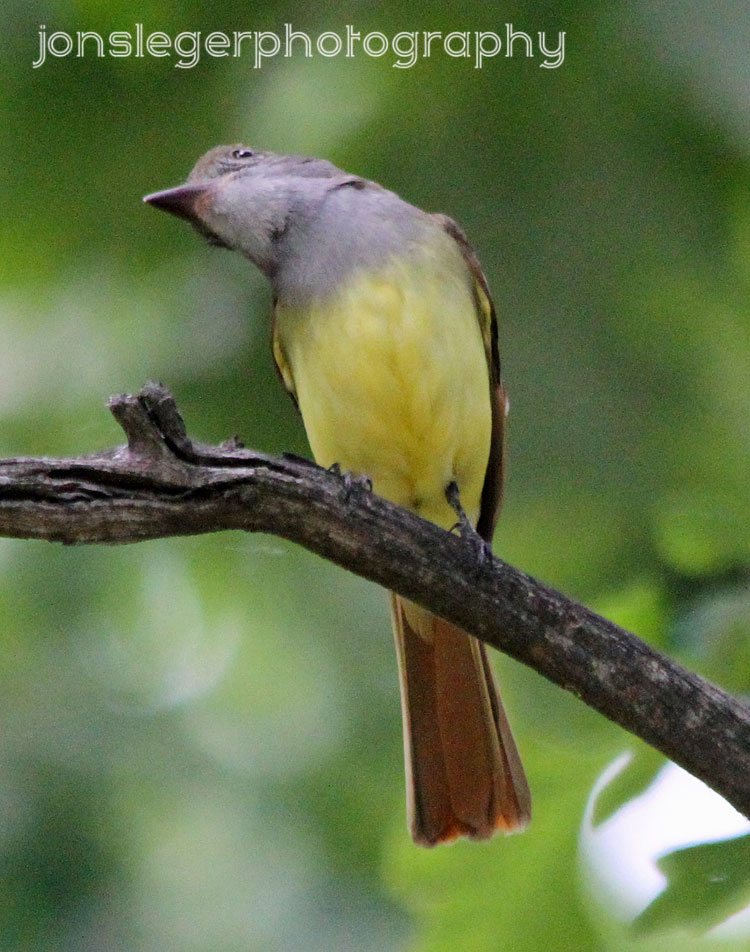
Great Crested Flycatchers (Above) is the largest of the Tyrant Flycatchers found in the Eastern half of the U.S., and is commonly found in mature deciduous trees. Its range stretches from the Atlantic Coast westward to the Great Plains of Nebraska, Kansas, Oklahoma, East Texas, and the Dakotas. They can also be found in the Southern edges of Canada. For Winter, they will travel to Mexico and Central America.
Great Crested Flycatcher, Rock Cut State Park, IL; 6-13-12.
I followed the movements of this particular Great Crested (Above) for quite some time, as it would fly back and forth between 2-3 large Oak trees and then suddenly make a dive bomb to the ground (Below) going after some insects, and then return to its perch in one of the Oaks.
Great-crested Flycatcher, Rock Cut State Park, IL; 6-13-12.
Its combination of colors makes it one of our prettier Flycatchers with its olive back and crown, gray throat and breast, bright yellow belly, and rufous tail and wing edges.

Sunday, June 17, 2012

"Free Beer!" Alder Flycatcher - another Mid May Arrival to Northern Illinois.

"FREE BEER!"
An Alder Flycatcher, Horicon Marsh NWR, WI; 5/13/2012.
Free Beer!? Where is this "free beer?" Well, it was in the small grove of trees next to the water by the floating boardwalk on the northern boundary of the Horicon Marsh National Wildlife Refuge. Now that I gave away the spot, please do not go foraging in this south central region of Wisconsin in the hopes you'll find some of this beverage that Wisconsin is well-known for brewing. The "free beer" that I am talking about is the song that the Alder Flycatcher (Above)  calls out. It sounds like someone yelling "free beer." So when I was walking on the short trail through this stand of trees and heard all the "free beer" calls, I was happy, not because I like beer, but because, first of all, I recognized it being the Alder Flycatcher (from my bird song recordings), and then secondly, it was a Lifer for me (# 394 at the time. I finally broke 400 last weekend).
Another Alder Flycatcher, Horicon Marsh NWR, WI; 5/13/2012.
These Flycatchers were all over this grove of trees - but mostly in the top branches. It still took some patient waiting before a few of them showed themselves at a lower level so I could get some decent photos (Above).  These Alder Flycatchers might be staying here for the summer as Horicon Marsh is at its most southern edge of its summer range. More than likely, they were passing through to their more common summer residences in North Central Wisconsin and further north into Canada, stretching East into Michigan and the Northeastern States. In Canada they can be found from coast to coast.

Saturday, June 16, 2012

Eastern Wood Pewee - Flycatchers Part 2

So continuing yesterday's theme of Eastern Flycatchers (Kingbirds and Phoebes), the Eastern Wood Pewee (Below) is usually present in Northern Illinois by mid May.
An Eastern Wood Pewee singing its familiar two-note refrain, Morton Arboretum, Chicago, IL; 5/27/2012.
If you have ever taken a walk in the woods anywhere east of the Great Plains, there is no doubt that you have heard the two-note whistle, that almost sounds like someone who would be whistling at a pretty girl - a long uprising note, then a beat later followed by a sliding descending note. I have always hear these guys singing, but it took me a long time to finally catch up with the originator of this song - The Eastern Wood Pewee (Above). It seemed like I could never locate this little flycatcher (6 1/4" long). It was always up high in tall trees hidden by the foliage.
Another Eastern Wood Pewee, Rock Cut State Park; 5/12/2012.
The first time I was able to definitively identify this guy was when one landed on a branch just a few feet in front of me, sing its two-note song then fly off.  Subsequently I have had more luck at finding these flycatchers for better photo ops (Above).

Friday, June 15, 2012

Fklycatcher Weekend! Eastern Kingbirds & Phoebes

An Eastern Kingbird reflecting the rising sun light, Rock Cut State Park, Rockford, IL; 5/20/2012.
Eastern Kingbirds (Above) were one of the first of several Flycatchers to arrive back to Northern Illinois. They were present everywhere by the first week of May. As far as my records (unofficial) show the only Flycatcher that arrives before May is the Eastern Phoebe (Two photos Below), which I see even by the end of March.
Eastern Phoebe, Rock Cut State Park; 6/13/2012.

A smaller Eastern Phoebe, Rock Cut State Park; 4/23/2011.
Both the Phoebe (Above) and the Kingbird (Below) are summer residents of Northern Illinois, and stretch their summer range into Canada as far west as Alberta for the Phoebe, and British Columbia for the Kingbird. So thier "Eastern" moniker doesn't mean they can only be found in the east. The Phoebe will migrate to the southeastern corner of the U.S. especially around the Gulf States and mexico. Whereas, the Kingbird will migrate further south into Central and South America.
Another Eastern Kingbird, Rock Cut State Park, Rockford, IL; 5/5/2012.
At 8 1/2" long, E. Kingbirds are also one of the larger Flycatchers that make their residence in the Eastern half of the U.S. There are plenty of larger Flycatchers, but most of them reside in the Western half of the U.S.
Another Eastern Kingbird, Rock Cut State Park, Rockford, IL; 5/20/2012.
These Flycatchers are relatively easy to spot. They like to sit on open branches always searching for insects. I find them most often on tree branches or bushes that overhang a river or lake. They fly out catching insects and frequently return to their same perch. I have also seen them out in open grassy fields that have a few trees to use for their perches. Other than their larger size, they are also easier to identify than the other smaller Eastern flycatchers by the white tail tips and weak wing bars.
An Eastern Phoebe, Rock Cut State Park; 7/21/2010.
Eastern Phoebes (Above), at 7" long, are smaller than its Kingbird cousin, and are more often found in the woods, but also I have seen them very routinely along a boardwalk over a cattail marsh, on the eastern edge of Pierce Lake, near the edge of woodland.