Showing posts with label N. Illinois. Show all posts

Friday, July 20, 2012

Cabbage White Butterflies & Common Whitetail Dragonflies

Butterflies & Dragonflies too...
When I started this Blog a little over two years ago, it was to share my love, interests, and photos of birds. Writing this blog has taught me a great deal about birds and has been very rewarding to me. However, this summer I decided to try my hand at taking butterfly photos. Of course, one thing leads to another and another...... and another...

Here is the list of the "anothers":
a.) Taking their pictures was not enough. I wanted to know what kind of butterflies that I was taking pictures of, so ...
b.) I had to purchase myself a field guide for butterflies. After perusing several different books, I settled on the KAUFMAN FIELD GUIDE TO BUTTERFLIES OF NORTH AMERICA.
c.) Then after going out and looking for butterflies, I became fascinated with another flying creature - Dragonflies...so...
d. I started taking pictures of Dragonflies... then...
e.) I had to know what kind of Dragonflies I was taking a pictures of.
f.) So far I have been relying on the Internet for information and identifications, but I see a Dragonfly Field Guide in my personal library in the future... then...
g.) I noticed that there were dragonfly-like insects which were a bit different. Whaddya know? There are such things as Damselflies, which, of course I've heard of before, but never really took it upon myself to know what they really were. And now I know that they are related to Dragonflies (both in the Odanta order) and also have differences. So of course ...
h.) I had to start taking pictures of Damselflies and identifying them as well. I also have yet to look for a Damselfly Field Guide, but I suspect they would be included in a book about Dragonflies... then...
i.) Finally, I couldn't just represent my blog as purely a blog about birds. But I didn't want to change the name of the blog or its address, nor start a new one. So I just changed the heading so it included other wildlife of which I might decide to take pictures. I hope you like it. Thanks to my gal Val (my built-in IT Help Desk) for teaching me new and improved Photoshop techniques for me to create the new header look.

Well, enough of the "anothers" and take a look at my first attempts at butterfly and dragonfly photography and identification:

CABBAGE WHITE BUTTERFLIES
A Cabbage White butterfly (a male with one spot on each wing), Espenscheid Forest Preserve, Rockford, IL; 6/12/2012.
Very common butterflies throughout the entire country are the Cabbage White butterflies which were swarming all over the place in early June, and will be seen for most of the summer.  I didn't have much of a problem getting a few good pics (Above and Below)...
Another Cabbage White (female with two spots on each wing), a couple of weeks later also in Espenscheid Forest Preserve; 6/26/2012.

A male Cabbage White with wings open, Espenscheid FP; 6/12/2012. Exp 1/1250; ISO 500.
Cabbage Whites usually land with its wings closed. When they did open them it was for just a split second. My challenge was to try to get a sharp focus on one during the split second it had its wings opened (Above: still a bit soft in its sharpness - but so far my best).  I also found that in the bright sunlight, as good as these little guys looked in my viewfinder, their very white color were like mini-fireballs in my pictures. So I had to dial up my shutter speed quite a bit.

A female Cabbage White, yellow variation, Deer Run Forest Preserve, Cherry Valley, IL; 7/1/2012.
I initially mistook the Cabbage White (Above) for a Sulphur Butterfly (a species good for a later post), but it turns out that some Cabbage Whites have a some yellowish variations. Also I labelled it as a female, since females have two spots on each wing. You can see the spots through its opaque wings.

COMMON WHITETAIL DRAGONFLY
A male Common Whitetail Dragonfly, Black Hawk Springs Forest Preserve, Rockford, IL; 6/23/2012. 
Common Whitetails were the first Dragonflies that caught my attention, therefore became the subject of my frst photographs. The males (Above) have large brown spots in the middle of their clear wings. They also have a light blue abdomen with tiny white spots on the sides called cusps. Their head and thorax are brown.
A female Common Whitetail, Black Hawk Springs FP; 6/23/2012.
Initially when I started taking pictures of Dragonflies, I assummed each different looking one was a different type. But it didn't take me long to realize that, like birds, males and females have different markings and colorings. The female Common Whitetail (Above) has a brown abdomen with yellow cusps, while its wings are also clear, but instead of the one large brown patch in the middle of its wings, they score three brown patches on each wing - one closest to its thorax, one in the middle, and one at the tip.
An immature male Common Whitetail, Black Hawk Springs FP; 6/23/2012.
The dragonfly (Above) looked like a cross between a male and female - sporting the female's abdomen and the male's wings. Upon research I learned that this is an immature male dragonfly. Then of course, I had to question - just how long does a Dragonfly live? If it only lived to a couple of weeks like butterflies, then how long would a dragonfly be an immature? a couple of hours? Through some more research, I found out that dragonflies may live (depending upon its species) as adults anywhere from a couple of months to about a half a year. Of the many species, the shortest life cycle (from egg to death) is about six months.  There are even dragonflies that live for several years as aquatic larvae before they emerge and live for a few months as adults. Most dragonflies don't die of old age but are caught by predators. Even if they do survive, they still don't live much longer than a few months.

Well, I hope you enjoyed my first venture into the world of Butteflies and Dragonflies. There will be more to come - as well as more about birds. I can't forget about the birds.

Sunday, July 15, 2012

Black Terns nesting in Glacial Park, IL & Horicon Marsh NWR, WI

BLACK TERNS
A Black Tern hovering over part of Horicon Marsh National Wildlife Refuge, WI; 6/16/2012.
About a month ago I was able to see my first Black Terns (#397 on my Life List), which were at Glacial Park, near Richmond, IL. However, they were so far out over the marsh that the best photo I could muster (Below) was pretty poor quality. So it goes without saying that a week later when I encountered a pair of Black Terns at Horicon Marsh, excited me for the chance to see them in action at more of a close range and to get a better photograph (Above) of this  beautiful species.
The best photograph I could come up with for the first Black Tern on my Life List, Glacial Park, Richmond, IL; 6/10/2012.
I was actually trying to locate some Marsh Wrens chattering away in the cattails and trying to get a Yellow-headed Blackbird in flight (would that be a YHBBIF?), when a Black tern flew over my head and I followed its flight to over the marsh. They are pretty easy to pick out, as their heads, belly, and breat are completeyl black, whereas most terns are primarily white. It flew pretty far out, but was still a lot closer than the Glacial Park Black Terns. Then I noticed at least two of these Terns hovering over the marsh.
A Black Tern fishing for a meal in the light rain, Horicon Marsh NWR, WI; 6/16/2012.
The two Terns put on quite a display, and even though it had started to rain, I was able to follow some of their flight and snap a couple of photos (Above).
I noticed that one of the Terns landed in the reeds and I lost its trail, but the other kept circling, hovering, and hunting nearby.  It also confronted a couple of Blackbirds (Red-winged and Yellow-headed) as if warning them not too get too close. I hoped that meant there was a nest somewhere. Only when the second Tern also landed did I notice the first Tern sitting on a muddy clump of reeds at the far end of the marsh (Below).
As I was following the flight of the Black Tern in the upper right center part of this photo, there was also another Black tern sitting on a nest in the lower left-center part of the photo, Horicon Marsh NWR, WI; 6/16/2012.
There are two Black terns in the photo (Above). Can you spot them both? (Below) is a close up the nesting Tern from the photograph (Above).

A close up of the Black Tern sitting on its nest, Horicon Marsh NWR, WI; 6/16/2012.
Having never seen a Black Tern before this summer, then seeing them twice within one week was exciting for me, as it is anytime I see a new bird. You birders who are able to identify a bird for the forst time know the feeling I am talking about.
A Black Tern, Horicon Marsh NWR, WI; 6/16/2012.
In the summer months, Black Terns are found across the northern states of the country, from Oregon and Washington in the West to the Great Lakes States in the Mid-section and the East, and spread throughout much of Canada. There are small pockets in California, Nevada, Colorado, and Kansas, where they can also be found. They typically will start their migration already in late July to their winter grounds in and around the northern coasts of South America.

Saturday, July 14, 2012

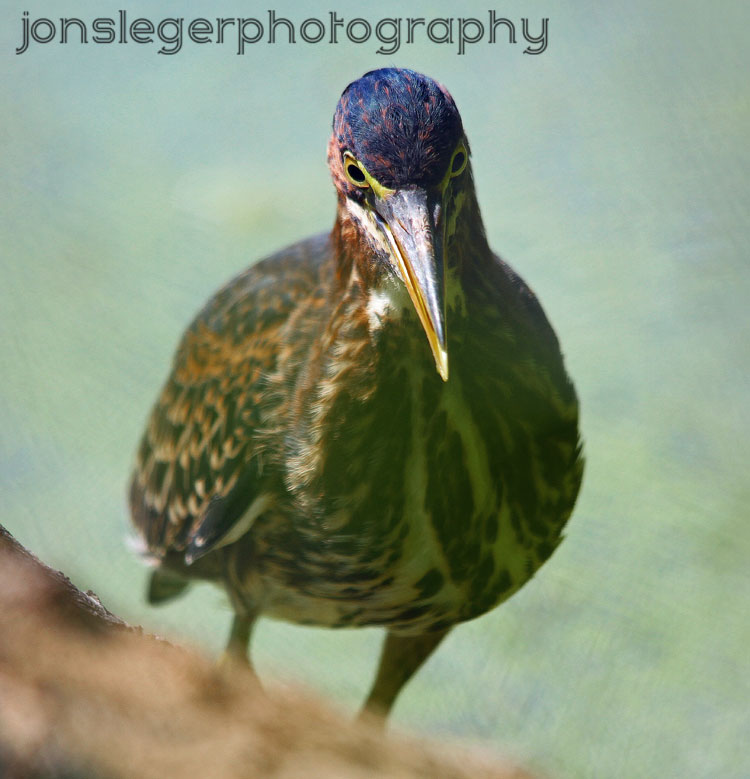
Green Heron, juvenile, Rock Cut State Park

Juvenile Green Heron, Rock Cut State Park, IL; 7/6/2012.
I spent three hours in the 100 degree heat looking for wildlife a week ago. As I was scanning a shallow lagoon at the southeastern end of Pierce Lake in Rock Cut State Park for water birds, a caught glimpse of a shadow of a bird against the algae-covered water at my feet. I realized that this bird was out of my sight, sitting on a low branch behind a larger tree trunk that was stretched out over the water's surface.  Since there was nothing too interesting on the water (Mallards, Canadas, & Coots), I waited patiently to see if this bird would pop out from behind the tree trunk.  And sure enough, it wasn't long and there he was (Above), peaking over the trunk - a Green Heron. It seemed rather small for the Green Herons I've seen, and by the streaks on its neck, I guessed it was a juvenile. It didn't have the dark reddish neck of an adult.
Juvenile Green Heron, Rock Cut State Park, IL; 7/6/2012.
This juvie Green Heron took turns hopping back and forth on the branches that extended from both sides of the tree trunk.  It's too bad that the branches on the side closest to me were in the shadows (Above), while the branches hidden by the tree trunk were in a nice photographical sunlight.
Trying out its ability to hunt,Juvenile Green heron, Rock Cut State Park, IL; 7/6/2012.
Periodically, this young Heron would test its hunting skills (Above).  I snapped a lot of pictures, and there is no way he didn't know I was there.  I was only a matter of ten feet away, and was not hidden. I even had to retreat my zoom lens (Sigma 150-500mm) to its lowest telephoto power to get a full body pic of the guy. I was still surprised how close I was and it did not fly away. Even after a couple of noisy hikers walked by, it still did not make attampt to flee. It just rehid behind the downed tree trunk, and soon reappeared after a minute (Below).

A juvenile Green Heron pretending I was not ten feet away, Rock Cut State Park, 7/6/2012.
A juvenile Kingfisher (yesterday's post) and a juvenile Green Heron were highlights of my Rock Cut hike on a 103 degree day.


Friday, July 13, 2012

Belted Kingfishers, Rock Cut State Park, IL

The Adult belted Kingfisher instructing its young, Rock Cut State Park, IL; 7/6/2012.
A week ago I spent a hot (over 100 degrees) few hours at Rock Cut State Park to see what was shaking and what kind of wildlife would be out and about in such steamy weather. I saw over 40 different species of birds, but the one I enjoyed the most was a family of Belted Kingfishers. As I hiked around Pierce Lake, I seemed to always be a couple beats late with catching a Belted Kingfisher in a position to get a picture. Most often these birds are off and chattering away before I even know they are nearby.  This hike was no exception - in the beginning. But I noticed that one particular B-KF stayed on its perch longer than usual, and when it flew off it didn't go very far. I soon realized that it was a young, probably freshly fledged, Kingfisher (Below).
A juvenile Belted Kingfisher out and about, Rock Cut State Park, IL; 7/6/2012.
This young Kingfisher literally flew completely around the lake following the shoreline, flying perhaps 50-100 feet at a time. In the past as I would approach an adult Belted-KF, it usually flew a good distance (sometimes completely across Pierce Lake, which is a good sized lake.) before I would catch up with it again.
An adult male belted Kingfisher, Rock Cut State Park, IL; 7/6/2012.
This adult male Kingfisher (Above) was not too far away from the juvenile. Sometimes the juvenile would let me get too close for its parent's comfort and I would hear the chatter of the distant adult, and only then would the juvenile take off.

An adult female Belted Kingfisher (L) pokes its head into my picture and appears to be  teaching  the juvenile (R) some important information, Rock Cut State Park, IL; 7/6/2012.
I was almost completely around the Lake, running into the juvenile at least in a dozen points, but never quite fast enough to get a decent picture, nor when I did get close was it in a clear position. I did notice that the adult Kingfishers tend to perch on branches fairly high up in trees, but the juvenile that I was following stayed on low branches, usually just a few feet above the water. I was about 80% around the lake, when I was approaching the little marshy pond on the northeast end the lake, I deliberately slowed down and tried to be stealthy because it is an area that the Kingfishers like to hunt. There were dense head-high bushes between me and the pond, when I heard the familiar clattering of a Kingfisher. In the corner of my eye, I saw the quick flight of a Kingfisher swoop down on the other side of the bushes. I slowly inched my way peering through the few open spaces in the branches until I saw the juvenile with its back to me. There were still branches separating us, and I used these to act as a blind, but I still couldn't get a full body photo without some leaves or branches partly obstructing the view (Photo at Top of page). As I was taking some photos, suddenly an adult female entered into my viewfinder (Above). I have never been this close to an adult Belted Kingfisher before and I tried to get as many photos as I could, knowing how skittish they are and off with the slightest movement.

Blurry green leaves in the foreground keep this from being a great photo of an adult female Belted Kingfisher, Rock Cut State Park, IL; 7/6/2012.
To my pleasant surprise, it didn't fly away as I kept snapping photos. There were still leaves partly obstructing my view (Above). The thin blind of leaves and branches were working well, but I still wished I could get a clearer photo free of obstructions. I knew if I shifted into a position in which I would have had a clearer shot, they would fly away. So I made sure I took enough photos before I tried to get a better vantage point. And sure enough, as soon as I moved to a more open look, they were both gone like a flash.

I had a lot of fun stalking these Kingfishers for the better part of three hours on a 4 1/2 mile hike around the perimeter of Pierce Lake.

Monday, July 9, 2012

Downy Woodpecker feeding its brood, Sugar River Forest Preserve

A DOWNY WOODPECKER FAMILY AT WORK

A male Downy Woodpecker feeding a young Downy, Sugar River Forest Preserve; 6/2/2012.
My first trip to Sugar River Forest Preserve rewarded me with an interesting interaction between an adult Downy Woodpecker feeding their young (Above) which were taking turns peeking their heads out of the excavated hole in a tree trunk. I was first attracted to their nest when I heard the constant rattling of the woodpecker nearby.  But it seemed different than when I usually hear Downys. This time the the Woodpecker sound was a constant, unceasing call that seemd a bit higher pitch. So when I looked up I saw a young male Downy peeking its head out of the trunk hole (Below) while the adult was nearby in the tree next to it.  The little guy didn't stop chattering until its parent showed up to give it something to eat.
A young male Downy peeking out of his nest waiting for a meal to show up, Sugar River Forest Preserve; 6/2/2012.

The  male Adult Downy gives the young male Downy a stern look, Sugar River Forest Preserve; 6/2/2012.
Then the father showed up (Above) and silenced the youngun. After it flew away, the chattering started again. I looked up, but this time it was a different young Downy. This one didn't have the red patch on its crown, so I knew it was a young female (Below)...

A young female Downy peeking its head out of her nest waiting for some attention, Sugar River Forest Preserve; 6/2/2012.

The female Adult shows up to deal with her young Downy, Sugar River Forest Preserve; 6/2/2012.
... then the female adult also shows up.

A different male Downy baby? Sugar River Forest Preserve; 6/2/2012.
After a bit, the young male popped his head out again, but upon analyzing it, I believed it was a third juvenal, because its bill looked bent, whereas the other male juvie had a straight bill.  It was cool to see an entire family of Downy Woodpeckers, both adults and probably three of their babies.  I found out from a very good website (Link Below) that most Downy broods will be between 3 -8 eggs, and the youngest (latest to hatch) frequently die.  Also both the male and female take turns caring for the young while they are being fledged.

Saturday, July 7, 2012

Duck Families - Mallards & Woods

Mother Mallard looking after her 3 ducklings, Rock Cut State Park; 6/15/2012.
As with Canada Geese (yesterday's post), by mid June to mid July, Mallard Duck families (Above) are easy to run across almost anywhere in the northern half of North America. Generally, Mallards will lay anywhere from a half dozen to a dozen eggs in one clutch taking about one month to incubate. Then another 7-8 weeks for the ducklings to be fully fledged. The large quantity of young in a clutch makes the Mallard Duck the most widely spread Duck in North America (perhaps the world?), so I was surprised last year while I was watching a Mallard with only one duckling following it around (Below). I waited for more to appear, but no more did. It goes to reason that the rest of her clutch was lost by a predator, parasites, or perhaps didn't hatch.
Mallard and single baby, Rock Cut State Park, IL; 5/22/2011.

Manky Mallard (cross with a domestic duck?) mother giving instructions to her brood, Rock Cut SP; 7/21/2010.
At first glance, you wouldn't suspect that the family of ducks (Above) were Mallards. The Mother (on the right) is likely a mix of a Mallard with a domestic species (the dark bill and white breast looked like perhaps a mix with a Northern Pintail? but more likely with a domestic duck).  Mallards have been notoriously known for their promiscuous behavior with their mating habits. They have been known to breed with several other species - wild and domestic.  When Mallards breed with a domestic duck they have been called "Manky Mallards" (coined by Charlie Moores at http://10000birds.com/manky-mallards-domestic-feral-or-just-plain-odd-mallards.htm ). This particular Manky mother has a brood of eight "Manklets" (I coined that one). In the photo (Above) you can see that six of them have the same markings as their mother, and in the photo (Below), you can see that only two of them have the more traditional Mallard Duckling look.
Falling in line under the watchful eye of the Sgt. Manky Mallard, Rock Cut SP; 7/21/2010.
In my short Birding life (2-3 years?) I have been trying to photograph as many Manky Mallards as I come across them. perhaps someday I will do a post featuring all these Mankies.

A Wood Duck family at the Nygren Wetlands, Rockton, IL; 6/2/2012.
Another duck speces, that is less common or promiscuous than the Mallard, is the Wood Duck. I have had the lucky oppurtunity to winess at least two Wood Duck families this Spring. The family of six ducklings (Above) were at quite a distance at Nygren Wetlands. (Below) I was was able to catch a baby Woodie running acoss the mudflat to catch up with the rest of the family. Again I was quite far away, and the ISO on my camera was not working properly that day, so all my photos in this outing were blown out and contrasty.
A blurry fuzzball of a Wood Duckling scurrying to catch up with rest of the brood, Nygren Wetlands, Rockton, IL; 6/2/2012.
Another distance shot of a different Wood Duck family, Horicon Marsh NWR, WI; 6/16/2012.
The second Wood Duck family (Above) I saw this Spring was at Horicon Marsh National Wildlife Refuge in Wisconsin.  Even though I was quite far across the pond from them, it didn't take Mother Woodie long to coax her brood of three into the cattail reeds out of sight. Because Wood Ducks are less common than Mallards, it is always a treat to spot one.

Friday, July 6, 2012

Canada Geese Families

CANADA GEESE FAMILIES

A Mother Canada Goose and her goslings, Horicon Marsh National Wildlife Refuge, WI, 5/29/2010.
One of the more common sights in late Spring are the newly formed Canada Goose families that spring up wherever there might be water for the little goslings to learn how to swim and eat.
Morning Sunlit Goslings, Rock Cut State Park, Rockford, IL; 5/18/2008.
When they are just a few days old, the young goslings will not be found very far from their mother.

A Family of 20+, Seney Wildlife Refuge, Michigan; 5/27/2007. Photo crdit: Valarie Wittman.
Canada Geese are known for their large broods (commonly 3-8 eggs, but often times more), such as the 20 Goslings belong to this pair (Above). It is also possible that this could be two mothers travelling together, each with 10 little goslings, forming a creche (a Goose Day Care Center).

Goslings, just a few days old, Horicon Marsh NWR; 5/13/2012.
Little yellow fuzzballs (Above) turn into more gangly, less cute, preteen geese (Below)...

An equivelent to a pre-teen, Canada Goose youngster, Espenscheid FP; 6/12/2012.
In a matter of about 6 weeks, this pre-teen (Above), will look very much like an adult, and if you didn't see them still clinging close to their mother, you would assume they were adults.

Monday, July 2, 2012

June is Baby Bird Month


BABY BIRD PHOTO ALBUM

If May was the nest-building month, then it goes to reason that by mid June we would see young birds testing their wings, learning how to find food and water, and how to act like the species it belongs to. Mid to late June and early July are definitely Baby Bird Months.

A Young House Wren out of the nest for the first time, Crystal Cove State Park, CA; 6/14/2011.
During a walk through Crystal Cove State Park (CA), a year ago, I was able to capture young twin House Wrens (One Above and One Below Top) out of the nest for the first time, while their Mom hovered close by (Below Bottom).
The twin of the House Wren Above, Crystal Cove State Park, CA; 6/14/2011.

Keeping a watchful eye, is the Mother House Wren of the two younguns above,Crystal Cove State Park, CA; 6/14/2011.
Young Triplet Black-capped Chickadees learning where to find water, Rockford, IL; 7/5/2011.
I witnessed three young Black-capped Chickadee chicks learning the ropes of becoming a Chickadee for a few days stretching form late June to early July last year. I watched their mother bring them one at a time to the bird bath in our yard. I was hoping to get all three at the bird bath at one time. It didn't happen for several days. Whenever I spotted them out and about, the three youngsters were never very far from eachother - learning their acrobatics in the tree branches, how to find seeds, berries and insects.  I guess they gave each other confidence and learned from each other what to do and what not to do. Late one morning as I was working on a project and looking out the window, I noticed that all three were foraging around the yard and hopping up and down off the bird bath. I waited patiently for the right moment, and when it came, I was ready. All three of them hopped onto the bird bath at the same time and were taking turns drinking. I was able to snap the photo (Above) before thay all went exploring in different directions.

A young American Robin on its first legs out of the nest, Rockford, IL; 6/15/2007.
Several years ago, another youngster that showed up in our yard was an American Robin (Above), looking very timid and unsure. It was easy to spot as newly fledged as it still had baby hair sticking out the top of its head, lots of dark spots on its breast, and the soft looking downward curved bill that seems common in newly out-of-the-nest birdlings. It didn't show a lot of confidence flying, as it repeatedly hopped up and down off a foot high rock in our front yard. It didn't seem to want to test any perches at a higher distance. I walked out of the house to test its fleeing ability. At first it looked at me not sure what to do and let me get pretty close before it decided I was not a safe bet. Then suddenly it was able to find its wings and took off and flew across the yard a good 50' or more before it landed. It passed the test with flying colors.
A Young Mourning Dove seemed hopelessly lost, Tower Hill State Park, WI; 6/30/2011.
Not all young birds have been fully fledged, as it seemed in the case of a very young Mourning Dove (Above) which was sitting in the middle of a trail at Tower Hill State Park in Wisconsin. Val and I were hiking and she asked me if I saw the bird on the trail and wondered what kind it was. When I located it, it was hiding in the long grass just off the trail. As I approached, it didn't fly away and generally didn't seem to know what to do. It either left the nest too early and couldn't fly, or it was too frightened to fly. I would guess the former because it didn't even try to flex its wings. It kept its wings tight against its flanks.
By the look of its scrawny neck, it just didn't seem old enough to be out of the nest yet.
The trail we were hiking was next to a rather tall cliff that had some historical buildings at the top.  I figured that the Mourning Dove nest was somewhere at the top perhaps even built on one of the old buildings, and that it had fallen out of the nest prematurely and made its way to the bottom of the cliff where it had to fend for itself.  I also figured that if it didn't learn to fly soon, it would end up being a tasty meal for a fox or some other predator.
This Owlet (Species unknown - perhaps Great Horned) was definitely too young to be out of its nest, Rockford, IL; 4/21/2006.
Another unlucky baby bird we found on one of our walks was an Owlet (Above). One April evening at dusk, Val and  were taking a walk around the mile long block in our beighborhood, when we heard a strange scratchy vocal sound. The sound was very near and I was sure that it sounded like an owl, but a not an adult. On the farm I grew up on, I heard this sound often and it was attributed to baby owls that nested near and around our farm buildings.  As we peered through the evening light (as it was very near to darkness) to find the source of the sound. We located it at our feet. Sure enough, there on the ground next to our neighbor's mailbox post sat a little white bundle of fur. Like the young Mourning Dove, it didn't try to get away. It obviously couldn't fly as it had few feathers to speak of. It sat there looking at us. Val left to get our cameras. While I stayed with the owlet. We took a few flash photos. Then in the large evergreen tree in the yard behind where the Owlet sat, we heard some fluttering movements and some soft grunting noises that sounded like they could have been made by a Great Horned Owl. The movements were very frantic and it seemd clear that the mother of this infant was looking for her youngun. I wanted to take it home to try to help it, but thought it best to leave it be and hope the mother was able to protect it or get it back to its nest.  The next mourning I walked out to the spot where it had been sitting and there was no sign of it. One positive clue was that there were no pile of feathers where a predator might have gotten to it before the mother coul help it. I have seen a coyote once in our neighborhood and knew they were around. I tried to look at the evergreen to spot a nest, but I couldn't detect one, nor could I hear or see any evidence of a Great Horned Owl.

In the next few posts I will feature more photos of the newly formed families of the bird world: ducks, geese, swallows, and woodpeckers.

Sunday, July 1, 2012

Killdeer Nests or Non-nests, such as they are.

"NEST? WHAT NEST?"

Killdeer eggs lying on the ground next to the driveway of my Sister and Brother-in-Law in Paris, Texas; 6/22/2011.
The past couple of posts this weekend have dealt with nesting habits of some birds: Friday - "The Nestbuilders" and Saturday - "birds that use man-made structures." Then there is the famous Killdeer which won't build any nest at all, nor will it use human constructed structures  Instead it lays its eggs on the bare ground, usually in an open grassy or gravelly area which has an environment where the eggs will be almost invisible, surrounded by pebbles, cinders, gravel, twigs, etc. It finds a small depression in the ground or might even scrape a very shallow hollow. Their eggs (Above) have a lot of brownish blotches and spots on a buffy background, perfect for blending in with its background. Killdeers will lay their eggs in such places as on the edges of parking lots, on the sides of roads or driveways ( as in the case Above), and on grassy pebbly beaches. When I visited my Sister and her husband in Texas last summer, Dan, my Brother-in-Law, told me that a pair of Killdeers layed eggs on the gravel of his driveway. He said he had to put a small log next to the nest (I mean eggs) so they wouldn't accidently run over them with their vehicles. As visible as the eggs are in the photo (Above), it took me quite a while to find them, even after Dan gave me a detailed description of where I would find them. They were hidden very well in broad daylight. 
A Killdeer feigning its broken wing routine, Olsen Lake, Rock Cut State Park; 5/5/2012.
The same Killdeer pretending to be prey,  Olsen Lake, Rock Cut State Park; 5/5/2012.
This Spring, while scanning Olsen Lake for water birds, there was quite a commotion inside the fence that bordered the beach. Two Killdeers were screaming their very loud and familiar and incessant "kill-deer - kill-deer - kill-deer..." call. One of the pair would fly away, then come back hop around the ground, fly away again, and repeat this several times. The other Killdeer put on its "broken-wing" display (Above). I knew then there was a nest (umm ...I mean eggs) on the ground somewhere on the other side of the fence. When a Killdeer feels that danger (me in this case) has approached too close to their eggs, it will put on a display in which it pretends it has a broken wing; therefore, offerring itself up as prey to the encroaching enemy. The idea is that predators will tend to go after the weakest link of a herd. So if I was the predator, I would then follow the "injured" Killdeer, beacuse it will be an easy prey, whose aim is to protect the eggs by leading me away from where the eggs lie. Of course, I hadn't any intention to follow the Killdeer and I certainly was not about to climb or leap over the chest high fence to get to them. This confused the Killdeer, and it would switch from its "broken-wing display" to running normal, then going back to its "act." It did this several times before it decided I was not  danger. I likewise decided I had better leave before it exhausted itself.

Below is a link to a video I found on youtube that does a good job showing how well the eggs and the bird are camouflaged by the surroundings and a nice example of the "broken-wing display" behavior.