Friday, January 18, 2013


Winter Wading Birds of Florida; White Ibis
White Ibis, Oasis Visitors Center, Big Cypress National Preserve, FL; 12/30/2012.
While on my five-day-long visit to Southern Florida, the week between Christmas and New Year's, I was fortunate to see 15 of the 18 Floridian wading birds featured in Sibley's Field Guide to Birds of Eastern North America. The three birds I did not observe were: Reddish Egret and both Bitterns (Least and American). Other wading birds found in the Field Guide, but are not found in Florida are White-faced Ibis, Flamingo, Scarlet Ibis, and the Little Egret (it is not surprising that I did not see any of these as well). The latter three are rare visitors from outside the country.
Of all the wading birds present in Florida, the White Ibis (Above and Below) seemed to be the most common and visible. I saw them in every spot I visited.

More White Ibis, Ding Darling National Wildlife Preserve, Sanibel island,FL; 12/30/2012.

My Florida Wading Bird sighting List:
12/26
Lovers Key State Park: White Ibis, Great Blue Herons, Great Egrets, Little Blue Herons, Roseate Spoonbills (Flyover)
Big Cypress Oasis Visitors Center: Cattle Egret, Glossy Ibis, Wood Stork, Tri-colored Heron, Great Blue Herons, Little Blue Herons, Great Egrets, Snowy Egrets, White Ibis
Corkscrew National Wildlife Refuge: Great Blue Herons, Great Egrets, Little Blue Herons, Yellow-crowned Night Heron, White Ibis
12/27
Key West: White Ibis, Great Egret, Great Blue Heron, Great Blue Heron (white phase)
12/28-29
Everglades National Park: Black-crowned Night Heron, Cattle Egret, White Ibis, Glossy Ibis, Great Blue Heron, Great Blue Heron (white phase), Great Egret, Green Heron, Little Blue Heron,  Roseate Spoonbills (flyovers), Snowy Egrets, Tri-colored Herons, White Ibis, Wood Stork
Big Cypress Oasis Visitors Center: Cattle Egret, Wood Stork, Tri-colored Heron, Great Blue Herons, Little Blue Herons, Great Egrets, Snowy Egrets, Roseate Spoonbills, White Ibis
12/30
Ding Darling National Wildlife Refuge & Sanibel Island: Great Blue Heron, Great Egret, Little Blue Heron, Roseate Spoonbills, Tri-colored Herons, White Ibis,  Yellow-crowned Night Herons
White Ibis, Everglades NP, FL; 12/28/2012.
 White Ibis are common in muddy pools, mudflats, and marshes. I also saw them on lawns and fields of all variety - short grass, long grass, and in plowed fields. They are almost completely white save for their black wing tips and bright orange bills and legs. The orange in the adults are closer to a red-orange hue, while juveniles sport a paler orange color.

A juvenile White Ibis, Ding Darling National Wildlife Refuge, FL; 12/30/2012.

When I first spotted a juvenile White Ibis (Above), I thought it was a a different species. Young White Ibis are mostly brown with white rumps and undersides. They start getting their white feathers in December - first on their back, until they molt into white adulthood by spring.
White Ibis resting on a dead branch, Everglades NP, FL; 12/29/2012.
While on a boat trip out onto Whitewater Bay in the Everglades, I saw several couples of White Ibis roosting in trees (Above and below).
A juvenile White Ibis, Everglades NP, FL; 12/29/2012.
White Ibis can be found along the coasts of all the Gulf States and Mexico, as well as up the southern Atlantic Seaboard, reaching as far north as North Carolina.

Sunday, January 6, 2013

Wood Stork; Everglades National Park


THE PREHISTORIC LOOKING WOOD STORK

A Wood Stork dwarfs over a Snowy Egret, Big Cypress National Preserve, FLA; 12/26/2012.
I spent a week in Florida (my first time in the State), between Christmas and New Years. One of my goals was to see a Wood Stork, so I particularly made a trip to Corkscrew Swamp Natural Wildlife Refuge which is known for being a regular habitat for these birds. Unfortunately no Wood Storks were to be found at Corkscrew. We also visited Lovers Key State park, which promised to have a large variety of birds - Their promise of birds was good, but no Wood Storks were included in that promise. We continued our travels toward the Keys for our next stay. While travelling, we were in the Big Cypress National Preserve (a part of the larger Everglades). We were driving on Hwy 41 which was following a long narrow canal and we stopped at what I thought was a typical rest stop, but it turns out it was the Oasis Visitor Center.  As we turned into the parking lot crossing over the canal immediately I saw several wading birds in the water. After parking, I grabbed my camera and walked over to the edge of the canal. There were several types of Egrets, Herons, and Ibises all concentrated into one area. The canal must have been teeming with fish for so many birds to be in one spot. And within seconds a Wood Stork (Above) appeared. I got my Wood Stork, but never imagined, that I would find it in a roadside canal.
In one small section of a roadside canal, within a few steps from the parking lot, there were Great Egrets, Snowy Egrets, White Ibis, Glossy Ibis, Great Blue Herons, Green Herons, Tri-colored Herons, and a Wood Stork (bottom right); Oasis Visitor Center, Big Cypress Preserve, FLA; 12/26/2012.
I was the only person taking photos on this side of the entrance driveway to the parking lot, but I noticed that there were many people congregated on a boardwalk on the other side of the parking lot. Val was already there, so I decided to check out what was so interesting.

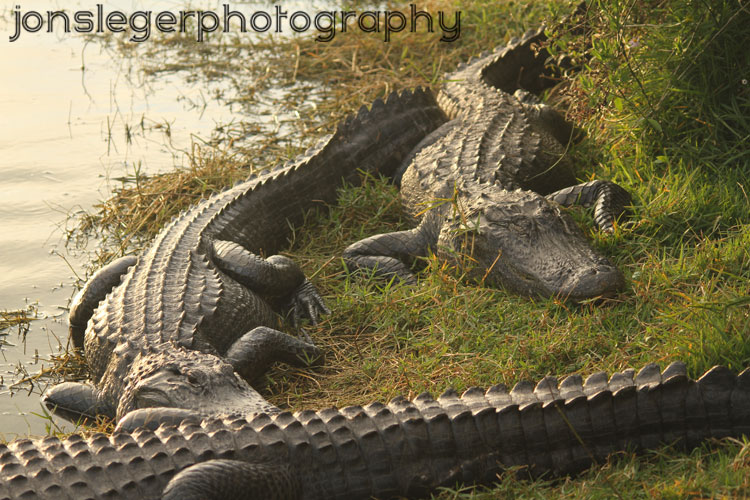
Alligators lounging on the banks of the canal, Oasis Visitor Center, Big Cypress Preserve, FLA; 12/26/2012.
It didn't take long to see what was "so interesting." There were literally dozens of alligators in the water and on the banks (Above).  It was fun watching them try to swim towards a fish in the water and give it a chomp. It was hard to tell if any succeeded as there was much splashing and the gator would disappear under the water for a few seconds. I didn't actually see any of the gators chewing or swallowing, but there were plenty of fat alligators lying on the banks, so the fishing must have been good.

A Wood Stork looking very prehistoric coming for a landing, Oasis Visitor Center, Big Cypress Preserve, FLA; 12/26/2012.
As I was watching the alligators in one side of the canal, I knew why all the wading birds were on the other side. They wanted to be the hunters, not the prey. Soon I noticed another Wood Stork appear in the sky (Above), and come in for a landing near where the other wading birds were feeding. Its bony head and gangly body reminded me of a bird that one would see in a prehistoric setting.

As we were ready to depart, a small group of  Roseate Spoonbills flew over. This area was a fantastic spot for Florida birding - at least a dozen different species of birds in less than a half hour without walking more than a few yards.

Another Wood Stork approaching a pond in the Everglades National Park; 12/28/2012.
A couple of days later while searching for Roseate Spoonbills at Eco Pond, near the Flamingo Visitors Center in  Everglades National Park, I saw another Wood Stork (Above and Below).

The same Wood Stork, Eco Pond,   Everglades National Park; 12/28/2012.
Wood Storks are more likely to be found in southern and central Florida all year round, but during migration they extend their territory to all of the Gulf Coast States and up the Atlantic Coast into South Carolina.  They can grow up to 40" and have wing span of more than 5 feet. This species was a lifer for me.

Saturday, December 1, 2012

Dungeness NWR, WA, Birds

Mt. Baker looms over the Lighthouse at the Dungeness National Wildlife Refuge, WA; 8/4/2012.
The Dugeness National Wildlife Refuge along the Strait of Juan de Fuca, just north of Sequim, Washington, is a rich habitat for wildlife, in particular of the avian persuasion. It serves as an important refuge for marine life, but also is a year round home for many birds as well as a vital stopping off point during the migration periods. A link to a website about the refuge is below...
During my short day visit in early August, I was able to spot a couple of dozen different species of birds ranging from sea and water birds to land birds and raptors.
Backlit by the morning sun, a Cedar Waxwing poses, Dungeness National Wildlife Refuge, WA; 8/4/2012.
Some of the birds I observed were:
Raptors: Bald Eagles, Osprey, Northern Harrier
Sea and Water Birds: Canada Geese, Mallards, Cinnamon Teals, Gadwalls, Pigeon Guillemots, Great Blue Herons, Western gulls, Belted Kingfisher, Glaucous-winged Gulls, Killdeers
Land Birds: Spotted Towhees, Cedar Waxwings (Above), Pileated woodpecker, Chestnut-backed Chickadees, American Robins, White-crowned Sparrow, Red-breasted Nuthatch, Common Raven, American Crow, Northern Red-shafted Flicker, Mourning Dove and a surprising Eurasian Collared Dove.
Some photos below...
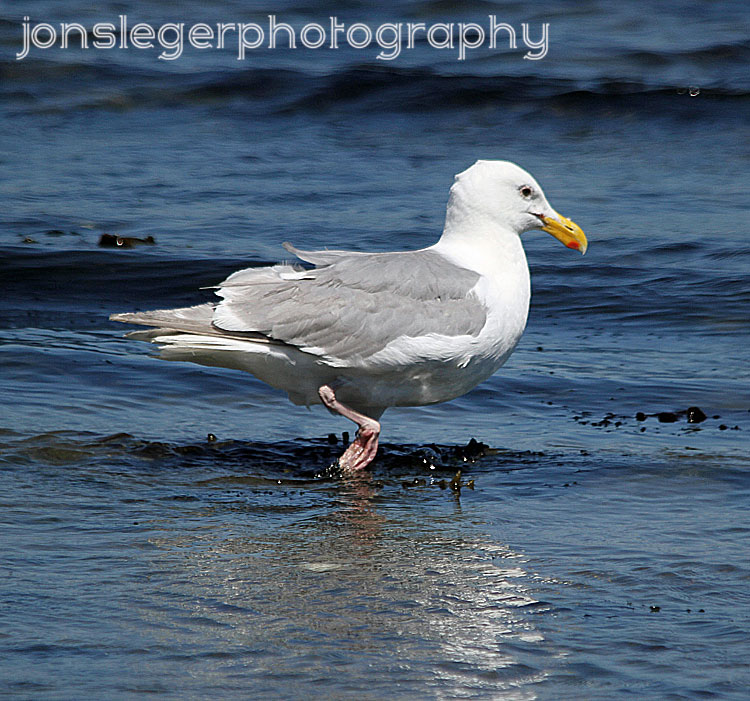
A Glaucous-winged Gull, Dungeness National Wildlife Refuge, WA; 8/4/2012.

Northern Flicker, Red-shafted variety, Dungeness National Wildlife Refuge, WA; 8/4/2012.

Osprey, Dungeness National Wildlife Refuge, WA; 8/4/2012.

Pigeon Guillemots, Dungeness National Wildlife Refuge, WA; 8/4/2012.

A young Spotted Towhee,  Dungeness National Wildlife Refuge, WA; 8/4/2012.

White-crowned Sparrow, Dungeness National Wildlife Refuge, WA; 8/4/2012.
I am sure that early August is probably a slow period for birdwatching, but I enjoyed my visit there nonetheless, and hope to make another trip during a migration month some year.

Sunday, November 25, 2012

Pigeon Guillemots, Dungeness National Wildlife Refuge, WA

A BAZAAR OF RED-FOOTED PIGEON GUILLEMOTS

The famous sand spit, the world's longest, at Dungeness National Willife Refuge, WA; 8/4/2012.
 
A Pigeon Guillemot with a meal of a crayfish, Dungeness National Wildlife Refuge, WA; 8/4/2012. 
While spotting Bald Eagles from the high ridge above the coastline of the Dungeness National Wildlife Refuge (Top), I noticed some tiny dark spots in the water just off the shore in the bay. I was too far away for my 150-500mm Sigma Lens to pick up what the spots were and I couldn't tell if they were moving or if the wave action passing over some black mud clumps made it look like they were moving. So I climbed down from the ridge and hikes along the shore until I reached the location. There was lots of mud clumps, but sure enough weaving in and out of some of the mud clumps were two Pigeon Guillemots, unmistakable with their bright red feet paddling in the water. Both were successful hunters, as they propelled themselves closer to where I was standing on the beach, I could see that one of them had a red crayfish in its bill (Above), and when the other had a either a short eel or a long fish in its bill (Below).
 
Two Pigeon Guillemots with their prized catches, Dungeness National Wildlife Refuge, WA; 8/4/2012.
Pigeon Guillemots are medium-sized seabirds with black body and large white wing patches interrupted by black bars. Their bills are black, pointed, and long, good for catching its prey. Their bright red legs and feet can be easily seen even while under the water's surface. Pigeon Guiilemots feed on crustaceans, mollusks and marine worms as evidenced by my photos.
Another Pigeon Guiilemot coming in for a landing, Dungeness National Wildlife Refuge, WA; 8/4/2012.
Word must have gone out about the good hunting, because within minutes of finding the two additional Pigeon Guillemots flew in and joined them. I was lucky to try to capture their landing maneuvers in a series of photos (Above and Below)...
The same Pigeon Guillemot bearing its red feet, ready for splash down...

... one hop and ...
 
... and splashdown, creating two small wakes, one on either side...
 
After the 3rd Guillemot landed, a 4th also appeared and came in for a landing ...
 
Ready for splash down...


... walking on water ...

... and then there were four... "Hey, where's our dinner?"
Pigeon Guillemots feed along the coasts of the Pacific Ocean, in summer stretching from Southern California to Northern Alaska, but in the Winter months concentrating their territory mostly along the Canadian British Columbia coast and across southern Alaska and throughout the Aleutian Islands.


Saturday, November 24, 2012

Bald Eagles in Dungeness National Wildlife Refuge, WA

THE AMERICAN BALD EAGLE:
THE BRAVE AND THE BALD

An adult Bald Eagle patrols its territory along the shorelines of the Strait of Juan de Fuca, Dungeness NWR, WA; 8/4/2012.
In early August I was fortunate to take a day trip to the Dungeness National Wildlife Refuge on the northern shorelines of Washington State. While there, I was able to spot our Nation's majestic Bald Eagle in various stages of growth. Within minutes of hiking up to the ridge overlooking the shore, I spotted a full grown adult (Above) flying along the beach. Unfortunately it didn't fly any closer, as it turned its course away from my vantage point.
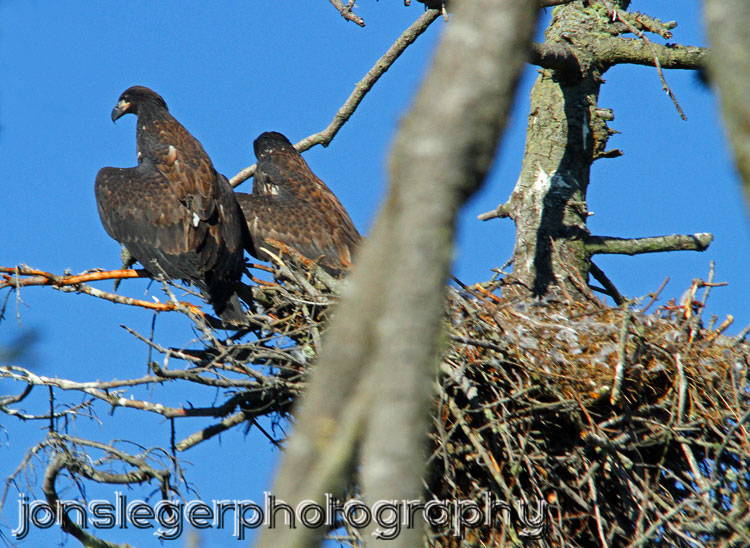
Two "baby" Bald Eagles, not yet left the nest, Dungeness NWR, WA; 8/4/2012.
Later in the day, I located a large Eagle's nest built on some dead branches in a Spruce tree overlooking Dungeness Bay. Two young eaglets (Above) were perched on some branches on the edge of the nest. It looked to me like they were old enough to fly and leave the nest, but a local birder who had been monitoring the nest said that they hatched in late June which made them about 6 weeks old at the time. The italicized information about Eagle growth below came from the American Bald Eagle Information website:

"Eaglet Growth - The young birds grow rapidly, they add one pound to their body weight every four or five days. At about two weeks, it is possible for them to hold their head up for feeding.
By three weeks they are 1 foot high and their feet and beaks are very nearly adult size.

Between four and five weeks, the birds are able to stand, at which time they can began tearing up their own food. At six weeks, the eaglets are very nearly as large as their parents.

At eight weeks, the appetites of the young birds are at their greatest. While parents hunt almost continuous to feed them, back at the nest the eaglets are beginning to stretch their wings in response to gusts of wind and may even be lifted off their feet for short periods.

At three or four weeks, the eaglet is covered in its secondary coat of gray down. In another two weeks or so, black juvenile feathers will begin to grow in. While downy feathers are excellent insulators, they are useless as air foils, and must be replaced with juvenile feathers before an eaglet can take its first flight, some 10 to 13 weeks after hatching."

Bald eagles build their nests in large trees near rivers or coasts. A typical nest is around 5 feet in diameter. Eagles often use the same nest year after year. Over the years, some nests become enormous, as much as 9 feet in diameter, weighing two tons. Even when a nest tree falls or a strong wind blows a nest down, the established pair usually rebuilds at or near the site within a few weeks if it is near the breeding season. The nest may be built in a tree, on a cliff, or even on the ground if there are no other options available.
A juvenile Bald Eagle, Dungeness NWR, WA; 8/4/2012.
There was also a juvenile Bald Eagle (Above) hanging around the same area, Juveniles will not reach sexual maturity until four to five years old, at which time they will grow in their white head and tail feathers. The adult (Below) was perched in close proximity to the nest, and was probably a parent to the two young eaglets in the nest, and perhaps even the parent of the juvenile (Above)

An adult Bald Eagle perched close to the nest, Dungeness NWR, WA; 8/4/2012.

Saturday, November 17, 2012

Gray Jay, Mt. Baker Wilderness


THE GRAY JAY - AN ALLUSIVE AVIAN

A Gray Jay begging for handouts at Picture Lake, Mt. Baker Wilderness, WA; 8/7/2012.
Of the many times I have seen Gray Jays since I've joined the birding ranks, I have never gotten a decent picture of one until finally this summer, while I was exploring in and around the beautiful Mt. Baker Wilderness in Washington State. As visible as Gray Jays are, I found it astonishing that I had no clear pictures of one - just blurry, and half hidden images. It seems that they are always visible and in good photo op positions when I don't have a camera ready. And when I do have a camera ready to take a picture, they are out of sight.

Mt. Shuskan reflected in Picture Lake, Mt. Baker Wilderness, WA; 8/7/2012.
While driving up to the end of the road leading into the Mt. Baker Wilderness, Val and I were drawn to Picture Lake which had a fantastic view of Mt. Shuskan reflected in its surface (Above).  When we reached Picture Lake and there was another party of people enjoying the view with a couple of Gray Jays squawking and begging for handouts only within a few feet of them in the open.  "Great," I thought - finally a chance to get a Gray Jay in my photo album. It only took me a minute to reach the lookout where the people and Jays were. I made sure I had my camera ready, but by the time I arrived, the people were already further down the trail and the Gray Jays disappeared. I hung around for a while and one appeared briefly - long enough to get the picture (Top of page), but that was it. It didn't give me any more looks, although they were clearly around - but hidden in the spruces that surrounded the lake. What is it about me and Gray Jays? All I want is a picture. No other Jays are this difficult for me.

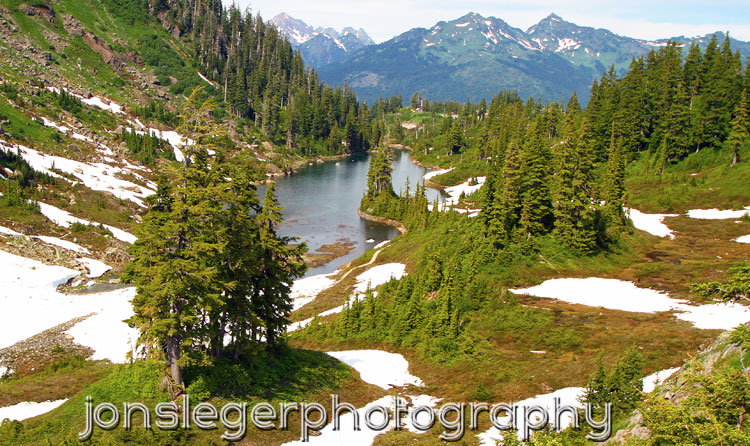
Bagley Lakes, Mt. Baker Wilderness, WA; 8/7/2012.
Another beautiful view of the scenery in the Mt. Baker Wilderness.

Sunday, November 11, 2012

American Pipit, Mt. Baker Wilderness, WA

MT. BAKER A COOL RESPIT DURING A HOT SUMMER
 
Mt. Baker, as seen by the long entrance road, Mt. Baker Wilderness, WA; 8/7/2012.

American Pipit already out of its breeding colors, with a meal ready for its baby, Mt. Baker Wilderness, WA; 8/7/2012.
My first trip to the Mt. Baker (Above) Wilderness was fantastic. It was a beautiful area with lots of snow even a week into August (Below). This was a nice vacation away from the sweltering heat of the Midwest, where we were just a week earlier - in the 100 degree weather of Northern Illinois.

I enjoyed the snow at the end of the road leading into the Mt. Baker Wilderness, WA; 8/7/2012.


Bagley Lakes Trail, Mt. Baker Wilderness, WA; 8/7/2012
One of the cool trails that I hiked was the trail to Bagley Lakes (Above). It was on this trail that I found an American Pipit (2nd from top). It gave me some good looks, would fly away then come back, and chipped at me for quite some time. I knew then when it kept coming back that there was either a nest or young Pipit in the area. It was probably too late in the year for a nest, so I listened for a young Pipit to answer back to its mother's call.
A baby American Pipit, Bagley Lakes Trail, Mt. Baker Wolderness, WA; 8/7/2012.
And sure enough, soon I heard another bird chipping, and the sound was very near. After scanning the ground for a couple of minutes, I found it. The baby Pipit (Above and Below) was sitting in an open area not far from me, squawking at its mother but clearly not trying to fly away from me. It looked fully fledged enough to fly.
The same baby American Pipit, Bagley Lakes Trail, Mt. Baker Wolderness, WA; 8/7/2012.
The only other time I remember seeing an American Pipit was in Rocky Mt. Nat Park a couple of years earlier. These are high altitude birds that nest and breed on the tundra. They are found scattered about the Rocky Mt. highlands into Canada and Alaska.