Showing posts with label San Pedro Riparian Natural Conservation Area. Show all posts

Sunday, August 12, 2012

Southwest Warblers Part 3: Lucy's Warbler

Lucy's Warbler, San Pedro Riparian Natural Conservation Area, Sierra Vista, AZ, 4/9/2012.
Continuing my weekend series on Warblers from the Southwest, I was very happy to locate my first Lucy's Warblers (Above).  I saw at least two different Lucy's while birding in the San Pedro Riparian NCA during my 2012 Springbreak.  To tell you the truth, when I was photographing these pretty little guys (only 4.25" long), I didn't recognize them and had to refer to my Sibley's Field Guide to Birds of Western North America to make the identification. 
Lucy's Warblers are not a very commonly found bird, but for the best possibility of locating them, look along streams (such as the san Pedro River where I found them) in the dense brush.
Lucy's Warbler, San Pedro Riparian Natural Conservation Area, Sierra Vista, AZ, 4/9/2012.
Lucy's Warblers are a pale bluish gray with a white eye line and undertail coverts. Another good field mark is their rufous cap and rump, which is very evident in the photo (Above).

Lucy's Warbler, San Pedro Riparian Natural Conservation Area, Sierra Vista, AZ, 4/9/2012.
Lucy's Warblers summer range is quite small, but can be found in southern Arizona and slightly spreading across the borders into California, Nevada, New Mexico, and Mexico.

Saturday, August 11, 2012

Southwest Warblers Part 2: Wilsons Warbler

Wilson's Warbler, San Pedro Riparian Natural Conservation Area, Sierra Vista, AZ, 4/9/2012.
I was fortunate to get a few good looks at the Wilson's Warbler (Above), while exploring the San Pedro Riparian Natural Conservation Area near Sierra Vista last April, while these warblers were migrating to more northern summer homes.
Another Wilson's Warbler, San Pedro Riparian Natural Conservation Area, Sierra Vista, AZ, 4/9/2012.
During the summer months, Wilson's Warblers are found throughout the West along the Pacific Coast and inland in Idaho, western Montana and Wyoming, the northeast corners of Utah and Nevada, northwest corner of Colorado. They are also found from coast to coast in Canada and throughout all pf Alaska except for the extreme northern coast.

Yet another Wilson's Warbler, San Pedro Riparian Natural Conservation Area, Sierra Vista, AZ, 4/9/2012.
Wilson's Warblers look very much like the Yellow Warbler, except add a small black cap on the Wilson's and subtract the red streaks on the breast from the Yellow.

Friday, August 10, 2012

Southwest Warblers: Yellow, Yellow-rumped, and Orange-Crowned


WARBLERS OF THE SOUTHWEST

Yellow Warbler, 1st-year, San Pedro Riparian Natural Conservation Area, Sierra Vista, AZ, 4/10/2012.
On my Spring Break trip to Arizona, I was hoping to add a few new birds to my list, particularly some warblers.  Typically, the Midwest and Eastern U.S. have a much larger variety of warbler species to see than the Western U.S., but there are a few species that are more likely to be found in the West and Southwest and of course those species that can be found throughout the entire country, such as the Yellow Warbler (Above).
Warblers that can be seen in the Western States during the Summer
Western: Orange-crowned*, Wilson's*, Black-throated Gray*, Yellow-rumped Audubon's*, MacGillivray's
Northwest and North Central West: Nashville, Townsend's, Hermit, American Redstart*, Northern Waterthrush, Ovenbird
Southwest: Virginia, Lucy's*, Grace's, Red-faced, Painted Redstart*, Olive (Locally southeast AZ southwest NM), Colima (Locally in the Big Bend area of Texas)
West and East: Yellow*, Common Yellowthroat*, Yellow-breasted Chat*
* Denotes the warblers that I observed in Southeast Arizona during April, 2012.
Yellow Warbler, 1st-year, San Pedro Riparian Natural Conservation Area, Sierra Vista, AZ, 4/10/2012.
There were Yellow Warblers all over the San Pedro Riparian NCA in early April, and then they show up in my hunting grounds of Northern Illinois in late April. I saw both mature adults and ther paler 1st-Years (Above).
Yellow-rumped Warbler, Ramsey Canyon,Sierra Vista, AZ; 4/9/2012.
Another very common warbler seen in the West is the Yellow-rumped Audubon's (Above and Below), which is distinguished from the Eastern species (Yellow-rumped Myrtle) with its yellow throat. The Myrtle has a white throat.

Yellow-rumped Warbler, San Pedro Riparian Natural Conservation Area, Sierra Vista, AZ, 4/10/2012.

Orange-crowned Warbler, San Pedro Riparian Natural Conservation Area, Sierra Vista, AZ, 4/10/2012.
What I thought was a Yellow Warbler sneaking around the heavy brush, when I first saw it, turned out to be an Orange-crowned warbler (Above). It was my first sighting of this species. Hooray!
In the next few days, i will post pictures of some more Southwest Warblers that I saw on my Spring break trip: Wilson's, Lucy's, Painted Redstart, and Black-throated Gray.

Friday, August 3, 2012

Gila woodpecker vs. Hummingbird Feeder, San Pedro Riparian National Conservation Area, AZ

GILA WOODPECKER VS. THE HUMMINGBIRD FEEDER

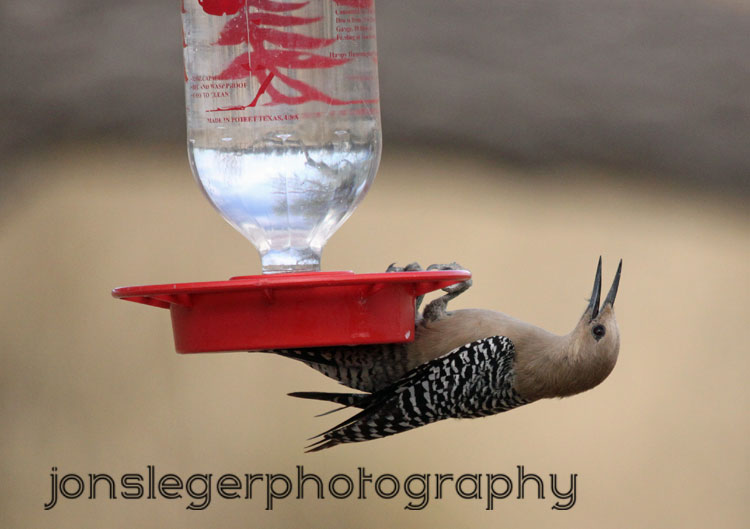
A Gila Woodpecker wondering how to get a drink from this hummingbird feeder, San Pedro Riparian National Conservation Area, AZ; 4/10/2012.
While I was birding out in the San Pedro Riparian National Conservation Area last April, I had fun watching a pair of Gila Woodpeckers trying to figure out how to get a meal out of the local bird feeders that wern't exactly suited to their body styles. First of all, the female Gila (Above) was trying to get a sip of nectar from a hummingbird feeder. She landed on it and looked at the feeder, not finding how to get to the liquid.

"Wait a minute...There's a little hole in here."
Then notices there are little holes in the bottom section. Using her tail to balance her position, she tried to bend her neck to reach one of the holes.

"Ooops!"
But she kept slipping down (Above).

"Let's try this side."
She flew off and returned to try another angle (Above).

"A little help...please"
She looked at me taking pictures almost as if she was asking for suggestions, and wondering I was just standing there and not helping her out.

"Ah Hah!"


Eventually, she was able to position herself in a way to get the tip of her bill into one of the holes.

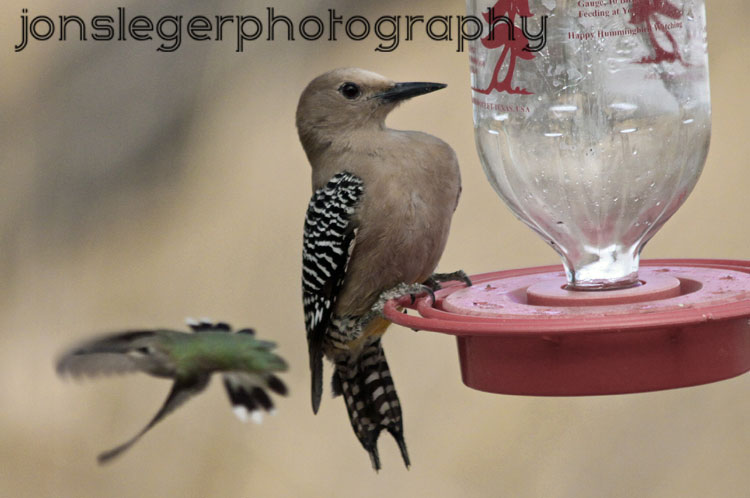
Meanwhile a Black-chinned Hummer kept circling, wondering when the big hummer is going to leave.
All the while this was going on, a female Black-chinned Hummingbird kept circling the feeder, getting impatient with the Gila Woodpecker for hogging her territory (above).

Meanwhile.........
Meanwhile, a male Gila WP tried his luck on another feeder,  San Pedro Riparian National Conservation Area, AZ; 4/10/2012.
A male Gila Woodpecker (Above) landed on another feeder suited more for smaller birds such as sparrows, finches, and chickadees. He also was trying to figure how to position himself to get to the openings which would lead him to his meal.
"Hmmm..."
It was almost as if he was thinking about how to do this - going over strategy in his mind.
Sliding down
He is starting to employ his strategy, as he started inching his way down the feeder.
"Nobody's watching, right?"
He also gave a look, as did the female on the hummer feeder, of "am I doing this right?"

"I think I get it."
However, he never did get is bill in the feeder hole. Giving up, he flew off.

It was fun moment of birds trying out their problem solving skills.