Showing posts with label Hawaii. Show all posts

Tuesday, June 7, 2011

Black-crowned Night Herons, Late March Migration to Northern Illinois

A Black-crowned Night Heron; you can see its white plumes sticking out the sides of its head; South Pond, Lincoln Park, Chicago; 3/30/2011.
I was in Chicago at Lincoln Park on March 30, this Spring and was surprised to see a Black-crowned Night Heron (Above) sitting in a tree at South Pond. There was even a sign asdvertising BC Night Herons, and I thought perhaps it was a permanent resident - why else, I thought, would there be a sign about them, without gauranteeing that they would show up. Although most bird books will list Black-crowned Night Herons as summer residents of Illinois, they have been a rare sighting over the past few years. A couple of weeks later, I was reading on the IBET boards that more BC-N. Herons were viewed at South Pond. Then I did some more reading and found out that last spring (2010), a zoologist from Chicago was pleasantly surprised when he noticed one nesting in a tree near South Pond in Lincoln Park, one of the busiest places in Chicago. Soon the one turned into several, then to dozens, and before the Spring ended there were over 200 nesting Black-crowned Night Herons at South Pond. It turned out that the one I saw was one of four early arrivals and again like last Spring, hundreds more soon followed. see the link below to a website with the story and some great pics of all the nests ...
http://openlands.org/News/Other-News/openlandscapes-black-crown-night-herons-arrive-at-chicagos-lincoln-park.html

and   http://www.ilbirds.com/index.php?topic=48197.0

A Black-crowned Night Heron, Kaui, Hawaii; 7/10/2008.
Other than Chicago, I have seen these Herons up at Horicon Marsh National Wildlife Refuge in Wisconsin, and couple of years ago I saw many of them in Hawaii (Above). Here in the contiguous States, BC N. Herons can be found in several areas: The West Coast, Midwest, East Coast, Southeast and Southwest. They get their names because they do their hunting and foraging mainly at night. (Below) is a photo of a BC-N. Heron searching for prey at a small waterfall near the hotel I was staying at in Kaui.

A Black-crowned Night Heron hunting in the evening light, Kaui, Hawaii; 7/9/2008.

Wednesday, November 24, 2010

Duck, Duck, Goose (and Turkey and Chicken too!) - Greater White-fronted Geese?

What better day than to turn our thoughts to all of the fowl that have given up their lives for our pleasure at the Thanksgiving Table - geese, turkeys, ducks and chickens.  All of the photos on today's post are actually of wild birds - believe it or not.

Are these Greater White-fronted Geese or Graylag (barnyard) Geese? North Pond, Lincoln Park, Chicago; 10-3-10.

A closer look at this goose - the white-tipped tail and the white patch at the base of its bill suggests a Greater White-fronted Goose, North Pond, Lincoln Park, Chicago; 10-3-10.
I'll start with a trio of handsome geese that Val and I saw on the North Pond, while visiting Lincoln Park in Chicago.  When I first saw these birds (Above) I thought they were Greater White-fronted Geese (GWFG), but upon research I found that they would be on edge of the farthest eastern fringe of their migration route.  As I noted in the caption of the 2nd photo above, they seemed to fit the description of a GWFG, but as I researched photos of both the GWFG and the Graylag Goose - they are both so close in appearance - I became more and more inconclusive. According Sibley's Field Guide to North American Birds, the Graylag is more common in farm ponds and city parks (Lincoln Park, North Pond, hmmm...) and some also sport a small white patch at the base of their bills, and some had white-tipped tails and some didn't.  The Graylag is a bit bigger (6" longer than the GWFG), but without both of them being next to each other I would not be able to tell its size. Are there any bird experts out there that can help me with the identification? Let me know. Regardless of what species they were, they certainly were photogenic.

Another goose that I had trouble ID'ing earlier this spring was a pure white goose (Above). While hiking around the lake at Bauman Park, there were the usual abundant flocks of Canada Geese, but in the midst of one small flock was this pure white goose, which upon my investigation and creeping slowly closer, it became very defensive and protective of its goslings; whereas the adult Canada Geese within the same flock ignored me. I hoped the white goose was a Snow Goose. It had the wrinkly feathers on its neck and its trademark "grin," a small dark section of its bill which makes it look like it's smirking or grinning. But it lacked the black tipped wing and it's highly unusual that a Snow Goose would be flocking with Canadas. However, it is not unusual for an escaped white domestic goose to travel with and mate with Canadas. I have seen that before, and this white goose was definitely the mother of the goslings which appeared to have Canada markings but with some unusual white markings.  (Below) is definitely a domestic white goose that was swimming in Saguaro Lake near Phoenix AZ.

The setting of this white goose was very eye-catching as it contrasted with the black reflection of the bridge swirling together with the pure blue water, Saguaro Lake, Phoenix, AZ; 10/27/07.
Canada Geese are the most common and abundant of all geese in North America. Below are a few of my favorite photos of the Canadas:

A lone Canada Goose rests in the sunset lit lake at Bauman Park. Just before I snapped the picture, it moved enough to create the rings that was caught by the sunlight , Rockford IL; 5/14/10.

I loved how the heads of these goslings glowed in the morning sunlight, Rock Cut State Park, Rockford, IL; 5/18/08.

Val captured these two adult Canadas with a brood of over 20 goslings (you can't see all of them in the photo) as they swam towards us in the Seney Wildlife Refuge, Upper Peninsula Michigan; 5/27/07.

Val took this fantastic shot of a flock of Canadas flying past a full moon at Bauman Park, Rockford, IL; Oct., 2007.
Other than Canada Geese, another very abundant waterfowl species are the Mallard Ducks. Mallards are found coast to coast year round, and travel all the way to the northern reaches of Alaska and Canada in the summer months and all the way south into Mexico during the winter months. below are some of my favorite Mallard pics:
One evening while hiking around Pierce Lake in Rock Cut State Park, I captured these Mallards silhouetted against the sunset reflecting in the lake. Because of the landscape orientation of the photo and that Mallards are so common around here, I ended up choosing this photo as my Logo for this blog, Rockford; 6/15/07.

A Mallard doing a balancing act on a rock in a pond at Anderson Gardens. I loved how the green trees reflecting in the pond created a perfect background for the Mallard to "pop out" as the focal point in this composition. Rockford, IL; 6/16/08.

The duck in this photo had me perplexed for a year as I couldn't find any pictures to help me with its ID. However my friends at http://www.birdersworld.com/ informed me that this most likely the result of a Mallard mating with another duck species. The offspring is known as a "Manky Mallard," a name coined by Charles who is the forum leader at his website http://10000birds.com/ ; Photo taken in Phoenix, AZ, 12/29/09.
Well, one can't highlight birds on Thanksgiving Day without the mention of the Turkey. (Below) is a reprise of a Wild Turkey photo that I posted on one of my earliest posts (6/24/10) on this blog.

This Wild Turkey gobbled at me while I was riding my bike in Rock Cut State Park early one morning. I loved how the rising sun backlit its red wattle and tail feathers; Rockford, IL; 5/23/10.
My last photo is of a bird that you may be surprised is wild. In the summer of 2008, while val and I were in Hawaii, we noticed a lot of chickens roaming about, and roosters crowing at all times of the day, including in the middle of the night.  I wondered why the locals allowed their chickens to run free. Val was fascinated over these chickens and took several photos.  Me - being a sensible Midwestern boy, born and raised around farms which had many chickens, I just didn't see them as an interesting item - especially since we were in Hawaii. One day while perusing a book about Wild Birds of the Hawaiian Islands, it had included these chickens and they were called Wild Jungle Fowl (Below). Apparently they are descendants of many generations of domesticated chickens that escaped their pens during typhoons, cyclones, and other storms.

Val took this photo from a safe distance of a Wild Jungle Fowl terrorizing the island of Oahu, Hawaii; 6/8/08.
Happy Thanksgiving! And remember, whatever fowl you may be serving this year at your Thanksgiving table, it is most likely a distance relative of one of the fine birds that I have highlighted in this post. Give it its proper respect before devouring it. I have heard of a "Turducken," but what about a "Turdugoosken?"

Saturday, October 9, 2010

Mute Swan

While staying in Kauai, I saw a Mute Swan for the first time in the wild. It made its home on a nearby pond (Below).

A Mute Swan at a pond in Kauai, Hawaii; 7/6/08.
Mute swans can grow as large as 5' long with a wing span of over 6'. They are unique in the swan family with its orange bill.  I also saw one while in London during a Spring Break trip last April (Below).
A Mute swan in a St. James Park pond, London, UK; 4/8/10.
My most surprising sighting of a Mute Swan came in the spring of 2009, when I saw a small flock of three at our own Rock Cut State Park (Below), here in Rockford, Illinois. They make their summer homes in small lakes in the Northern lakes of Wisconsin, Michigan, and Canada, and around the Great Lakes: Superior, Michigan and Ontario.


Three Mute Swans resting at Pierce Lake at Rock Cut State Park, Rockford, IL; 5/10/09.

Sunday, October 3, 2010

Chukar

We visited the Haleakala National Park on the Island of Maui and hiked down the celebrated "Sliding Sands Trail." When we started the hike we were in a cloud (as parts of the National Park is as high as 10,000 feet above sea level) and had very little visibility. But as we hiked to a lower altitude we emerged beneath the cloud cover and enough sunlight passed through the cloud to give us a glimpse of the beautiful landscape, which gave us a feeling of being on the moon or some unearthly planet (Below).

A view from the "Sliding Sands Trail", Haleakala National Park on Maui, Hawaii; 7/14/08.
 While on this trail we were hoping to see the rare Hawaiian Goose, the Nene, but instead several times we ran a cross a chicken-like bird called a Chukar (Below). I have never heard of a Chukar before this. The Chukar was introduced to the U.S. (and Hawaii) from the Middle East for sport hunting, but never really established any kind of large flocks. When they are seen, they are usually found on arid rocky slopes, which is a perfect description of the terrain surrounding the "Sliding Sands Trail. "
A Chukar on the sliding Sands Trail of Haleakala National Park, Maui; 7/14/08.

Chukars are chunky and medium sized birds (like chickens) that have a pale grayish brown body with very bold black bars on its flanks. It has a black band across its eyes that extends down behind its cheeks and across its throat, which gives it the impression of being a bandit. It has a red beak and a red eye ring sets its eyes off from the black mask.


Another pair of Chukars in Haleakala Nat. Park, Maui, Hawaii; 7/14/08.


Saturday, October 2, 2010

Brown Noddy

While we were taking a boat trip around the beautiful NaPali Coast of the island of Kauai, we passed some cliffs with a colony of Brown Noddies (Below). The Brown Noddy is a tropical seabird in the tern family which is mostly brown except for a white forehead blending into a gray nape, and small white half-eye ring. It has a wedge-shaped tail with a small notch at the tip. It has a long slender black bill and black legs and feet. .

A colony of Brown Noddies on a cliff edge; NaPali Coast, Kauai, Hawaii; 7/9/10.

The Brown Noddy is colonial, usually nesting on elevated situations on cliffs or in short trees or shrubs. It only occasionally nests on the ground. A single egg is laid by the female of a pair each breeding season. I feel fortunate to have spotted these because its only breeding colony in the contiguous United States is in Dry Tortugas at the tip of Florida, about 70 miles west of Key West.

Sunday, September 26, 2010

White-tailed Tropicbird

It seemed like that at every waterfall we visited (which were many) while in the Hawaiian Islands, there were these gorgious white birds with long tails circling the the sky above waterfalls. They were in constant motion and always at heights that were impossible to get a good photo (Below - a bad attempt at photographing  one). When I asked a local the name of these birds I was told "White Tropicbird."  At first I though they were pulling my leg - that would be like calling a blue bird we see in the Rocky Mountains, a Blue Mountainbird or a Mountain Bluebird ... oh.

This is the best photo I captured of the perpetually in-motion White-tailed Tropicbird at Wailua Falls, which was the waterfall used in the opening scene of the old television show "Fantasy Island."; Kauai, Hawaii; 7/11/08.


Wailua Falls on the Island of Kauai was used in the opening scene of the old TV show, "Fantasy Island."; Hawaii; 7/11/08.
Well the true name is indeed, a White-tailed Tropicbird. The Tropicbird is a large white bird  with a long black bar on upperwing coverts, and a black loral mask which extends through and past its eye. Its bill is yellow to orange and its unique trait is its extremely long white tail streamers that can be up to seventeen inches long. Its legs and feet are yellowish, with black webbing on the toes. These birds breed on windward sea cliffs on oceanic islands throughout the Atlantic, Indian, and Pacific oceans as well as the Caribbean. (Below - for a better view of this beautiful bird - not my photo)

A better view of a White-tailed Tropcbird; Google Images. http://www.itsnature.org/air/birds-air/white-tailed-tropicbird/

Saturday, September 25, 2010

Red-billed Leiothrix

Red-billed Leiothrix
The Red-billed Leiothrix is a beautifully marked bird with bright coloring. The adults have bright red bills and a dull yellow ring around their eyes. Their backs are dull olive green and have a bright yellow-orange throat with a yellow chin. They have forked tails. Female Leiothrix are similar to males but with a duller shade. Juveniles have black bills and gray coats. This Leiothrix is also known for its loud melodious songs. We ran across one on the Judd-Nuuanu Trail on Oahu (Above).

Red-billed Leiothrix are native to Southern Asia and are now found on most of the Hawaiian Islands with the exception of Kauai, which ironically it was first introduced to in 1918. Sometime later, these birds were introduced to the other islands. Leiothrix prefer to inhabit underbrush's at all elevations with a cover of dense vegetation near the ground. Some birds have been found at elevations of 9,000 feet. Flocks of Leiothrix's have been known to fly up to elevations of 13,500 feet for a short period of time. These birds favor areas with at least 40 inches of rain.


Sunday, September 19, 2010

Common Waxbill

A small flock of Common Waxbills at Hanauma Bay, Oahu, Hawaii; 6/25/08.
The Common Waxbill is another bird that we observed only on the island of Oahu; indeed, doing some research it has only been seen in a couple of specific locations only on Oahu (and not found on the other Hawaiian Islands). We saw a small flock (Above) of these birds while exploring Hanauma Bay on Oahu's Southeast corner. They are a very pretty member of the Finch family with gray-brown upperparts and lower breast, and bellyline - also sporting very fine barring on back, wings, sides, lower breast, belly, and tail. What gives Waxbills a striking look is its Red beak, eyes and mask surrounded by white cheeks, throat, and upper breast (Below). Some have a rosy-pink patch on the belly.
 

A Common Waxbill sporting its bright red mask and beak; Oahu, Hawaii; 6/25/08.
 
Common Waxbills are usually observed pecking at the ground - on lawns, grassland, and cultivated fields. Sometimes they will be found in clearings of forests and marshes.

Saturday, September 18, 2010

Red-vented Bulbul

This Red-vented Bulbul was very aggressive toward other birds as they competed for birdseed on the grounds of the Bed & Breakfast we stayed at in Oahu, Hawaii; 6/25/08.


We saw several Red-vented Bulbuls (Above) while on Oahu. It is a Blue Jay sized bird with dark brown body, black head with a crest, a white rump and red vent (under the tail behind the legs). They are considered an invasive pest on the island of Oahu. Apparently they haven't found their way onto Maui or Kauai, but there have been limited sightings on the Big Island. They are considered a pest because they are not native to the Hawaiian Islands, and cause considerable damage to Hawaii's fruit orchards and orchid Farms. They not only eat and destroy fruits and vegetables, but also eat the petals and bulbs off of very rare and expensive orchids. They were introduced from India, and are relatively common throughout Asia from China to Pakistan. Bulbuls also are very aggressive to other birds, chasing them away and taking over their habitats.

Saturday, September 11, 2010

White-rumped Shama

White-rumped Shama; Oahu, Hawaii; 6/27/08.
The White-rumped Shama (Above) is a beautiful songbird with a long tail that is common in the forests of the Hawaiian Islands. We heard and saw them often on the island of Oahu. They were imported from Asia and were originally a captive bird used as pets, but eventually escaped captivity and have established a healthy wild population. They are very territorial, and the size of the tail may determine the size of the territory, with larger tailed birds (Below) having larger territories. Territories include a male and female pair during the breeding season with the males defending the territory. The White-rumped Shama is a famous songbird with wide-ranging songs and notes which are loud, melodious and shrill. They are known to imitate the calls of other birds. We always enjoyed hearing them sing while hiking through the forests of Hawaii.

The large tail of this White-rumped Shama may suggest that it rules a larger territory than another Shama with a smaller tail; Oahu, Hawaii; 6/28/08.

Friday, September 10, 2010

Common Mynah

The Common Mynah was imported from Asia, and is quite widespread in Pacific Islands and Australia. In the U.S. there are pockets in Southern Florida where it is rather common.


Common Mynah, Oahu, Hawaii; 6/25/08.
A couple of summers ago, Val and I had the fortunate oppurtunity to spend a couple weeks in the Hawaiian Islands.  Not surprising, the Islands are a host of many birds that are not seen (or at least not very frequently) in North America. Now that I have become more interested in bird photography, I regret not being more of a birder while I was there, and I did not capitalize on some great opportunities, but in the next couple weekends I will highlight some of the birds I did manage to capture.

One of the birds that is a common sight (especially on Oahu) in the Islands is the Common Mynah Bird (Above) which might be compared to our Starling or American Crow - some people would consider a nuiscance and a noisy beggar residing in urban areas thriving on human handouts and garbage.  However, the Mynah is quite striking in appearance with its black head, brown body and bright yellow beak and cheek, which gives it a look of having a perpetual scowl.  When in flight (Below), the Mynah's bold white markings on the wings and tail contrast brilliantly with its dark body. I wish that I had a better photo to capture its flashy feathers in flight.
The Common Mynah coming in for a landing; Oahu, Hawaii; 6/25/08.

Tuesday, August 17, 2010

Cattle Egret


Cattle Egret in the fields on Oahu, Hawaii

When I was in Hawaii in the summer of 2008, I saw flocks of Cattle Egret (Above, 6-25-08, Oahu) , especially in fields on the islands of Oahu and on Kauai. This is the first time I have run across these Egrets. They are the smallest of the White Heron family, only growing up to 20" tall compared to the Great Egret (39" tall). Since I have learned that they are common along the southern coasts of Florida and throughout the Gulf as well as along the Pacific coast stretching from Mexico all the up to Northern California. In the summer they will be found inland in the Southern states and as far up as Kansas, Missouri, Southern Illinois, and believe it or not, the grasslands of North Dakota. This is not all that surprising, because when I saw them in Hawaii, they seemed to be more of an open field and grassland bird than a shorebird.  They have mostly white plumage with feint yellowish-pinkish feathers on its crown, back and breast during mating season. In both photos (Above and Below), you can see those colorings. Although their feet are not visible in the photos, they are yellow during breeding (Mar - July), and turn dark during off breeding months (Aug - Feb).


Cattle Egret in the jungle brush near Hanakapai Waterfall, Kauai.

In Kauai, while hiking the Kalalau Trail we were surprised to find a solo Cattle Egret (Above, 7-10-08, Kauai) foraging among the jungle brush at Hanakapai Falls. All of our other obsevations seemed that this bird stayed in small flocks and in open fields. However, this guy either knew something that the other Cattle Egret didn't, or he was very lost.

Sunday, July 4, 2010

Red-crested Cardinal

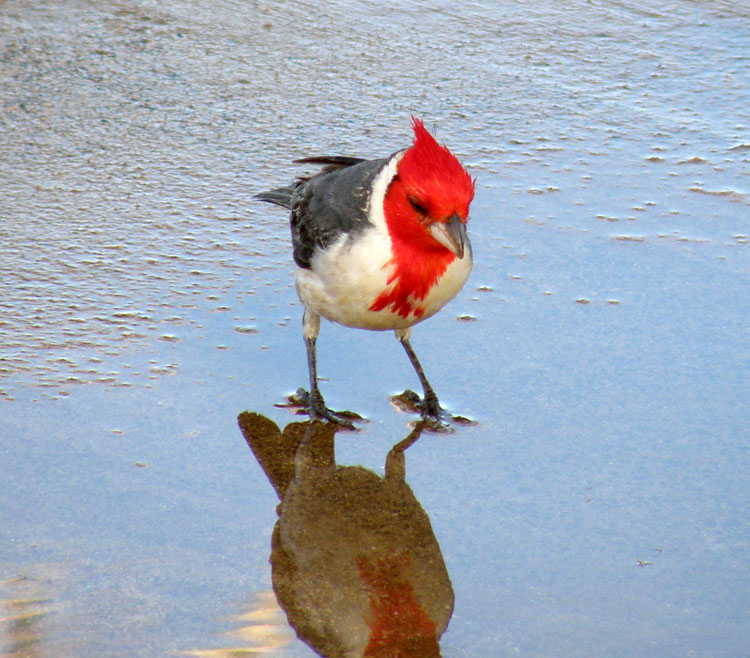
In honor of our country's Independence day celebration, I tried to find a red, white and blue bird. The closest could find in my files of birds was this great photo of a Red-crested Cardinal, which Val snapped while she was hanging around a beach on the island of Kauai, Hawaii. Some of the Hawaian residents called them Brazilian Red-caps, but I found out later that those are completely separate species. They were fairly common to see on Oahu and Kauai.
Val's photo of a Red-crested Cardinal, Kauai, Hawaii; 7/11/2008.

Tuesday, June 15, 2010

Black-Crowned Night Heron

Again, keeping the theme of Wading birds at the Horicon Marsh Wildlife Refuge (5/29/10), below is a photo of a Black-Crowned Night Heron sitting in a tree. Then the middle photo below is the same Heron flying away.


The photo (7/8/08) below is another look at the Black-Crowned Night Heron, taken in Kauai, while we were in Hawaii in the summer of 2008.