Showing posts with label Arizona. Show all posts

Monday, August 13, 2012

Southwest Warblers Part 4: Painted Redstart and Black-throated Gray Warbler


Painted Redstart: The first time I saw a Painted Redstart was when one greeted me at the front door feeder of the Ramsey Canyon Nature Conservatory last December. Unfortunately it flew so close to my 150-500mm Sigma Lens that I couldn't get a clear picture of it before it disappeared. So when I had a chance to revisit the Conservatory last April, I was hoping to get a second chance at photographing these strikingly beautiful black warblers with a red breast and belly and white wing patches and outer tail feathers, and a white patch under its eyes which make it look like it's in a perpetually sad disposition.

Painted Redstart, Ramsey Canyon Nature Conservatory, AZ; 4/9/2012.
I hiked pretty far into the Canyon, and fortunately after missing a few chances of these Redstarts, one showed itself long enough for me to capture its image (Above).
Painted Redstart, Ramsey Canyon Nature Conservatory, AZ; 4/9/2012.
Painted Redstarts (Above) have a pretty small area in the U.S. to find them - Southeast Arizona and Southwest New Mexico. Otherwise they are much more common in the canyons of Mexico.

Black-throated Gray Warbler: A more common Warbler, but a first for me was the Black-throated Gray Warbler (Below), which I located on the Cave Creek Canyon Trail in the Chiricuaha Mountains, two days later from my Ramsey Canyon visit.
Black-throated Gray Warbler, Chiricuaha Mts., AZ; 4/11/2012.
When I first heard, then saw, this warbler with its white and black markings, I initially thought it to be a type of Chickadee (I was hoping for a Mexican Chickadee). But after comparing my photos to the Sibley's Field Guide, I realized that I found my first Black-throated Gray Warbler. I was disappointed thet I couldn't get a clear photo of this warbler as my only clear shot was well out-of-focus. My somewhat in-focus photos (Above and Below) did not have the best point of views, but the photos along with remembering its song, was good enough to make a definite identification.

Black-throated Gray Warbler, Chiricuaha Mts., AZ; 4/11/2012.
Black-throated Gray Warblers can be found throughout much of the western U.S. from the Pacific Coast of British Columbia in the North to the southern borders of California, Arizona, and New Mexico. They can be found mostly in an arid habitat of Oak or Juniper woodlands.

Sunday, August 12, 2012

Southwest Warblers Part 3: Lucy's Warbler

Lucy's Warbler, San Pedro Riparian Natural Conservation Area, Sierra Vista, AZ, 4/9/2012.
Continuing my weekend series on Warblers from the Southwest, I was very happy to locate my first Lucy's Warblers (Above).  I saw at least two different Lucy's while birding in the San Pedro Riparian NCA during my 2012 Springbreak.  To tell you the truth, when I was photographing these pretty little guys (only 4.25" long), I didn't recognize them and had to refer to my Sibley's Field Guide to Birds of Western North America to make the identification. 
Lucy's Warblers are not a very commonly found bird, but for the best possibility of locating them, look along streams (such as the san Pedro River where I found them) in the dense brush.
Lucy's Warbler, San Pedro Riparian Natural Conservation Area, Sierra Vista, AZ, 4/9/2012.
Lucy's Warblers are a pale bluish gray with a white eye line and undertail coverts. Another good field mark is their rufous cap and rump, which is very evident in the photo (Above).

Lucy's Warbler, San Pedro Riparian Natural Conservation Area, Sierra Vista, AZ, 4/9/2012.
Lucy's Warblers summer range is quite small, but can be found in southern Arizona and slightly spreading across the borders into California, Nevada, New Mexico, and Mexico.

Saturday, August 11, 2012

Southwest Warblers Part 2: Wilsons Warbler

Wilson's Warbler, San Pedro Riparian Natural Conservation Area, Sierra Vista, AZ, 4/9/2012.
I was fortunate to get a few good looks at the Wilson's Warbler (Above), while exploring the San Pedro Riparian Natural Conservation Area near Sierra Vista last April, while these warblers were migrating to more northern summer homes.
Another Wilson's Warbler, San Pedro Riparian Natural Conservation Area, Sierra Vista, AZ, 4/9/2012.
During the summer months, Wilson's Warblers are found throughout the West along the Pacific Coast and inland in Idaho, western Montana and Wyoming, the northeast corners of Utah and Nevada, northwest corner of Colorado. They are also found from coast to coast in Canada and throughout all pf Alaska except for the extreme northern coast.

Yet another Wilson's Warbler, San Pedro Riparian Natural Conservation Area, Sierra Vista, AZ, 4/9/2012.
Wilson's Warblers look very much like the Yellow Warbler, except add a small black cap on the Wilson's and subtract the red streaks on the breast from the Yellow.

Friday, August 10, 2012

Southwest Warblers: Yellow, Yellow-rumped, and Orange-Crowned


WARBLERS OF THE SOUTHWEST

Yellow Warbler, 1st-year, San Pedro Riparian Natural Conservation Area, Sierra Vista, AZ, 4/10/2012.
On my Spring Break trip to Arizona, I was hoping to add a few new birds to my list, particularly some warblers.  Typically, the Midwest and Eastern U.S. have a much larger variety of warbler species to see than the Western U.S., but there are a few species that are more likely to be found in the West and Southwest and of course those species that can be found throughout the entire country, such as the Yellow Warbler (Above).
Warblers that can be seen in the Western States during the Summer
Western: Orange-crowned*, Wilson's*, Black-throated Gray*, Yellow-rumped Audubon's*, MacGillivray's
Northwest and North Central West: Nashville, Townsend's, Hermit, American Redstart*, Northern Waterthrush, Ovenbird
Southwest: Virginia, Lucy's*, Grace's, Red-faced, Painted Redstart*, Olive (Locally southeast AZ southwest NM), Colima (Locally in the Big Bend area of Texas)
West and East: Yellow*, Common Yellowthroat*, Yellow-breasted Chat*
* Denotes the warblers that I observed in Southeast Arizona during April, 2012.
Yellow Warbler, 1st-year, San Pedro Riparian Natural Conservation Area, Sierra Vista, AZ, 4/10/2012.
There were Yellow Warblers all over the San Pedro Riparian NCA in early April, and then they show up in my hunting grounds of Northern Illinois in late April. I saw both mature adults and ther paler 1st-Years (Above).
Yellow-rumped Warbler, Ramsey Canyon,Sierra Vista, AZ; 4/9/2012.
Another very common warbler seen in the West is the Yellow-rumped Audubon's (Above and Below), which is distinguished from the Eastern species (Yellow-rumped Myrtle) with its yellow throat. The Myrtle has a white throat.

Yellow-rumped Warbler, San Pedro Riparian Natural Conservation Area, Sierra Vista, AZ, 4/10/2012.

Orange-crowned Warbler, San Pedro Riparian Natural Conservation Area, Sierra Vista, AZ, 4/10/2012.
What I thought was a Yellow Warbler sneaking around the heavy brush, when I first saw it, turned out to be an Orange-crowned warbler (Above). It was my first sighting of this species. Hooray!
In the next few days, i will post pictures of some more Southwest Warblers that I saw on my Spring break trip: Wilson's, Lucy's, Painted Redstart, and Black-throated Gray.

Sunday, August 5, 2012

Another Western Woodpecker: Acorn Woodpecker

MORE SOUTHWEST WOODPECKERS

Acorn Woodpecker, Ramsey Canyon, Sierra Vista, AZ, 4/9/2012
The first time I saw an Acorn Woodpecker was in Yosemite National Park several years ago. The next two times I saw these guys were both in Ramsey Canyon, AZ, last fall and this spring (Above). 
Acorn Woodpecker, Ramsey Canyon, Sierra Vista, AZ, 4/9/2012.
Ramsey Canyon is the place to be to find Acorn Woodpeckers.

Saturday, August 4, 2012

Arizona Woodpecker in Ramsey Canyon

 MORE SOUTHWEST WOODPECKERS
Arizona Woodpecker, Ramsey Canyon, Sierra Vista, AZ, 4/9/2012.
As I entered the road leading to the Nature Conservatory at Ramsey Canyon, before I even reached the parking lot, I saw a good-sized bird fly across the road in front of me and land on the trunk of a tree to the right side of the road. By the way it was clinging to side of the trunk of the tree, I knew it was a woodpecker, but its coloring was a bit different than the usual woodpeckers I am used to in the Midwest. As I slowed the car down and pulled over, The woodpecker flew to the next tree trunk up the road. So I stealthily gathered my camera, opened the car door, and used the car as sort of a blind and focused over the roof of the car at the woodpecker. Once I trained my focus on the woodpecker and it appeared in my viewfinder, I realized it was an Arizona Woodpecker, my first sighting ever, which always makes me happy. It stayed put long enough for me to snap off a few photos (Above and Below).
The same Arizona Woodpecker, Ramsey Canyon, Sierra Vista, AZ, 4/9/2012.
It was awesome to be greeted by an Arizona Woodpecker, before I even reached the actual Conservatory. I remember the only other time I visited the Ramsey Canyon Nature Conservatory, the first bird I saw as I got out of my car was a Painted Redstart, also a first. I love Ramsey Canyon!

Friday, August 3, 2012

Gila woodpecker vs. Hummingbird Feeder, San Pedro Riparian National Conservation Area, AZ

GILA WOODPECKER VS. THE HUMMINGBIRD FEEDER

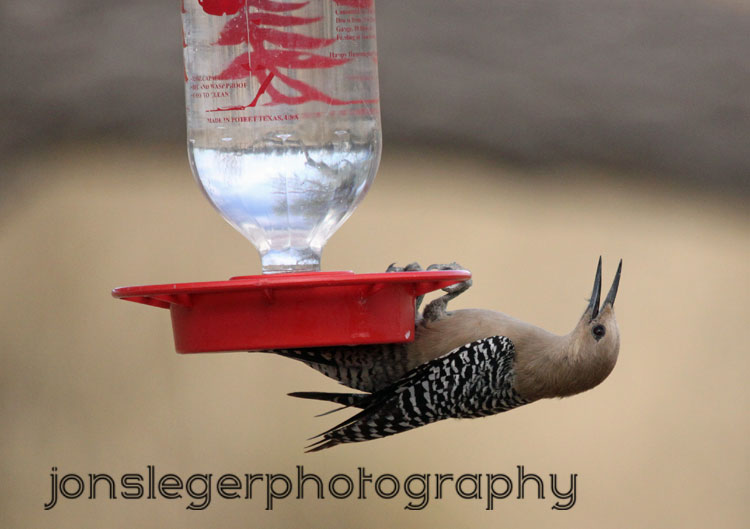
A Gila Woodpecker wondering how to get a drink from this hummingbird feeder, San Pedro Riparian National Conservation Area, AZ; 4/10/2012.
While I was birding out in the San Pedro Riparian National Conservation Area last April, I had fun watching a pair of Gila Woodpeckers trying to figure out how to get a meal out of the local bird feeders that wern't exactly suited to their body styles. First of all, the female Gila (Above) was trying to get a sip of nectar from a hummingbird feeder. She landed on it and looked at the feeder, not finding how to get to the liquid.

"Wait a minute...There's a little hole in here."
Then notices there are little holes in the bottom section. Using her tail to balance her position, she tried to bend her neck to reach one of the holes.

"Ooops!"
But she kept slipping down (Above).

"Let's try this side."
She flew off and returned to try another angle (Above).

"A little help...please"
She looked at me taking pictures almost as if she was asking for suggestions, and wondering I was just standing there and not helping her out.

"Ah Hah!"


Eventually, she was able to position herself in a way to get the tip of her bill into one of the holes.

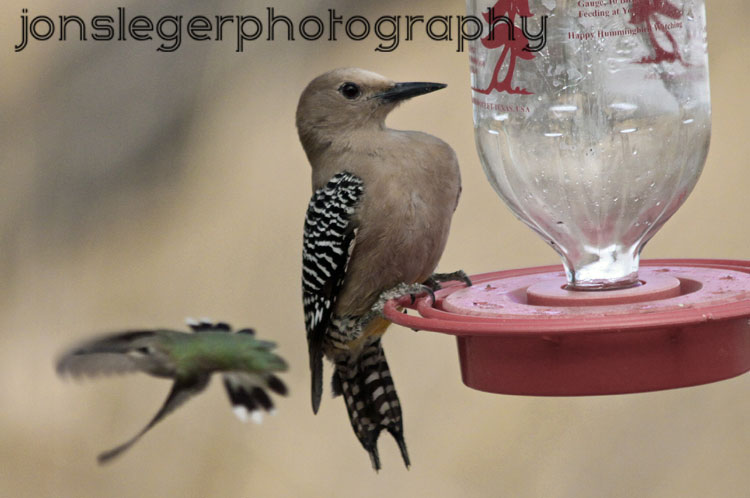
Meanwhile a Black-chinned Hummer kept circling, wondering when the big hummer is going to leave.
All the while this was going on, a female Black-chinned Hummingbird kept circling the feeder, getting impatient with the Gila Woodpecker for hogging her territory (above).

Meanwhile.........
Meanwhile, a male Gila WP tried his luck on another feeder,  San Pedro Riparian National Conservation Area, AZ; 4/10/2012.
A male Gila Woodpecker (Above) landed on another feeder suited more for smaller birds such as sparrows, finches, and chickadees. He also was trying to figure how to position himself to get to the openings which would lead him to his meal.
"Hmmm..."
It was almost as if he was thinking about how to do this - going over strategy in his mind.
Sliding down
He is starting to employ his strategy, as he started inching his way down the feeder.
"Nobody's watching, right?"
He also gave a look, as did the female on the hummer feeder, of "am I doing this right?"

"I think I get it."
However, he never did get is bill in the feeder hole. Giving up, he flew off.

It was fun moment of birds trying out their problem solving skills.

Monday, July 30, 2012

Southwest Hummingbirds Part 4: Magnificent and Rufous

MAGNIFICENT AND RUFOUS OFFER DIFFERENT LOOKS THAN THE USUAL HUMMERS
As I mentioned in yesterday's post (7/29/12), I was able to see at least four different species of Hummimgbirds, while sitting in one spot at the Ramsey Canyon Nature Conservatory.
A male Magnificent Hummingbird, Ramsey Canyon NC, Sierra Vista, AZ; 4/9/2012.
By far my favorite of the group of hummers was the Magnificent Hummingbird (Above). It was very aptly named, as I found it to be truly "magnificent" to observe. At 5.25" long, it is much larger than the other hummers (ranging from 3.5" - 4" long) that I have seen. Its dark overall coloring was very striking. In the right light, the Magnificent's crown will appear purple with a green throat, but in the shade he looked all black to go with its black breast and belly and with dark green back and wings. He's like the mysterious superhero of hummers.
A male Magnificent HB, Ramsey Can. NCA, Sierra Vista, AZ; 4/9/2012.
I also felt very fortunate to be able to see one of these regal hummers as they are not commonly found on U.S. soil. However, when they are within our borders, they can be found in the very local area of southeastern corner of Arizona in pine-oak forests. Otherwise it is more likely to be located in Mexico.

Another different looking hummingbird than the usual green-backed, red-throated , buffy-breasted species that occupy the western states, is the Rufous Hummingbird (Below).

A male Rufous Hummingbird, Ramsey Can NCA, Sierra Vista, AZ; 4/9/2012.
He appeared and was gone so fast that I almost missed him.  I was focussing on a Broad-billed Hummer (7/29 post) when he showed. The pic (Above) I did get is not the one of my best (poorly focussed), but was the best of the three I managed to get before he disappeared. I was hoping it would return, but never did. What I like about the Rufous is its unusual coloring for a Hummingbird, with an orangish head, back, belly, and tail, offset by its white breast, green wings and dark orangish/brownish throat. Females lack the orange back head and belly, and with the exception of orange under its tail, look much more like other typical hummers. I didn't notice a female at this spot, however. Rufous Hummingbirds are one of our more northern hummers as they reside in Oregon, Washington State and into Canada all the way up to Alaska during the summers. I was happy to get him while he was passing through in southern Arizona.  As a rare sighting, last winter in Chicago, a Rufous Hummingbird was spotted and spent much of the winter there, way out of its usual territory and long past its migration window.

Sunday, July 29, 2012

Southwest Hummingbirds Part 3: Broad-tailed and Broad-billed

THE HUMMER BROADS

A female Broad-billed Hummingbird, Ramsey Canyon Nature Conservatory, Sierra Vista, AZ; 4/9/2012.
Broad-billed Hummingbird: During my Spring Break Southwestern birding trip, I was lucky enough to make my second visit to the Ramsey Canyon Nature Conservatory, which is considered to be one of the best places to find a wide variety of species of hummingbirds. After I completed a long hike into and out of the canyon, I still had an hour before the grounds closed for the day. So I camped myself on a bench facing one of their many hummingbird feeders. Within that hour I saw four (maybe five) different species visiting the one feeder: A Broad-billed (Above), a Magnificent and Rufous (tomorrow's post), many Black-chinneds, and an unconfirmed possible Blue-throated (my photo was inconclusive, but was probably a Black-chinned).
Val's photo of the beautiful male Broad-billed Humminbird, Sonoran Desert Museum, Tucson; 12/27/2012.
While visiting the wonderful Sonoran Desert Museum in Tucson, AZ, Val visited the hummingbird house, in which resided hummingbird species that could be found in the Sonoran Desert of Arizona. She was able to catch several excellent close-ups of many different types, including the Broad-billed (Above).  Males sport a dark green belly and dark blue throat and breast with black wings and dark green back, all off set with a brilliant red bill. Don't ask me why I didn't make it to the Hummingbird House. I was probably out chasing wild birds.
Broad-billed Hummingbirds are common in the southeast corner of the Arizona (i.e.Ramsey Canyon NC) during the summer. Rarely do they venture north, but there are few odd sightings of these guys in California.
Val's photo of a female Broad-billed Hummingbird, Sonoran Desert Museum, Tucson, AZ; 12/27/2009.
Val photographed a female Broad-billed (Above) at the Hummingbird House as well.


Broad-tailed Hummingbird: The second of the "broad" hummingbirds is the Broad-tailed (Below).

A male Broad-tailed Hummingbird, Rocky Mt. Nat. Prk, CO; 7/8/2010. Photo taken when I still had my Canon RebelT1i with a Canon 55-250mm lens. I hadn't yet owned my current Sigma 150-500mm lens.
While camping in Rocky Mountain National Park two summers ago, I liked to get up early and before making breakfast, meander around the vast slope, meadow, and creek area to the south of our campground to look for wildlife. One morning, while I was stalking a Mountain Bluebird, I was able to catch a glimpse of a hummingbird that showed itself for only a moment before it buzzed in a high pitch out of sight. My first reaction was a Black-chinned, but upon viewing my photo (Above), the bill seemed too short, and the only other hummer that would be present this far north in Colorado in midsummer, would be the Broad-tailed, and indeed, unless I am mistaken, this what I ID'd it as. Broad-tailed Hummers can be found in dry arid places, especially in and around coniferous forests, which was where I was (check). The male has fairly dark green flanks with an orangish edging to the insides of its tail feathers (check).  In the right light its dark throat would turn a rosy red. The road-tailed range includes Idaho and Wyoming to the north spreading south through Nevada, Utah, Colorado, Arizona, New Mexico, and into Mexico. It likes higher altitudes, but will not go as far west to the Pacific Coast.
A female Broad-tailed Hummingbird (or a female Calliope?), Sonoran Desert Museum, Tucson, AZ; 12/27/2009.
Val also caught a good picture of a female Broad-tailed Hummingbird (Above) at the Sonoran Desert Museum Hummingbird House.  Initially I ID'd this hummer as a Calliope, as the females of both the Calliope and Broad-tailed are very similar with a green head and back, grayish throat, dark wings and a buffy breast. I decided that it was a Broad-tailed because the wing tips of the hummer (Above) do not reach the tip of the tail, whereas on the Calliope, its wing tips are as long as the tip of the tail, and the Broad-tailed has more white on its breast. And finally, in the photos I've seen of the Calliope, it seems that its bill is thinner than the Broad-tailed, and this hummer looks to have a thicker bill.  However, the eye gave me some trouble with the ID. Calliopes have a white spot behind its eye as does the hummer (Above), while Broad-taileds have a complete white eye-ring.  The bird above doesn't appear to have a complete eye-ring, but shadow and feathers could obscure it. I am still leaning toward the Broad-billed because of the length of the wings.

Saturday, July 28, 2012

Southwest Hummingbirds Part 2: Anna's and Costa's - Winter Hummers

WINTER HUMMINGBIRDS

Anna's Humminbird showing off its colorful crown and gorget, Famosa Slough, San Diego, CA; 4/7/2012.
Along with the Black-chinned Hummingbird (Fri. 7/27/2012 Post), Anna's Hummingbird (Above) are pobably the most common hummers I have seen in the times I've been to the Southwest in the past few years. In fact if you see a Hummingbird somewhere inside the borders of the U.S. during the winter months, it is undoubtedly an Anna's. They reside along the Pacific Coast the entire year and will broaden their range in the winter months by extending into Mexico.  I have seen many Anna's in Arizona in the winter and in California in the spring and summer.
Anna's Hummingbird, Riparian Preserve, Gilbert, AZ; 4/12/2012.
To see more of my photos of Anna's Hummingbirds, check out my 4/22/2012 post about them earlier this spring:

The only other Hummingbird that could possibly be seen in the winter months is the Costa's Hummer. It will hang out in the far Southwest corner of Arizona and the southern tip of California all year round, as well as the Baja Peninsula. In the summer, they will migrate slightly north into central California and the western edge of Arizona.  In the winter months it will spread south along the Pacific Coast of Mexico.
Val's photo of a male Costa's Hummingbird, Sonoran Desert Museum, Tucson, AZ; 12/27/2009.
 I saw a Costa's this Spring in the Kofa National Wildlife Refuge in the Southwest corner of Arizona, near Yuma. My photo (Below) wasn't very sharp, but Val caught an excellent close up of one at the Sonoran Desert Museum, near Tucson a couple of years ago (Above). Male Costa's have a beautiful purple gorget, which wings out to the sides of the throat.
A female Costa's Hummingbird, Kofa Nat. Wildlife Refuge, Yuma, AZ, 4/6/2012.
So unles you are are south of the border, Costa's and Anna's are likely to be the only hummers you'll see in the Winter.

Friday, July 27, 2012

Southwest Hummingbirds Part 1: Black-chinned

CHIN UP!
A pair of Black-chinned Hummingbirds - male (left) and female (right), San Pedro Riparian NCA, 4/10/2012.
Where I live in Rockford, IL, we are pretty much restricted to seeing one type of Hummingbird - the Ruby-throated Hummingbird (Photo at the bottom of the page). But the Western U.S. can brag of having a dozen types living within their States in one season or another. They can add another three rare visitors from Mexico that show up across the border from time to time for a total of 15 possible Hummingbirds to see.
Western Hummingbirds: Broad-Billed*, Violet-crowned, Blue-throated, Magnificent*, Lucifer, Black-chinned*, Anna's*, Costa's*, Calliope, Broad-tailed*, Rufous*, and Allen's*.
Rare Mexican Visitors: White-eared, Berryline, Plain-capped Starthroat.
Of the 13 hummingbirds found in the U.S., I have been lucky enough to see 9 of them (marked with an *), including the Red-throated from the East. Only 4 more to find. I have aslo been lucky enough to see two while in Mexico:  Cavinet's Emerald, and the Buff-bellied, for a total of 11 hummingbirds.
A male Black-chinned Hummingbird, Sabino Canyon, Tucson, AZ; 4/8/2012.
Last Spring while I was in Arizona for my Spring Break, I came across one of the more common Western Hummers, the Black-chinned Hummingbirds in many of the places I birded: San Pedro Riparian National Conservation Area and Ramsey Canyon (Sierra Vista) (Below),  Sonoran Desert Museum and Sabino Canyon (Tucson) (Above), and Phoenix Botanical Gardens, Riparian Preserve (Gilbert).
A male Black-chinned Hummingbird, Ramsey Canyon, Sierra Vista, AZ; 4/9/2012.
In the summer, one can find Blackichinned Hummers from Texas in the East stretching all the way to the Northwest corner of Washington State as well as into British Columbia.
A female Black Chinned Hummingbird at the feeders of Ramsey Canyon Nature Conservatory, Sierra Vista, AZ; 4/9/2012.
 In the photos of the female (Above and Below) you can see the tongue hanging sticking out, no doubt in anticipation of the fine nectar it will find in the hummer feeders of the Ramsey Canyon Nature Conservatory.
Another female Black-chinned Hummingbird at the feeders of Ramsey Canyon Nature Conservatory, Sierra Vista, AZ; 4/9/2012.

Val's photo of a female Black-chinned HB, Sonoran Desert Museum, Tucson, AZ; 12/27/2009
A male Black-chinned HB sipping the nectar of  the flowers of Sabino Canyon, Tucson, AZ; 4/8/2012.
The Hummingbird (Above) is a different one from the Black-chin (two pics from the top), because this one has a band on its left leg, whereas the other one does not. Both of these hummers were cooperating by taking turns feeding off the orange desert flowers.

A male Ruby-throated Hummingbird, Paris, TX; 6/22/2011.
(Above) is a photo of the only Hummer found in the eastern half of the U.S., the Ruby-throated.