Friday, April 8, 2011

Cedar Waxwing - Northern Illinois Resident


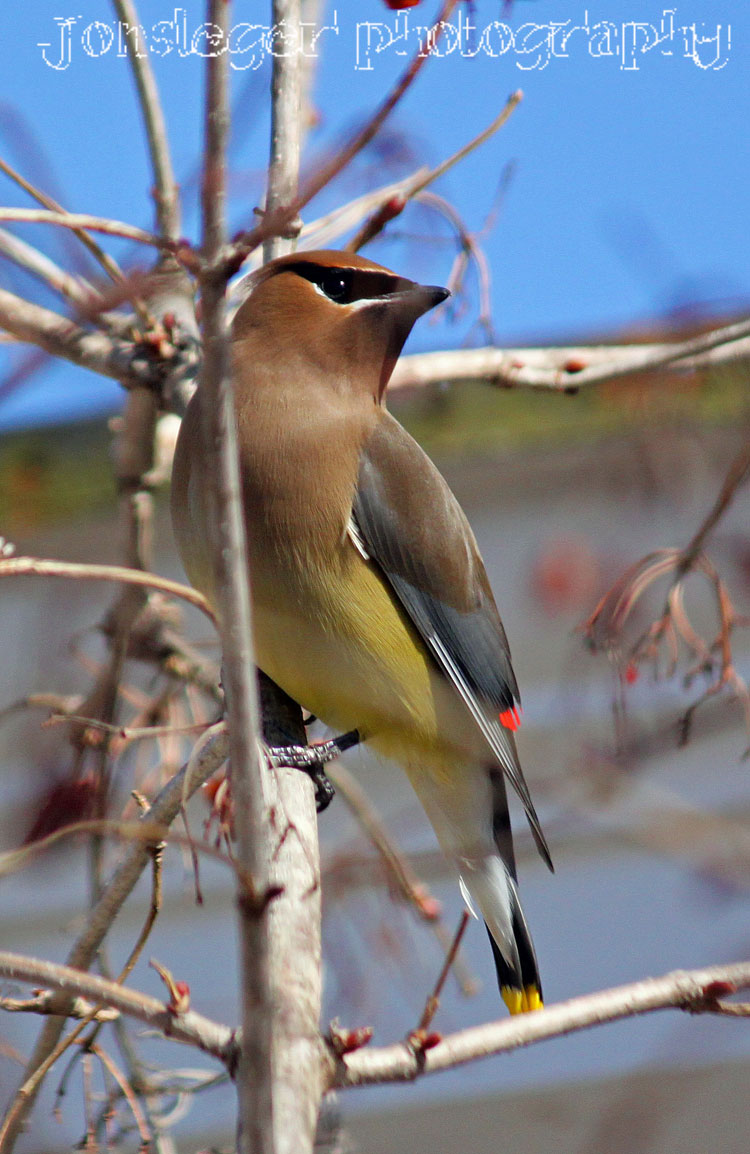
This beautiful Cedar Waxwing
showing off his"angry"
look with its with black mask,
Galena, IL; 3/28/11.
 Our beautifully marked Cedarr Waxwings (Right) are another year round resident of Northern Illinois. They Spend all year in the northern half of the country, but in winter will spread down to the southern half, and in the summer months will be found throughout most of Canada as well.  Of the two types of waxwings found in the U.S., the Cedar is the most common. Its cousin, the Bohemian Waxwing (sorry no pics) live farther north in Alaska and Canada in the Summer and will venture into the U.S.'s northern states in winter. I have never seen a Bohemian ... yet.

A Ceadar Waxwing in Rock Cut State Park,
Rockford, IL; 8/2/09.
Cedar Waxwings travel in small flocks of a half dozen or so to larger flocks of several dozens. But when nesting they will split off into their mated pairs.  These Waxwings are very easy to spot, with bright spots of color offsetting their general light brown bodies and grayish wings. They have bright yellow tips of their tails (Bottom pic) as well as pale yellow bellies. Also a bright red stripe on their secondary wing feathers with white inner edges of their tertials. However, their most identifiable feature is their heads sporting a fine feathered out crest and spooky black mask outlined in white. This mask which slants back to a sharp point, makes them look like have a perpetual scowl as if they're angry about some misjustice that just took place. My GF, Val, might say they are an "angry bird" her current favorite screen game that she plays on her phone.  Though these Waxwings look nothing like Val's "angry birds."

If you want to find a Waxwing, look for a bush with berries, Waxwings' favorite food (Below).

A Cedar Waxwing eating his favorite meal - berries, Galena, IL; 3/28/11.

The glowing bright yellow tail of a Cedar Waxwing, Galena, IL; 3/28/11.

Thursday, April 7, 2011

Blue Jays, Crows & Starlings - IL winter birds

A Valentine's Day sunrise sets the icicles hanging off the eves on fire, Rockford, IL; 2/14/10.


Three more birds that are very common all year long in Northern Illinois are the Blue Jay, American Crow and European Starling.  All three of these birds have adapted well to human settlements and can be seen in parks and suburbs as well as forest preserves and rural areas.

The beautifully marked Blue Jay at our backyard feeder, Rockford, IL; 1/30/10.
Blue Jays (Above) are found all year round east of the Rockies. They feed on both insects as well as large nuts (acorns and corn kernels) and seeds.  There are actually two versions of the Blue Jay: The pale version which is shown (Above and Below), and the dark version whose nape is dark blue instead of grayish and the throat has more blue on it than the grayish white throat of the pale. Othrewise they are the same. Their range spreads into Canada all the way south to the Gulf Coast states.

Another "pale" adult Blue Jay, Rockford, IL ; 1/3/10.

This American Crow sitting on top of our backyard grill is wondering why we aren't out there grilling him up a meal; talk about oppurtunistic! Rockford, IL; 11/7/10.
Another member of the Corvidae family (Jays, Magpies and Crows) is the all-American Crow (Above). These guys are found coast to coast spreading just a bit north into Canada and southward to the Gulf Coast, but not found in the deep southern edges of the southwest states (Texas, Arizona, New Mexico and Cal.). In these parts the Raven is more prevalent.

A European Starling, in winter "white-spotted" plumage, enjoying the suet cake in our backyard on New Year's day,
 Rockford, IL; 1/1/11. 
European Starlings were introduced in America from Europe in the late 1800's and are now very common and widespread all year round throughout the entire U.S. and into Canada and Mexico. They will nest anywhere - birdhouses, crevices in buildings, tree cavities, and are very aggressive toward other birds. They travel in large mobs making a lot of noise. In winter their plumage is a a glossy black with white dots all over (Above). In summer, their plumage takes on a myriad of irridescent colors looking like a mosaic (Below).

The mosaic-like backside of a European Starling, showing off its breeding plumage of spots and stripes,
Montrose Point, Chicago, IL; 3/30/11. 

Wednesday, April 6, 2011

Ring-billed Gulls, Herring Gulls and Belted Kingfishers

A winter creek in Rock Cut State Park, Rockford, IL; 1/30/11.

A floating Ring-billed Gull, North Pond, Chicago, IL; 10/30/10.

Two shorebirds, the Ring-billed Gull and the Herring Gull are found year round in northern Illinois, espaecially off Lake Michigan and along the major waterways of the Rock, Mississippi and Illinois Rivers. But they can also be found inland from time to time near other water sources. I've seen them both at Rock Cut State Park and Nygren Wetlands Preserve. The Ring-billed Gull will call Lake Michigan a year round home, but in the summer months will migrate north into Canada. In winter months, it will be found throughout much of the lower 48 states, except for the northern plains states, and the Rocky Mountain states.

A Herring Gull resting on the rocky shores of Lake Superior, Upper Michigan; 5/26/07.
Another gull that will sopend year round in our parts and throughout much of the Great Lakes region, is the Herring Gull (Above).  these Gulls will also spend yer round along the Northern atlantic coasts, but in summer they will generally be spread throughout Canada and Alaska. In winter they can be found throughout the eastern half of the nation as well as alng the Pacific coastal states. They will avoid the mountains (Rockies and Appalachians).


I've been chasing this belted Kingfisher at Rock Cut State Park for over a year and finally caught it in my viewfinder a couple of weeks ago, Rockford, IL; 3/27/11.
Another year round bird that will be found along river banks and both freshwater lake shore lines and ocean coasts is the Belted Kingfisher. These unique birds will be found anywhere there is fish to be caught. They will be found year round from coast to coast save for the upper plains and southwest. In the summer they will migrate north into Canada and Alaska, and in winter they will migrate south to the southwest and into Mexico. Belted Kingfishers are very striking with its blue body and shaggy crest and white breast and collar, and very long bill. The females will sport a reddish band across its chest and sides, while the male will sport a blue band across its chest. Ever since I spotted a particular Belted Kingfisher at Rock Cut, I've been trying to get its photo. It seems that I am always a beat behind.  Several times I got an open view of this bird, only to have it fly away the instance I lift my camera to focus. Each time it flies away with its chattering call - as if it is laughing at me. This skittish bird is out of sight whenever I get within photo distance.  And it always takes off laughing at me as if to say, "You'll never take a picture of me, haha!" I finally got it in my viewfinder just a couple of weeks ago and immediately after I snapped the photo it took off flying, chattering and disappearing into the tree line.

Tuesday, April 5, 2011

Year round Tree Clinging Birds

The winter sun casts swirly shadows on the snow, Rockford, IL; 2/3/11.
Three tree-clinging birds that spend all year in Northern Illinois are the Downey Woodpecker (6 3/4" long), the Red-bellied Woodpecker, and the Northern "Yellow-shafted" Flicker.


A Downey Woodpecker enjoying its winter meal of suet, Rockford, IL; 2/3/11 
The Downey Woodpecker (Above) is widespread throughout the U.S.  from coast to coast up into Alaska and south into Florida. There are pockets in the Southwest (Nevada, Southern Cal, the southern half of Ariz and New Mex, as well as western Texas) that Downey Woodpeckers are not residents.
A Red-bellied Woodpecker, Rockford, IL; 1/31/10
The Red-bellied Woodpecker (9 1/4" long) (Above) can be found year round the eastern half of the U.S. extending north into Wiscosin, Minnesota, and South Dakota down to the Gulf Coast.

A Northern Yellow-shafted Flicker, Rock Cut State Park; 3/27/11.
The Yellow-shafted Northern Flicker is another year round resident of Northern Illinois.  It can be found throughout the U.S. and in the summers north into Canada. Although it clings to sides of trees like woodpeckers, it actually spends a lot of time foraging on the ground looking for ants and insects.  Flickers at 12 1/2 " long are larger than the two woodpeckers in this post.
The same Northern Flicker; 3/27/11.

Monday, April 4, 2011

American Goldfinch


Ice forms on the foliage during a January ice storm in Rockford, IL; 1/17/10.

Goldfinches in their winter plumage at the backyard feeder, Rockford, IL; 1/5/11


An American Goldfinch with an unusual white patch on its crown
foraging on the ground in our back yard, Rockford, IL; 11/21/10 
American Goldfinches are an everpresent bird in both our backyards and parks and forest preserves year round. And if you watch closely you can witness their transformation from their drab winter plumage (Two pics Above) to their brilliant breeding plumage (Two pics Below).

A male American Goldfinch in the midst of growing its breeding plumage, Rockford, IL; 3/20/10

An American Goldfinch in its full golden regalia, Horicon Marsh Wildlife Preserve, WI; 5/29/10.
American Goldfinches are common and widespread from coast to coast year round through the central belt of the U.S. In summers they will spread up into Canada. and in the winter they will spread into the southern third of the U.S.

Sunday, April 3, 2011

Red-winged Blackbirds, Common Grackles, Brown-headed Cowbirds

A large snowdrift pushed up against the back of our house; just another thing to look forward to in a Northern Illinois winter, Rockford, IL; 2/2/11

Three other birds that I have often thought migrated south away from Northern Illinois are the Red-winged Blackbird, the Common Grackle and the Brown-headed Cowbird. However several bird guidebooks state that they can spend the winter in our area. For myself, I have never seen any of these three from November through February.  Usually mid to late march will be the first I see any of these.

I have seen many Red-winged Blackbirds (Above) since mid March, but I never see them between October and March. But according to several bird guide books, they may spend the winter in northern Illinois, as well as pretty much the entire U.S. except for the northern regions of the midwest states (Wisconsin, N.Dakota, Minnesota, Michigan) and much of the Northeast. In summers they will spread their range into all of the U.S. plus most of Canada.
A Red-winged Blackbird BIF, Blackhawk Springs Forest Preserve; Rockford IL.
 
A Red-winged Blackbird, Rock Cut State Park, Rockford, IL; 5/2/10.


A Common Grackle at my backyard feeder, Rockford, IL; 3/28/10.
The Common Grackle (Above) will be found throughout most of the U.S. east of the Rockies (including the Rockies), but in winter they will limit their range to the Midwest, Southeast, and Central Atlantic states. Again, like the Red-winged Blackbird, eventhough they are considered year round residents, I didn't see them all winter and just within the past two weeks they have been arriving in Northern Illinois by the droves. These Grackles are quite long at slightly over a foot. Their irridescent feathers will change colors depending on the angle of light hitting them.
A Brown-headed Cowbird, Rockford, IL; 4/2/10.

Brown-headed Cowbirds (Above) are  another bird that is considered year-round residents, but I also never see them in winter months. These Cowbirds are not considered friendly birds to have around, as the adults lay their eggs in other birds' nests and force them to raise their young. Often times the young Brown-headed Cowbird will take all the food brought by the nest's mother and crowd the other young out of the nest altogether. In summers Brown-headed Cowbirds can be found liteally from coast to coast thoughout the entire North American continent, except for Alaska and extreme northern Canada. In winter they will limit themselves to both coasts and throughout much of the lower half of the U.S. stretching north to Northern Illinois, Indiana, and into Massachusettes.


Saturday, April 2, 2011

Northern Illinois Year Round residents - Ducks, Geese, and Turkeys


Canada Geese at Blackhawk Springs Forest Preserve, Rockford, IL; 2/12/11.

The two most obvoius birds that spend year round almost everywhere in the U.S. are the water birds: Canada Goose (Above) and Mallard Ducks (although two are Mallards mixes with another species) (Below two pics).
A pair of Mallards; the male is an obvous mix a it is sporting a white throat which 100% male Mallards would not have, and no red breast which 100% Mallards would have, Rock Cut State Park; 3/26/11.
This male Mallard accompanied by a female hybred (perhaps a mallard and Black Duck mix? another Mallard mix sporting a white throat), Rock Cut State Park, Rockford, IL; 3/27/11.
A flock of Wild Turkeys at Rock Cut State Park, Rockford, IL; 2/27/11
A third bird that is seen often year round in these parts is the Wild Turkey (Above) and (Below).

A Wild Turkey at Rock Cut State Park; 2/27/11.