Thursday, August 25, 2011

Ruby-throated Hummingbird - Texas Birds


A male Ruby-throated Hummingbird, Texas; 6/22/2011.
Hummingbirds are always fun to watch as they buzz around flower gardens and Hummingbird feeders. My sister in Texas, had a hummingbird feeder which she filled with sweetened beet juice. It sure worked. Not long after she filled it and hung it up, a Ruby-throated Hummingbird (Above & Below) found it and spent much of the hot afternoon drinking the beet juice. Ruby-throats are the only Hummingbird we have in Illinois, and in Texas it is one of two (along with the Black-chinned) that are common in Texas.
A male Ruby-throated Hummingbird feeding on beet juice, Texas; 6/22/2011.

A female Ruby-throated Hummingbird, Superior, WI; 8/9/2011.

Female Ruby-throats (Above), actually don't possess the brilliant red throat  A couple of weeks ago while travelling up to the Boundary Waters in Northern Minnesota, we stopped at a lakeside park off of Lake Superior in Superior, WI, there was a bouquet of Ruby-throats hovering around a flower garden in this park.
Sunset of the day
Sunset photo taken from out of the car window in Michigan; 8/7/2008.

Wednesday, August 24, 2011

Eastern Bluebirds - Texas Birds

Eastern Bluebird, Texas; 6/22/2011.
Bluebirds are always fun to spot and watch. A pair of Eastern Bluebirds (Above) made their home in a birdhouse on my sister's property in Texas. Every mourning, you could see them flying back and forth between the bird house and the garden.
Eastern Bluebird, Rock Cut State park, IL; 4/9/2011.
Earlier in the spring, I caught a good pic of an Eastern Bluebird (Above) in Rock Cut State Park, near where I live in Northern Illinois.
Sunset of the Day
Illinois sunset on Pierce Lake in Rock Cut State Park; 6/14/2007.


Tuesday, August 23, 2011

Yellow-billed Cuckoo - Texas Birds

Yellow-billed Cuckoo, Texas; 6/23/2011.
On my last morning visiting my sister in Texas, I made one last hike around their property, and I heard a bird that I had heard the two previous days. So three days in a row I heard this bird call which started out as a sort of a knocking then turn into a slow repetitive series reminiscent of a lower gutteral crow. I had no idea what kind of bird this was (thinking perhaps it was some sort of upland game bird or rail), so I tried my best to follow the sound, untill I heard it in a very close proximity, and saw a rather large bird fly into a nearby tree.  While I was getting ready to focus on it, it made the call that I had been hearing for the past 36 hours. It was hidden in a shady section of the tree which didn't make for a very good photo, but it soon flew to another tree in a more sunny open spot and stayed long enough for me to get my picture (Above). As soon as I saw it through my viewfinder,  suspected it was a Cuckoo, but since I have never seen nor heard one before, I wasn't positive. Later on after researching, my suspicions were confirmed as it indeed was a Yellow-billed Cuckoo (#320 on my Life List). They are a large bird (a foot long) with a brown head, back and tail, offset with a white throat, breast and belly, and of course, a large slightly hooked yellow bill (thus its name). Although my photos do not show it, their tails have a distinct white and black striping.
A Yellow-billed Cuckoo feeding on an insect, Texas; 6/23/2011.
Yellow-billed Cuckoos are found in much of the U.S. and Mexico, ranging from the southern states from the Atlantic Coast westward to Arizona. They extend their range as far north as South Dakota in the west
spreading east through southern Minnesota, Wisconsin, Michigan and into the Northeast.

Sunset of the Day
Storm clouds helped create this sunset in the Grand Tetons Nat. Park, WY; 6/15/2006.

Monday, August 22, 2011

Summer Tanager - Texas Birds

A juvenile Summer Tanager, Texas; 6/22/2011.
While visiting my sister and her husband in Texas, we were on their back deck when we all noticed a colorful bird at their birdbath (Above). I thought it was a Summer Tanager, but the coloring didn't look quite right.  After looking it up in my trusty Sibley Field Guide to North American Birds, I found it to be a juvenile Summer Tanager. Adult males are all red and adult females are yellow. This guy had traits of both colors.

A juvenile Summer Tanager, Texas; 6/22/2011.
The juvenile Summer Tanager (Above) must have liked the cool birdbath in the 90°+ weather, because it appeared several more times that afternoon.

A juvenile Summer Tanager getting ready to dive into the birdbath, Texas; 6/22/2011.
At one point, he was taking dives (Above) into the bath and dunking himself (Below), and it was fun getting this all recorded with my burst mode.

A juvenile Summer Tanager cooling off, Texas; 6/22/2011.
A juvenile Summer Tanager enjoying his bird bath, Texas; 6/22/2011.
Summer Tanagers can be found throughout the southern states from Arizona to Florida and as far north as my neck of the woods in Northern Illinois, as well as Indiana and Ohio.

A female Summer Tanager, Sequoyah Nat. Wildlife Refuge, Oklahoma; 6/23/2011.
Then just a day later, after we left Texas, to break up our day's drive we stopped in Sequoyah National Wildlife Refuge found on the eastern edge of Oklahoma. While hiking through this refuge we came across a pair of adult Summer Tanagers. Female Summer Tanagers (Above) are completely yellow with darker wings and a large bill. Male Summer Tanagers (Below) are completely red.

A male Summer Tanager, Sequoyah Nat. Wildlife Refuge, Oklahoma; 6/23/2011.

A female Summer Tanager, Sequoyah Nat. Wildlife Refuge, Oklahoma; 6/23/2011.

A male Summer Tanager, Sequoyah Nat. Wildlife Refuge, Oklahoma; 6/23/2011.
This pair of Summer Tanagers gave us several good looks to get some decent photos. Together with the juvenile from Texas, Summer Tanagers became #317 on my Life List.

Sunset of the Day

Sunset from our Mineral Park Campground in the North Cascades Nat. Park, Washington State; 7/3/2006.

Sunday, August 21, 2011

Scissor-tailed Flycatcher - Texas Birds

Male Scissor-tailed Flycatcher, Texas; 6/22/2011.
My dream came true! Whoo Hoo! While we were driving across North Texas on the way to my Sister's house in Northeast Texas, I saw several Scissor-tailed Flycatchers flying along the side of the highway. There is no mistaking this bird for any other, as it has an extremely long tail (Above) and can be found in a small area of the U.S. - Texas, Oklahoma, Kansas, and the western edges of Missourri, Arkansas, and Louisiana. So as we were travelling through Texas, I thought this is my chance to spot one. But just seeing them out the window in fleeting moments as our car drove past, wasn't good enough. I was hoping that I'd get a chance to see one in close range when we get to our destination.

Female  Scissor-tailed Flycatcher, Texas; 6/22/2011.
When we arrived at my sister's house late in the day on 6/21, it was already too late to do any serious birding, but to be sure, I was up early the next mourning to do some birding on their beautiful 30+ acres. Sure enough within the hour, I found a pair of Scissor-tails flitting about between a large tree and the telephone wires in the front yard. Needless to say I was happy to get several photo oppurtunities.
Female BIF of a Scissor-tailed Flycatcher, Texas; 6/22/2011.
Scissor-tails have a whitish / pale gray body, a bit darker on its back and lores. Their wings and long tails are black and have some orangish coloring on its flanks and undertail area. After getting a few good shots while they were perching, my next goal was to try to get a BIF ("Bird in Flight") to show off their long tail in the 'scissors' position. I did get a pretty decent photo of the female (Above) but never did get a good shot of the male's much longer tail in flight.
Male Scissor-tailed Flycatcher, Texas; 6/22/2011.
The Scissor-tailed Flycatcher became #316 on my Life List - and perhaps my favorite, because for so long as I looked at photos of these beautiful birds, I never thought I'd get a chance to see one. A big "Thank you" to my Sister and Brother-in-Law for moving to Texas and inviting us to their property!

Sunset of the Day
Sunrise on a Texas ranch; 6/22/2011.


Saturday, August 20, 2011

Hairy Woodpecker - Texas Birds

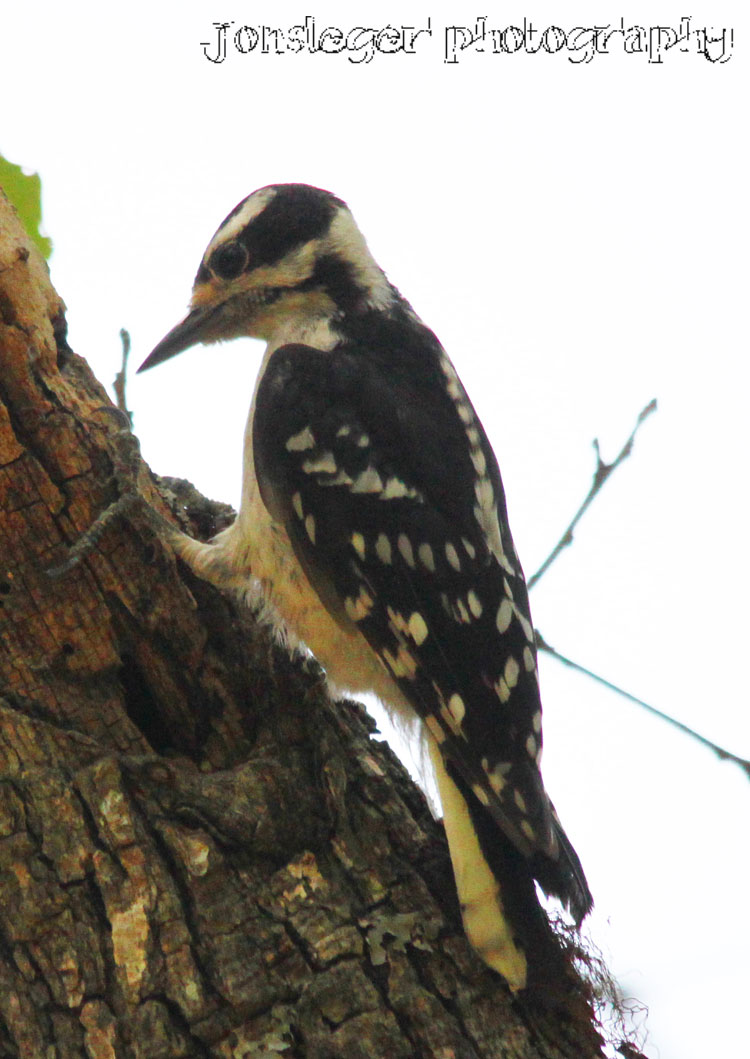
A female Hairy Woodpecker, Texas; 6/22/2011.
Another addition to my Life List was the Hairy Woodpecker as one (or more) was quite visible on the property in Texas owned by my Sister and Brothert-in-Law. Hairy Woodpeckers are found throughout the U.S. from coast to coast and from Mexico to Canada although not as common as the Downy Woodpecker. They are very similar in appearance to the Downey, the main difference being its call and the size of its bill. The Hairy's bill is much larger in proportion to its head than a Downy's. So for the past year or two, everytime I saw a Downy (which is 99% of the time), I was hoping that it was a Hairy, and I would study the photos I took, trying to convince myself it was really a Hairy WP so I could add it to my Life List (#319). But until I saw how large the Hairy's bills really are (Above and Below), I knew all of my previous photos were of Downys.

A good look at the Hairy Woodpecker's large bill, Texas; 6/22/2011.
Hairy Woodpeckers are also quite a bit larger (9-1/4" long) than a Downey (6-3/4" long). But for me, until I get more experience, I probably would not be able to differentiate in overall length between the two unless they were side by side. (Below) I included a photo of a Downy so one can see how short its bill is compared to a Hairy.
A female Downy Woodpecker and its much smaller bill, Rockford, IL;11/8/2009.
Sunset of the Day
Sunset in the Blue Ridge Mts, North Carolina; 6/14/2010.

Friday, August 19, 2011

Mississippi Kite - Texas Birds

Mississippi Kite, Texas; 6/22/2011.
One of the birds I saw on my Sister's and Brother-in-Law's property in Texas was an addition to my Life List, a Mississippi Kite.  Unfortunately, the mourning I spotted this raptor sitting on an open branch of a dead tree about 50 yards away, the light was very low and gray, so the photo (Above) was the best I could manage with my 500mm Sigma Lens with ISO capacity of only 5.3-6.

In the summer months, Mississippi Kites are found in the South from Texas to Florida, and extend as far northwards as Southern Illinois, Kansas, and North Carolina. Occasionally they will wander further north as evidenced late last summer, there was a pair of these guys in Rockford (Northern Illinois) for a few days before they must have realized they were out of their zone and departed. They evidently didn't read the bird guides.
The photo (Above) almost looks like a black & white photo, but it is not and as it suggests, Mississippi Kites are devoid of color. They are plain gray with a pale head set off with a darker eye mask and tail. They are one of our smaller raptors at only 14" in length.

Sunset of the Day
A purple Sunset at the Eastern most point in the U.S., Quoddy Head State Park, Maine; 7/31/2008.