Saturday, May 11, 2013

Texas 2013 Springbreak Birding Trip: Day #2 & Yellow Rail Walk

DAY 2, APRIL 14, 2013

On day 2 (April 14. 2013) of my Texas Spring break Birding Trip I visited a total of 5 locations, 3 Bird Sanctuaries in High Island and 2 more in the Anahuac National Wildlife Refuge.

Day's Totals:  Total Species: 71,   Lifers: 8
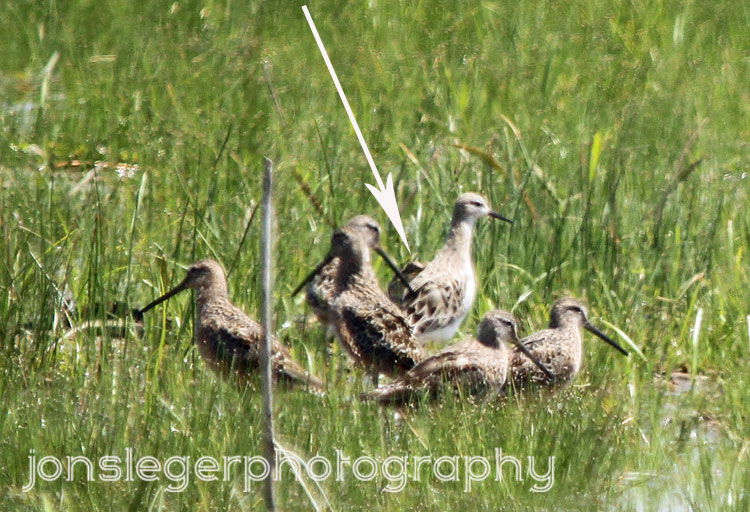
Bird of the day: one of my Lifers, a female Ruff, a rare sighting of a bird from Eurasia, It is the light taller bird in the center of the picture. Also the bird in the right hand corner is a Stilt Sandpiper, another Lifer for me,  Skillern Tract, Anahuac NWR, TX; 4/14/2013.
All in all it was a very satisfying 2nd day of my trip. The 8 Lifers I saw today surpassed my 6 from yesterday, which gave me a total of 14 lifers in my first two days of my 7 day trip. However, none of these Lifers came in the mourning, which I spent in 3 different bird sanctuaries in High Island.
When I planned out my Texas trip, I thought that High Island would be one of the "highlights" of my trip, with all the hype it receives about its heavy migration traffic in the Spring. I was very disappointed with my time spent here.  I saw a total of only 31 different bird species in the three locations altogether, and none of the pictures that I am featuring in this blog are from my High Island photographs, because none of them were very interesting or striking. The most interesting of the birds I saw came from the Smith-Oaks Rookery - of nesting Spoonbills, Cormorants and Egrets - all of which can be seen in my last post:( http://northernillinoisbirder.blogspot.com/2013/05/southeastern-texas-2013-springbreak.html ).

The breakdown of the birds seen within each of the Bird Sanctuaries is listed below:

BOY SCOUT WOODS BIRD SANCTUARY
Total Species: 15
Lifers: 0
Birds Seen: Baltimore Orioles, Blue Jay, Brown-headed Cowbird, Gray Catbird, Great-tailed Grackles, Mourning Doves, Northern Cardinals, Northern Mockingbirds, Orchard Orioles, Red-eyed Vireo, Red-winged Blackbirds, Warbling Vireo, White-eyed Vireo, White-throated Sparrow, White-winged Doves

EUBANKS BIRD SANCTUARY
Total Species: 7
Lifers: 0
Birds Seen: Blue Jay, Gray Catbird, Great-tailed Grackles, Green Heron, Northern Cardinal, Northern Yellow-shafted Flicker, Ruby-crowned Kinglet

SMITH-OAKS BIRD SANCTUARY
Total Species: 18
Lifers: 0
Birds Seen: American Coots, Anhingas, Black-bellied Whistling Ducks, Black Vultures, Blue-winged Teals, Common Moorhen, Double-crested Cormorants, Gray Catbird, Great Egrets, Great-tailed Grackles, Green Heron, Mourning Doves, Neotropic Cormorants, Northern Cardinals, Northern Mockingbirds, Palm Warblers, Roseate Spoonbills, Turkey Vultures

A Crested Caracara, became my first Lifer of the day when I was driving between High Island and Skillern Tract, TX; 4/14/2013.
I decided to abort my High Island birding and take another trip out to Anahuac National Wildlife Refuge which I enjoyed very much the day before. I decided to take a different route so I could go to an area called "Skillern Tract" which is does not physically adjoin Anahuac, but is considered an extension of the Refuge. I overheard some birders in High Island say that a Ruff (Pic at the top of page) was sighted there, so I thought I'd try my luck. On my drive out I stopped three different times along the road to take pictures, one was of another Lifer, a Crested Caracara, which was sitting atop a utility pole (Above). It is not a very good picture as the "Mexican Eagle" as it is sometimes called, was high on the utility pole and backlit by the bright midday sun.

ROADSIDE BIRDS
Total Species: 12
Lifers: 1 (Crested Caracara)
Birds Seen: Belted Kingfishers, Black Vultures, Cattle Egrets, Crested Caracara, Glossy Ibis, Great Egrets, Great-tailed Grackles, Killdeer, Northern Mockingbirds, Red-tailed Hawk, Red-winged Blackbirds, White-faced Ibis.

The same photograph as the top of the page with the alligator highlighted, Skillern Tract, Anahuac NWR, TX; 4/14/2013.
When I arrived to Skillern Tract, I didn't need any luck. There was a large group of birders present with cameras and scopes with the Ruff fully "scoped" out.  All I needed was to have it pointed out to me and snap away. It was quite far out in the marshy grassland so I knew my pics would not be of high quality. After viewing my pics at the end of the day, I noticed a funny looking bird just to the right of the Ruff, and realized it was a young alligator - sitting in the midst of the birds (Above). I could only guess that by how still it was posed, it was waiting for a bird to get close enough for it to snatch a meal. While I was out in the field with the other birders, I do not recall anyone mentioning the fact that there was a predator within a few feet of the prized rare Ruff. Within a few shots I saw that the birds were getting closer to the gator (Below).

The gator looks awfully close to the Ruff and Dowitcher to me. It also has a smug smirk on its face as if he knows within seconds he has a delicious meal in his jaws, Skillern Tract, Anahuac NWR, TX; 4/14/2013.

In this pic, the Ruff is directly in front of the gator (the arrow pointing to it), which is till in its frozen pose. It's hard to tell just how close the gator is to the birds, but it still did not make a lunge at the a bird, Skillern Tract, Anahuac NWR, TX; 4/14/2013.
(Above) the gator and birds appear literally next to each other, but still the gator is holding its pose without making an attempt to grab one of the birds. Later the small flock of Dowitchers and the Ruff suddenly flew off and landed in a different spot in the marsh. I wondered if the gator made a move and scared off the birds.

Also several yards further out past to where the Ruff was feeding was a flock of Hudsonian Godwits (about 8-10) mixed in with other wading birds. They were pretty far out. My 150-500mm Sigma lens was able to get pictures enough to identify the Godwits, but the photos themselves were of worse quality than my Ruff pics, and did not deserve to be featured in this post.

SKILLERN TRACT (ANAHUAC NWR)
Total Species: 5
Lifers: 3 [Ruff (Rare sighting), Hudsonian Godwits, Stilt Sandpiper]
Other Birds Seen: Black-necked Stilts, Long-billed Dowitchers,

In a matter of a half hour I was able to add 4 new species to my Life List (starting with the Crested Caracara and ending with the Hudsonian Godwits). Not a bad half hour in my trip. After my brief stop at Skillern Tract, I continued on to revisit the Anahuac NWR. My bird list from that visit is below, which includes another 4 Lifers for me...

ANAHUAC NATIONAL WILDLIFE REFUGE
Total Species: 47
Lifers: 4 (Seaside Sparrow, Sedge Wren, Wilson's Phalarope, Yellow Rail)
Birds Seen: American Coots, Barn Swallows, Black-necked Stilts, Black Vulture, Blue-winged Teals, Cattle Egrets, Common Moorhen, Common Yellowthroat,  Double-crested Cormorants, Dunlin, Eastern Kingbirds, Eastern Meadowlark, Forster's Terns, Glossy Ibis, Great Blue Heron, Great Egrets, Greater Yellowlegs, Great-tailed Grackles, Killdeer, Laughing Gulls, Least Sandpipers, Lesser Goldfinch, Lesser Yellowlegs, Long-billed Dowitchers, Northern Cardinals, Northern Harrier, Northern Mockingbirds, Northern Shovelers,  Red-tailed Hawk, Red-winged Blackbirds, Roseate Spoonbills, Savannah Sparrows, Scissor-tailed Flycatcher, Seaside Sparrows, Sedge Wrens, Snowy Egrets, Sora Rail, Stilt Sandpipers, Tree Swallows, Turkey Vultures,  Vesper Sparrow, White-faced Ibis, White Ibis, Willets, Wilson's Phalarope, Yellow-crowned Night Heron, Yellow Rail.

White-face Ibis either stretching or drying their wing feathers in the sun, in a field near Skillern Tract, Anahuac NWR, TX; 4/14/2013.
On my drive out of Skillern Tract I observed a stand of White-faced Ibis (Above) holding their wings up in the air as if they were in a classroom and a few of them knew the answer of a question asked by the head-ibis.
A Common Moorhen in the reeds, Anahuac NWR, TX; 4/14/2013.
A Killdeer sitting on its stone nest along the roadside, Anahuac NWR, TX; 4/14/2013.
I had another successful visit to the Anahuac National Wildlife Refuge, observing almost another 50 species and adding 4 more Lifers to my list. After a couple of hours of exploring this fantastic Refuge, I was on my way out and saw a Killdeer (Above) sitting on the gravel shoulder of the narrow main road. I knew immediately that it was on a nest. I decided to pull over, well away from the Killdeer as not to startle it, to try to get some photos.
Its eggs are visible under the Killdeer as it rose to confront me when I came too close for comfort,  Anahuac NWR, TX; 4/14/2013.
I slowly approached the Killdeer, wondering how close I could get before it would go into its "broken wing" routine, and in a way wanting to capture it on video.  The fearless Killdeer allowed me to come within 30 feet before it even stood up (Above). It did not move away from its eggs and I felt guilty about making it rise, so I did not push the bird into its "broken wing" routine, and I backed away to leave it alone. For those of you readers who may not be familiar with a Killdeer's behavior when it feels something is threatening its nest, it will pretend to be injured and flop around trying to lure the predator to follow it (thinking it is injured thus an easy target for a meal) away from the nest, thus protecting the eggs from being a potential meal. I very much respect the fearlessness of Killdeers.

A Seaside Sparrow, during the "Yellow rail Walk,"  Anahuac NWR, TX; 4/14/2013.
The Yellow Rail Walk
As I was leaving the Refuge, I decided to pull into the little building and report to the managers on duty about the Killdeer nest, just in case they didn't know about it - it was only a couple hundred yards from their kiosk. As I was there, we got to conversing about the sightings of the day (mine and others) and they asked if I was going on the "Yellow Rail Walk" which was happening in just 15 minutes.  I didn't know about it, but I didn't need to be anywhere, so I asked about what it was about.  As it was explained to me  - a group of people walk out into the marshy sedge grass pulling a rope (Approx. 50' in length) with old gallon milk jugs attached with 5-10 feet of space between them. The jugs have some stones in them to weigh them down a bit but not to make them too heavy to pull. This rope is pulled through the marsh, the habitat of the Yellow Rail, in hopes of causing the Rail to try to get out of the way. When the Yellow Rail is spotted by one of the group everyone makes a tight circle around the Rail keeping our feet close together so the Rail can't escape between our legs. Rails are noted for their "iron will" by holding their place and not moving as people or animals walk right past them.  If we are able to keep the Rail inside the circle long enough for everyone in the group to see it, the leader of the "Rail Walk" reaches down in attempt to pick it up to show everyone. Usually the Rail will then fly up high enough to clear the circle of people and escape back into the sedge. During our 30-40 minute walk, we were able to scare up one Yellow Rail, but along with the Rail, we saw many Seaside Sparrows and Sedge Wrens flying out of our path. Both were also Lifers for me. 3 more Lifers in a half an hour.  Because the "Rail Walk" had difficult footing and we needed to always be looking at the ground to keep ourselves from tripping in the sedge or over clumps of mud and fire-ant hills, there wasn't much time to focus on birds, which were flying quickly out of the marsh and landing in the tall grass usually out of sight. I didn't get a chance to photograph a Sedge Wren, but I did manage to focus on a Seaside Sparrow (Above) before it hid in the tall grass. It's not a great photograph, but I was surprised that I was able to get it in my viewfinder and take a picture, while I was high-steppin' it through the marsh, before it hid itself again.

More photos from the afternoon at Anahuac NWR below:


Eastern Meadowlark, Anahuac NWR, TX; 4/14/2013.


Lesser Yellowlegs,  Anahuac NWR, TX; 4/14/2013.
Snowy Egret,  Anahuac NWR, TX; 4/14/2013.

A Vesper Sparrow,  Anahuac NWR, TX; 4/14/2013.
A juvenile White Ibis,  Anahuac NWR, TX; 4/14/2013.

The always beautiful Scissor-tailed Flycatcher,  Anahuac NWR, TX; 4/14/2013.
On my way out of the Refuge to call it a birding day, I found one last species sitting on a wire fence, a Scissor-tailed Flycatcher (Above). No matter how often I see them when I am in their territory, I am always attracted to them and want their pictures, because their long tail is so unique and they do not make their way to Northern Illinois, where I live, so I don't et to see them very often. It was a good ending for my second day of birding.

My next post will cover Day 3 of my Texas trip at Aransas National Wildlife Refuge.

Friday, May 3, 2013

Southeastern Texas 2013 Springbreak Birding Trip Report

THE LONE STAR STATE
= MULTI-BIRD STATE
 
A Ferruginous Hawk watching me watching him. My first Lifer of the trip. Anahuac NWR, TX, 4/13/2013.
This winter when I was planning a birding trip during my Spring break from teaching school, I was looking at several places, but ultimately decided that Southeastern Texas would give me the most opportunities to find birds that I would not find anywhere else in the U.S.  So I made a vague plan of some of the areas that I would visit and see what luck may bring.

Disclaimer:  I am a Hiker turned Birder, so I tend to want to put on hiking miles. My birding efficiency is most probably lacking from what true serious birders may do. What I mean is that I find a place that sounds interesting or where a bird I am searching for may exist. Then I find a hike that "might" lead me to that bird. Regardless of finding the bird or not, I will finish the hike no matter the length. Of the 14 places I visited only at one (Sabal Palms Sanctuary, near Brownsville) I did not hike. I just stood on the Visitor's Center deck until the bird I was hoping to see, showed up (it did - Crimson Grosbeak). Then I left. But this is not my usual way of birding. Also I tend to be a bit impatient. While stalking a bird that I hear or see fleetingly in my peripheral vision, I do not stalk for hours waiting for the bird in question to show itself. I am more likely to spend at max 5- 10 minutes, and if the bird doesn't show itself in a reasonable position for a photograph opportunity, I move on.
 
Trip Results:
7 = Total days of trip (4/13 - 4/19/2013)
14 = Total # of places I visited (not including stopping along the road to take photos)
201 = Total # of species identified
           (probably could've been a lot more if I was less impatient or more competent).
32 = Total # of new species added to my Life List (probably could've been more if...blah, blah, blah)
6 = Total # of species added to my list of birds seen in the U.S. (not including Lifers above)
40 = Approximate total of miles hiked while stalking birds.
13  = Birds that I was hoping to find and/or thought I had a good chance but struck out: American Oystercatcher, Cave Swallow, Clay-colored Thrush, Green Kingfisher, Groove-billed Ani, Hook-billed Kite, Northern Beardless Tyrannulet, Purple Gallinule, Red-billed Pigeon, Swainson's Warbler, Tamaulipas Crow, White-tailed Kite.
 
DAY 1 REPORT (4/13/2013)
TOTALS: 85 SPECIES; 8 LIFERS

Anahuac National Wildlife Refuge was my first stop; however it was an unscheduled stop. I didn't even plan on visiting here. I was on my way to High Island (the place to be in April) when I saw the sign for the exit to Anahuac and I decided to make a stop to check it out - I needed to stop and stretch my legs and do some hiking. I was pleasantly surprised and impressed by both its Visitor's Center and its 34,000 acre refuge. My two visits here produced my highest yield of 76 different bird species  with 11 Lifers.
 

Black-necked Stilt, Anahuac NWR, TX, 4/13/2013.
 
ANAHUAC NATIONAL WILDLIFE REFUGE [52 species, 6 Lifers]
Lifers: Ferruginous Hawk (Top of page), White-tailed Hawk, White-faced Ibis (Below - bottom), Black-bellied Whistling Ducks, Fulvous Whistling Ducks, Boat-tailed Grackles (below-top).
A Boat-tailed Grackle fly by, I determined this was a Boat-tailed. not a Great-tailed, because its iris was very dark compared to the bright white iris of the Great-tails in this area. These Boat-tails became my 2nd Lifer of the trip, Anahuac NWR, TX, 4-13-13.

A White-faced Ibis, my 3rd Lifer of the trip, Anahuac NWR, TX, 4/13/13.
 
Other Sightings: American Coots, American white Pelican, Anhingas, Bank Swallows, Barn Swallows, Belted Kingfisher, Black Vulture, Black-crowned Night Heron, Black-necked Stilt (3rd pic from top), Blue Jay, Blue-winged Teals, Brown Pelicans, Cattle Egrets, Cedar Waxwing, Cliff Swallows, Common Moorhens (below bottom), Common Yellowthroat, Double-crested Cormorants, Dunlin, Eastern Kingbird, Eastern Meadowlark, Field Sparrows, Forster's terns, Glossy Ibis, Great Blue Heron, Great Egret, Greater Yellowlegs, Great-tailed Grackles, Green Heron (Below - top), Killdeer,  Laughing Gulls, Least Sandpipers, Lesser Yellowlegs, Loggerheaded Shrike, Mallard Duck, Mourning Doves, Neotropic Cormorants, Northern Cardinals, Northern Harrier, Northern Mockingbirds, Northern Rough-winged Swallows, Northern Shovelers, Osprey, Red-bellied Woodpecker, Red-tailed Hawk, Red-winged Blackbirds, Savannah Sparrows, Snowy Egret, Tree Swallows, Turkey Vultures, Vesper Sparrows, White Ibis, White-crowned Sparrow, Willets, Wood Duck, and Yellow-crowned Night Heron.
Green Heron, Anahuac NWR, TX, 4/13/2013.

Common Moorhen, Anahuac NWR, TX, 4/13/2013.


Pipevine Swallowtail, Anahuac NWR, TX, 4/13/2013.
More pics from Anahuac (below):
Savannah Sparrow, Anahuac NWR, TX, 4/13/13.

A pair of Blue-winged Teals,Anahuac NWR, TX, 4/13/13.
Snowy Egret, Anahuac NWR, TX, 4/13/13.
Laughing Gull, Anahuac NWR, TX, 4/13/2013.

Seven baby Alligators, Anahuac NWR, TX, 4/13/13.
I saw one baby alligator in a low marsh on one of my hikes. As I was focusing on it I noticed more movement in the water. Within seconds there were seven babies (Above) all within a couple square feet of each other.

SMITH-OAKS BIRD SANCTUARY, HIGH ISLAND [20 birds (12 not from Anahuac)]

0 Lifers; Other Sightings: American Crow,  Anhingas, Black Vultures, Blue-winged Teals, Brown Creeper, Common Grackle, Common Moorhen, Double-crested Cormorants, Downey Woodpecker, Eastern Kingbirds, Eastern Towhee, Great Egrets, Loggerheaded Shrike, Red-breasted Nuthatches (a surprise to find them this far south), Red-winged Blackbirds, Roseate Spoonbills, Scarlet Tanagers, Swamp Sparrow, Turkey Vultures, Warbling Vireo.
 
Special Note: This Sanctuary boasts a very large rookery with nesting Roseate Spoonbills, Great Egrets, and Double-crested and Neotropic Cormorants.

Nesting Cormorants in the Rookery, Smith-Oaks Sanctuary, TX, 4/13/13.

nesting Egrets and Spoonbills,  Smith-Oaks Sanctuary, TX, 4/13/13.
Roseate spoonbill at the Rookery,  Smith-Oaks Sanctuary, TX, 4/13/13.
Scarlet Tanager,  Smith-Oaks Sanctuary, TX, 4/13/13.

BOLIVAR FLATS [32 Species (21 diff from Anahuac &  Smith Oaks), 2 Lifers]

Least Tern,  Bolivar Flats, TX; 4/13/13.
Lifers: Piping Plover (Below), Least Tern (Above)
Piping Plovers were checking out the surf for a meal, Bolivar Flats, TX; 4/13/13.
Other Sightings: American Avocet (Below), American Golden Plover, Black Skimmers, Black Tern, Black-bellied Plover, Black-necked Stilts, Blue-winged Teals, Brown Pelicans, Caspian Terns, Cattle Egret, Common Terns, Forster's Terns, Great Blue Heron, Great Egret, Herring Gulls, Laughing Gulls, Least Sandpiper,  Marbled Godwits, Reddish Egret, Ring-billed Gulls, Royal Terns, Ruddy Turnstone, Sanderlings, Sandwich Terns, Scissor-tailed Flycatchers, Semipalmated Sandpipers, Tri-colored Heron, Western Sandpiper,  Willets, Wilson's Plovers.

An American Avocet in full breeding plumage, Bolivar Flats, TX; 4/13/13.
Bolivar Flats is a wonderful coastal area along the Gulf of Mexico south of High Island just a couple of miles before you reach the end of Bolivar Peninsula where the ferry crosses Galveston Bay to Galveston.

More pics from Bolivar Flats (Below):
Black Skimmers cruising the Gulf, Bolivar Flats, TX; 4/13/13.

Colorful Brown Pelicans, Bolivar Flats, TX; 4/13/13.

Common Terns, Bolivar Flats, TX; 4/13/13.

Marbled Godwit, Bolivar Flats, TX; 4/13/13.

Royal Tern, Bolivar Flats, TX; 4/13/13.

Ruddy Turnstone, Bolivar Flats, TX; 4/13/13.

Willet, Bolivar Flats, TX; 4/13/13.

Wilson's Plover, Bolivar Flats, TX; 4/13/13.
Semipalmated Sandpiper, Bolivar Flats, TX; 4/13/13.
Reddish Egret, Bolivar Flats, TX; 4/13/13.
I would have stayed longer to scout out Bolivar Flats, but it was already late in the day and it was starting to lose daylight. But this is a great area to find shorebirds along the coast and wetland birds in the grassy and marshy area inland.

All in all  my first day birding in Texas yielded almost 90 different species and 8 new species added to my Life List.

My next post will cover Day#2 when I revisited Anahuac NWR, Skillern Tract, Eubanks Bird Sanctuary, Boy Scouts Woods Bird Sanctuary, and Smith-Oaks again.


Monday, April 29, 2013

Wild Turkeys, Northern Illinois Year Round Resident

A flock of Wild Turkeys on the lawn of a house adjacent to Rock Cut State Park, Rockford, IL; 4/1/2013.
Along with the Ring-necked Pheasant (yesterday's post, 4/28/2013), Wild Turkeys are another upland game bird that is a year round resident of the Northern Illinois area.  After a day of hiking and photography, I was leaving Rock Cut State Park early this spring when a I saw at least two dozen Wild Turkeys feeding on the lawn of a house that borders the boundary of the park. With my 150-500mm Sigma lens I couldn't back up far enough to fit all of the turkeys into one frame, but (Above) are 16 of the 24 turkeys that were on the lawn.
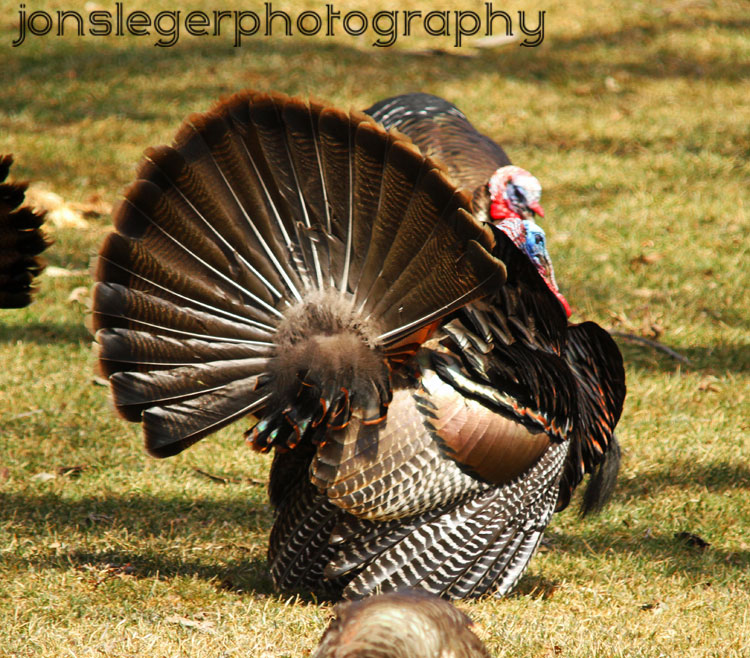
A male showing off his stuff for the surrounding females, Rock Cut State Park, Rockford, IL; 4/1/2013.
There were at least 5 males displaying their full tail feathers - ah, must be springtime.
A good look at the tail feathers from behind, Rock Cut State Park, Rockford, IL; 4/1/2013.
When the male's feathers are at full display it almost looks like he wearing a floor length skirt as well as the feathered out tail.

Wild Turkeys are found throughout most of the U.S. east of the Mississippi and much of the West, especially in the Prairie States, but also into the mountains.

Sunday, April 28, 2013

Ring-necked Pheasant, Northern Illinois year round resident.

A Ring-necked Pheasant crossing the road in front of me out near, Rockton, IL; 5/6/2012.
I have seen many Ring-necked Pheasants in my life, but until about a year ago, I have never had one so out in the open while I had a camera with me. This beautiful guy (Above) crossed the road in front of my car and obliged me by hanging around long enough for me to find my camera and snap off a few pics out the window before he disappeared in the tall weeds.

Ring-necked Pheasants are year round residents in open fields of long weeds and grasses that will hide them from view. At times you can find them along road edges near edges of forests or along thick weedy brush. They can be found in the Northern States from coast to coast.